


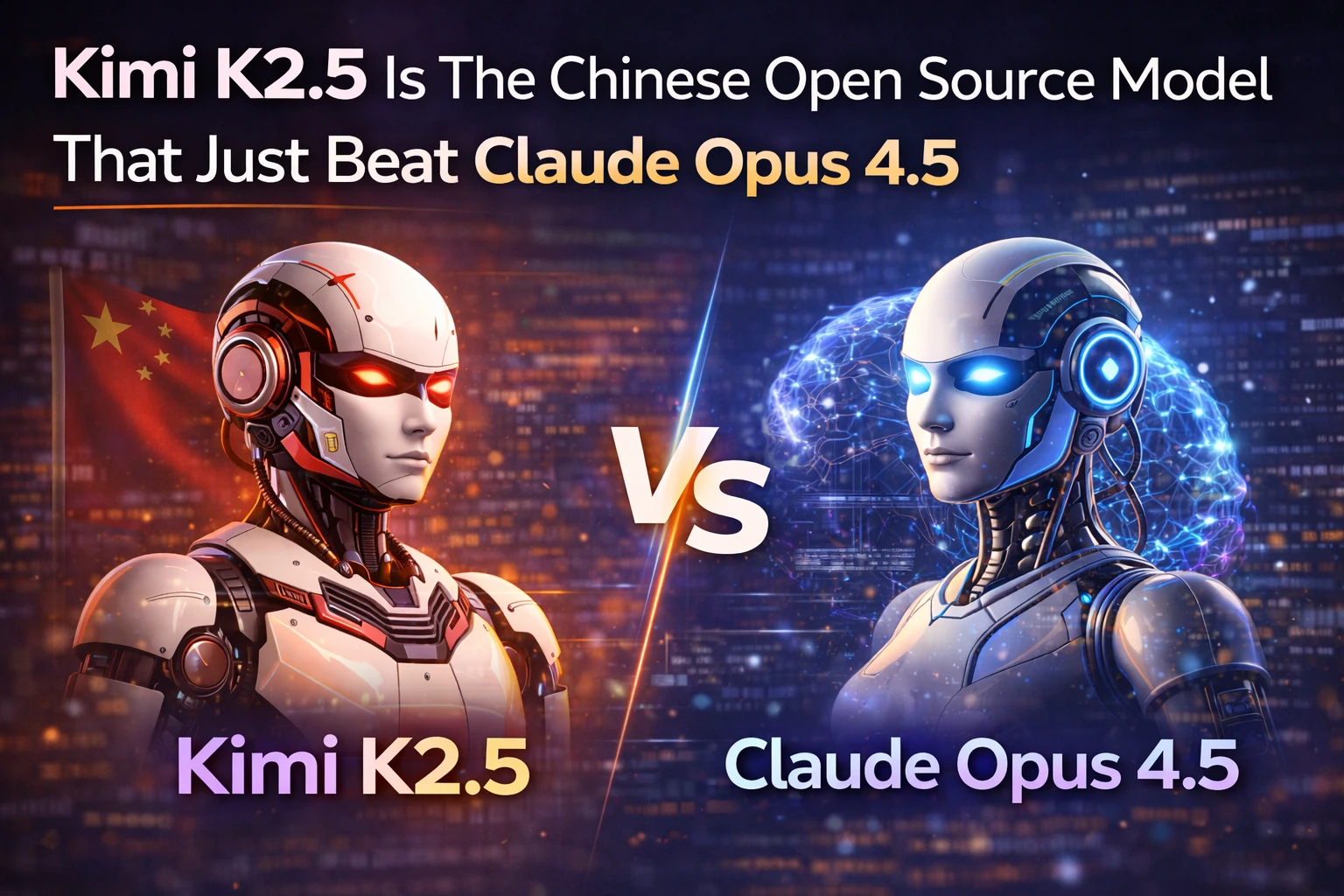
Here's the thing about Kimi K2.5
I've been following the open-source AI scene for a while, and most of the time, "open source beats closed source" is marketing talk. The actual benchmarks usually show the closed labs still have a lead. Not this time.
In January 2026, Moonshot AI — a Chinese AI lab founded by Yang Zhilin — dropped Kimi K2.5. It's a 1 trillion parameter Mixture-of-Experts model, trained on 15 trillion tokens of mixed visual and text data, and released under an open license. You can download it. You can self-host it. You can fine-tune it for your own use case without paying anybody a per-token fee.
And on paper, it beats Claude Opus 4.5, GPT-5.2, and Gemini 3 Pro across a bunch of the benchmarks that actually matter to developers building real products.
The benchmarks that made people stop scrolling
Let me give you the actual numbers, because this is where the "wait, really?" moment lives:
- SWE-bench Verified: 76.8% — this is the big one. SWE-bench tests whether a model can fix real-world bugs from real GitHub repos. Kimi K2.5 beats Claude Opus 4.5, GPT-5.2, and Gemini 3 Pro at this in agentic mode. For anyone building a coding agent, this is the number that matters most.
- MMMU Pro: 78.5% — multi-discipline multimodal understanding. Tests vision + text reasoning across college-level subjects.
- HLE (Humanity's Last Exam): 50.2% — a brutally hard benchmark covering PhD-level questions across physics, math, chemistry, and more.
- BrowseComp: 74.9% vs GPT's 59.2% — tests the ability to browse the web, synthesize information, and answer multi-hop questions. The gap here is massive.
- VideoMMMU — video understanding. Kimi K2.5 beats both GPT-5.2 and Claude Opus 4.5 on this too.
Now, I'm always skeptical of benchmark wins. Labs cherry-pick. Numbers get gamed. But when a model wins across this many different categories — agentic coding, multimodal reasoning, academic questions, and video — it's harder to dismiss as a one-off.
The 76% cost story
Okay, here's the part that should make every Indian startup founder sit up straight. Moonshot claims Kimi K2.5 runs at 76% lower cost than closed competitors. That means roughly one-fourth the price per million tokens.
Let me put this in Indian startup math. If you're running a customer support AI on Claude Opus 4.5 at roughly $15 per million input tokens and $75 per million output tokens, you can do the math on a 10 million query per month support bot — it's painful. With Kimi K2.5 running on your own infrastructure or on a cheap inference provider, that same workload drops to a fraction of the cost. Suddenly, margins that didn't exist before exist.
For bootstrapped startups in Bengaluru, Chennai, and Pune that have been rate-limiting their AI features because Claude Opus is too expensive, Kimi K2.5 is a lifeline.
The Agent Swarm paradigm
This is the part nobody else is covering properly. Moonshot didn't just train a bigger model. They built what they call the Agent Swarm paradigm. Here's how it works:
When you give Kimi K2.5 a complex task — say, "research this company and write a detailed due diligence report" — instead of processing it as a single linear conversation, it decomposes the task into parallel sub-tasks and spins up dynamically instantiated, domain-specific agents for each piece. One agent handles web research. Another handles financial analysis. Another handles reputation checks. They run in parallel, feed results back to a coordinator, and produce the final output.
This is similar in spirit to what Claude's sub-agent system does, but Moonshot claims their version is more dynamic — agents are created on the fly based on task needs, not pre-defined. For certain workloads (research, analysis, multi-step coding), this parallel structure is genuinely faster and more accurate than a single large model.
Native multimodal
Kimi K2.5 is natively multimodal, meaning it was trained on mixed visual and text data from the start — not bolted on after the fact. This matters because multimodal capabilities that are built in from the beginning tend to perform better than ones that are added later via adapters or vision encoders.
For Indian use cases, this opens up a lot. Think about:
- Document processing — reading PAN cards, Aadhaar, invoices, handwritten forms
- Agriculture — identifying crop diseases from photos taken by farmers on budget smartphones
- Education — solving handwritten math problems from notebook photos
- E-commerce — visual product search, image-based complaint resolution
All of this on an open-source model you can host in India, for data that never leaves your servers. That's a compliance win on top of a cost win.
The China angle — should you be worried?
Honestly, this is the question I've been getting the most. Should Indian developers use a Chinese-origin AI model for production workloads?
My take: the model weights are open. That means you can download them, inspect them, run them on your own infrastructure in India, and the Chinese government has zero visibility into what you do with it. This is very different from using a cloud API hosted in China. When you run Kimi K2.5 on your own GPUs in a Mumbai data center, it's effectively just math running on silicon.
That said, if you're building for government contracts, defense, or anything touching sensitive national data, you probably still want to stick with Western-origin models or Indian models for optics and policy reasons. For everything else — startups, consumer apps, SaaS tools — Kimi K2.5 is absolutely worth trying.
How to actually try it today
Moonshot has released weights on Hugging Face. You can run it via vLLM, SGLang, or TensorRT-LLM. For most Indian startups, the practical path is to rent H100 or H200 GPUs from an inference provider like Together AI, Fireworks, or DeepInfra and hit Kimi K2.5 as an API without worrying about infrastructure.
Start with a small experiment. Pick one use case where you're currently paying closed-model prices and benchmark Kimi K2.5 against it. If the quality holds, the cost savings are too big to ignore.
Honestly, this feels like a watershed moment for open-source AI. For the first time, a fully open model is genuinely competing with the best closed frontier models on the benchmarks that matter. And it's cheaper by a factor of four. That changes the math for every Indian startup building AI products in 2026.


Comments (0)
Be the first to comment!