


Let me break this down for you
Here's the thing about giving AI agents access to your database: it's terrifying. Let an LLM write SQL directly and one day it will decide DROP TABLE users is a reasonable interpretation of "clean up inactive accounts." We all know it. It's the reason most enterprise teams still won't let AI anywhere near their production databases.
Microsoft just dropped something that actually addresses this problem head-on. It's called the SQL MCP Server, and honestly, after playing with it for a few hours, I think this is the most important developer release of the month. Not flashy. Not an AI model. Just a very carefully designed bridge between your AI agents and your SQL Server databases that doesn't make you lose sleep.
What exactly is it?
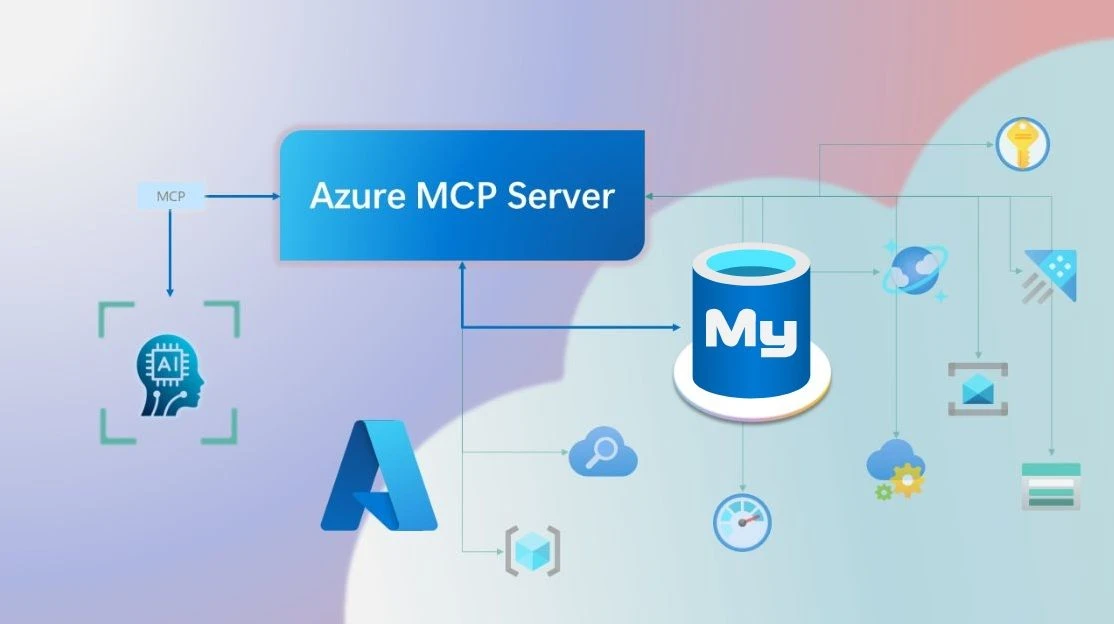
The SQL MCP Server is Microsoft's official implementation of the Model Context Protocol version 2025-06-18 — the same protocol that started at Anthropic and is now being adopted across the industry. MCP lets AI agents (Claude, Cursor, Windsurf, VS Code, Copilot, and 200+ other tools) connect to external systems in a standardized way, instead of every tool reinventing its own integration layer.
There are already over 2,300 public MCP servers covering everything from GitHub to Notion to Slack. But a SQL Server MCP that's built by Microsoft, blessed by the data platform team, and designed specifically to stop AI from destroying your database — that's a big deal.
The two transports
The server supports two transport modes:
- Streamable HTTP — for remote deployments where your MCP server runs as a service and agents connect to it over the network. This is the one you'll use in production.
- Stdio — for local development where the MCP server runs as a subprocess of your AI tool. Cursor, Claude Desktop, and VS Code all support this.
Both transports speak the same protocol, so you can develop locally in stdio mode and deploy to production with HTTP without rewriting anything.
The killer feature: NL2DAB instead of NL2SQL
This is where it gets interesting. Most "AI + database" tools use something called NL2SQL — natural language to SQL. You say "show me the top 10 customers by revenue last quarter" and the LLM writes a SQL query. Sounds great, works great in demos, is an absolute disaster in production.
Why? Because LLMs hallucinate column names. They invent table joins that don't exist. They write queries that technically run but return wrong data. And occasionally, they write queries that lock your entire database for 10 minutes during peak hours.
Microsoft went a different direction. SQL MCP Server uses NL2DAB — natural language to Data API builder. Instead of the AI writing raw SQL, it builds a request against a well-defined entity abstraction layer that Microsoft's Data API builder exposes. The entities are pre-defined by you. The allowed operations are pre-defined by you. The AI cannot invent new tables, cannot write arbitrary SQL, and cannot execute DROP, TRUNCATE, or ALTER statements unless you explicitly allow them.
In practice, this means the AI is sandboxed to the exact data surface you want to expose. It's like the difference between giving someone sudo access to your server versus giving them a carefully scoped REST API. Both let them get work done. Only one lets you sleep at night.
The sister servers
Here's what a lot of people missed in the announcement. Microsoft didn't just launch SQL MCP for SQL Server. They launched an entire family:
- SQL MCP Server — for Microsoft SQL Server, Azure SQL, and SQL Managed Instance
- PostgreSQL MCP Server — built by the Azure Database for PostgreSQL team
- MySQL MCP Server — covering Azure Database for MySQL
- Oracle MCP Server — for enterprises still running Oracle workloads
All four use the same NL2DAB pattern. All four support the same entity abstraction. This is Microsoft making a clear play: if you're running any major database, Microsoft wants to be the company that connects your AI agents to it safely.
Real-world use cases for Indian developers
Okay, enough theory. What can you actually build with this? Here are three use cases I think are going to explode in Indian enterprises this year:
1. Internal developer tools
Imagine a Claude-powered Slack bot where your support team types "how many orders from Chennai in the last 7 days?" and it instantly returns the answer from your production database — without the support person needing SQL skills, and without you having to build a custom dashboard. That's a two-day project with SQL MCP Server.
2. BI dashboards with AI-driven insights
Instead of pre-building 50 different dashboards, you build one "chat with your data" interface. Product managers ask questions in plain English. The MCP server constrains the AI to safe, read-only queries against curated entities. Answers come back with automatic visualizations. This kills the "I need a new dashboard" backlog that every data team has.
3. Customer support bots with real data
A support bot that can actually look up a customer's order history, check inventory for a specific Chennai warehouse, or pull a refund status — all from your live database, safely. This is the feature that makes support bots go from "useless chatbot" to "actually solves my problem."
How to start using it today
The server is open source and Microsoft has published it alongside documentation. Here's the quick-start path:
- Install Data API builder — Microsoft's open source tool that maps your SQL tables to entities with allowed operations
- Define your entities — Which tables, which columns, which operations (read only? read + insert? full CRUD?)
- Run SQL MCP Server — Point it at your Data API builder config and start either the stdio or HTTP transport
- Connect your AI tool — In Claude Desktop, Cursor, or VS Code, add the MCP server to your config
- Start asking questions — The AI can now safely query your database
Total setup time for a simple database: about 45 minutes. For a complex enterprise schema with role-based access: a weekend.
Why I'm actually excited about this
Most AI tooling releases this year have been incremental. Bigger models. Longer context. Better benchmarks. This one is different — it's a piece of infrastructure that unlocks a category of applications that was previously too risky to build. Every Tamil Nadu SaaS startup I talk to wants "AI features in our product." SQL MCP Server is how you build those features without your CTO having a heart attack about database safety.
If you're a developer, install it this weekend. If you're a tech lead, put it on the Q2 roadmap. This is going to be standard infrastructure by the end of 2026.


Comments (0)
Be the first to comment!