


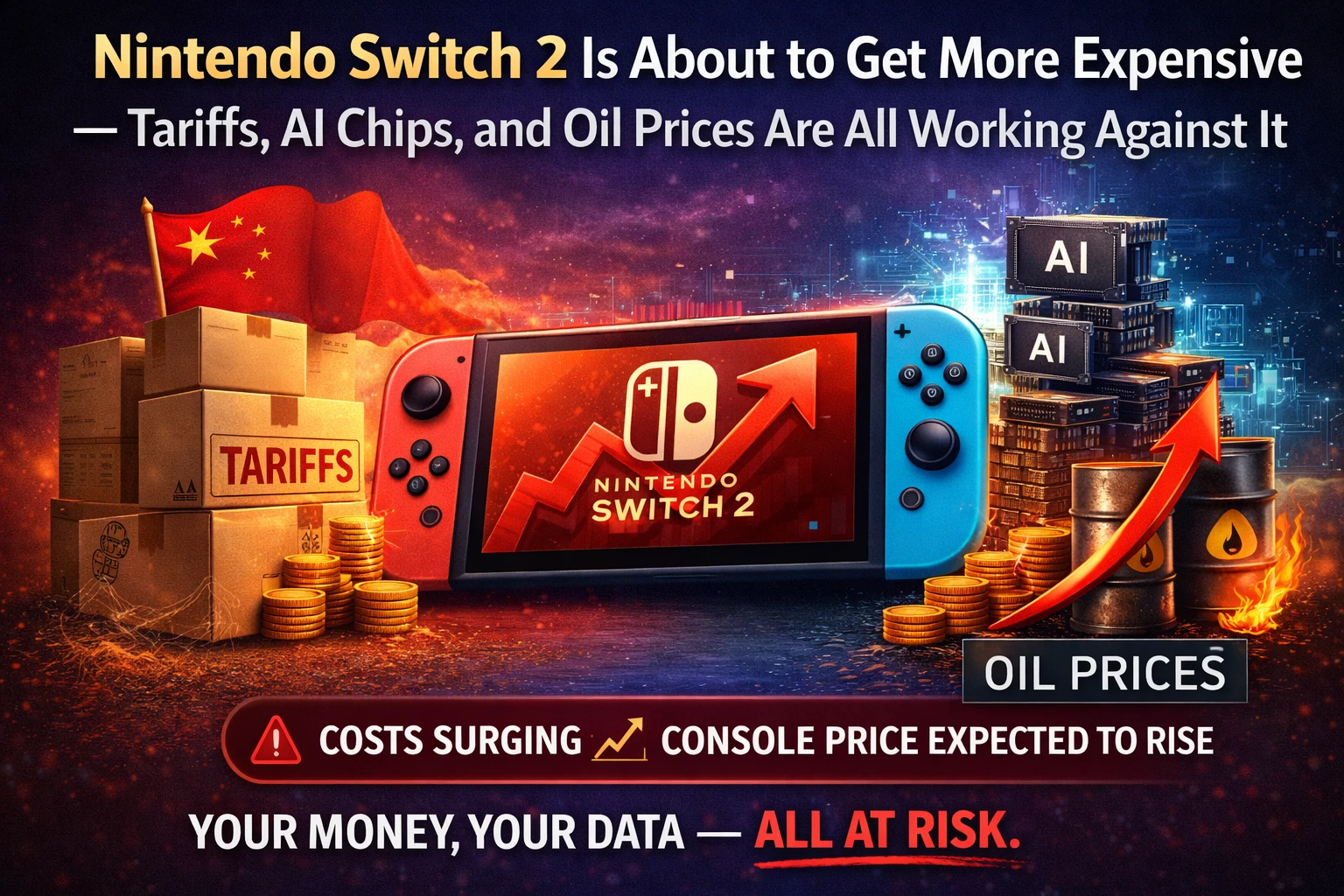
Nintendo is the last console company still holding its launch price — but probably not for much longer
Sony raised the PS5 price. Microsoft has hinted at Xbox hardware price adjustments. Nintendo has, so far, kept the Switch 2 at its launch price of $450. In India that translates to roughly ₹37,500 at grey market rates, or higher through official import channels.
A former Nintendo sales lead — speaking anonymously on a podcast hosted by other Nintendo alumni — says this price hold can't last. And the reasoning he gives is genuinely worth understanding, because the forces behind the coming price hike aren't just about Nintendo's balance sheet. They're about three global economic crises that are colliding simultaneously.
Factor 1: Tariffs — and Nintendo is literally suing over this
The first factor is US tariffs — trade taxes that the Trump administration has imposed on goods manufactured outside the US. Nintendo, like virtually all consumer electronics companies, manufactures its hardware in Asia. Every Switch 2 sold in the US comes with a tariff cost attached to it that Nintendo either absorbs (taking a smaller margin) or passes on to the consumer (raising the price).
Nintendo has been absorbing this cost so far. But the scale is significant — and Nintendo isn't just quietly complaining. The company is actively suing the Trump government over the tariffs, which tells you just how seriously they're treating this as an existential threat to their pricing.
Tariffs don't go away on their own. Unless the US trade policy changes or Nintendo relocates some manufacturing to the US (which takes years and enormous capital investment), this cost pressure is permanent. And it's been compounding with the other two factors simultaneously.
Factor 2: RAMageddon — the AI chip shortage hitting consoles
We've covered RAMageddon extensively in recent TamilTech articles — but here's the console-specific angle. The same shortage of RAM and memory chips that has pushed the Lenovo Legion Go 2 from $1,349 to $1,999 is affecting Nintendo's manufacturing costs for every Switch 2 cartridge and every Switch 2 console produced.
The Nintendo Switch 2 runs on custom NVIDIA chips with integrated memory. That memory — LPDDR5X and the flash storage used in cartridges — is sourced from the same global supply chain that AI data centers are raiding for High-Bandwidth Memory chips. Samsung, SK Hynix, and Micron have redirected production capacity toward HBM for AI infrastructure. Consumer-grade RAM and storage have become scarcer and more expensive as a result.
Nintendo tried to get ahead of this by doing mass production runs of the Switch 2 — building up inventory before prices got worse. That's a smart short-term hedge. But it doesn't solve the underlying supply constraint. Every new production run happens at higher memory prices than the last. The cost per unit keeps rising even if the retail price hasn't moved yet.
The ex-Nintendo source framed it clearly: "The demand that AI is causing for chips is causing memory prices to go up." For a console that ships millions of units — and Nintendo has sold 10+ million Switch 2 units since June 2026 — even a small per-unit cost increase becomes a massive total cost impact.
Factor 3: Oil, Iran, and the helium connection nobody is talking about
This is the one that most people haven't connected yet, and it's genuinely important to understand.
The ongoing US-Iran military conflict has driven oil prices up. Higher oil prices mean higher shipping costs — every ship, every plane, every truck that moves components from Asian factories to global markets runs on fuel that now costs more. That's the obvious part.
The less obvious part is helium. Helium is a byproduct of natural gas and oil production — specifically, it's extracted when certain oil and gas fields are processed. And helium is not optional for semiconductor manufacturing. It's used to cool equipment in chip fabrication plants, to create the ultra-pure atmosphere needed during wafer production, and in several other critical manufacturing steps. There is no substitute for helium in these processes — it's not like you can use a different gas.
When oil production is disrupted — whether by war in oil-producing regions, by sanctions, or by market dynamics — helium supply gets disrupted too. The same operations that produce the helium also process the oil. Less oil extraction in the Middle East means less helium as a byproduct, which means tighter helium supply for semiconductor fabs globally.
Nintendo cartridges are semiconductor products. Making them requires the same semiconductor manufacturing processes that require helium. When helium supply tightens and prices rise, cartridge manufacturing costs go up. This is a direct line from a Middle Eastern military conflict to the cost of a Nintendo Switch 2 cartridge in India.
Nintendo's mitigation attempts
Nintendo isn't just sitting still on this. The company has multiple levers it's trying to pull to avoid or delay a hardware price increase. One recent move: making digital versions of Switch 2 games cheaper than physical versions. This is a deliberate push to shift consumers toward digital purchases, which have lower manufacturing costs for Nintendo — no cartridge to produce, no physical packaging, no shipping. If Nintendo can shift 20-30% more of its game sales to digital, that reduces the pressure from cartridge production costs.
Nintendo also has meaningful non-gaming revenue streams — the Mario theme park at Universal Studios, merchandise and licensing, the Mario movie franchise (which generated over $1.3 billion globally). These revenues provide a buffer that allows Nintendo to absorb hardware losses longer than a pure electronics company could.
But the ex-Nintendo source's conclusion is that these buffers aren't enough. Too many external forces are moving simultaneously, too fast, and in the same direction. "It's inevitable" was his assessment — and it was delivered by someone who spent years understanding how Nintendo manages pricing strategy.
What this means for Indian Switch 2 buyers
The Switch 2 isn't officially sold in India. It's available through grey market importers and some specialty retailers, typically priced at ₹37,000-₹45,000 depending on the source and any bundled games. Official launch in India hasn't happened yet.
A US price hike on the Switch 2 will flow through to Indian grey market prices within weeks. If the Switch 2 goes from $450 to $500 or $550 in the US, Indian grey market prices will adjust proportionally — potentially pushing the console to ₹45,000-₹55,000 or more by the time you factor in import duties and grey market margins.
For Indian Nintendo fans who've been on the fence about importing a Switch 2: the window at the current price is probably not permanent. If the analysis from this ex-Nintendo insider is right — and the economic logic is sound — the Switch 2 will cost more in 2026 than it does right now. The question is when, not if.
The broader context for Indian gaming also matters here. The PS5 already raised its price. The Switch 2 will likely raise its price. RAM-driven hardware cost increases are affecting gaming PCs and handhelds. The overall cost of console gaming globally is moving upward, and Indian buyers who pay both the base price and import premiums feel that movement most acutely.
TamilTech's take
The helium angle in this story is the part that genuinely surprised us. Most people think about console prices in terms of "company wants more profit" or "supply and demand." The reality is more complicated: there's a chain from a military conflict in the Middle East, to oil production disruption, to helium supply reduction, to semiconductor manufacturing costs, to the price of a cartridge you buy to play Mario Kart. That's a genuinely strange world we're living in. For Indian gamers, the practical advice is simple: if you want a Switch 2 and have been waiting for an excuse, current prices are probably the floor, not the ceiling.




Comments (0)
Be the first to comment!