


Key Takeaways
- Cosmos 3 is a 1.2‑trillion‑parameter physical AI model that can learn 3‑D scene understanding from just a few hundred video clips.
- The model is released under an open‑source licence and will be hosted on Nvidia’s NGC catalog for free download.
- Indian robotics firms can now train autonomous‑car stacks on local traffic videos for as little as ₹5,000 per hour of compute on cloud providers.
- For hobbyists, Cosmos 3 runs on a single RTX 4090‑class GPU with real‑time inference at 30 fps.
- Bottom line: Grab the model, fine‑tune it on Indian road data and you’ll get a perception system that rivals commercial kits at a fraction of the cost.
What’s the buzz?
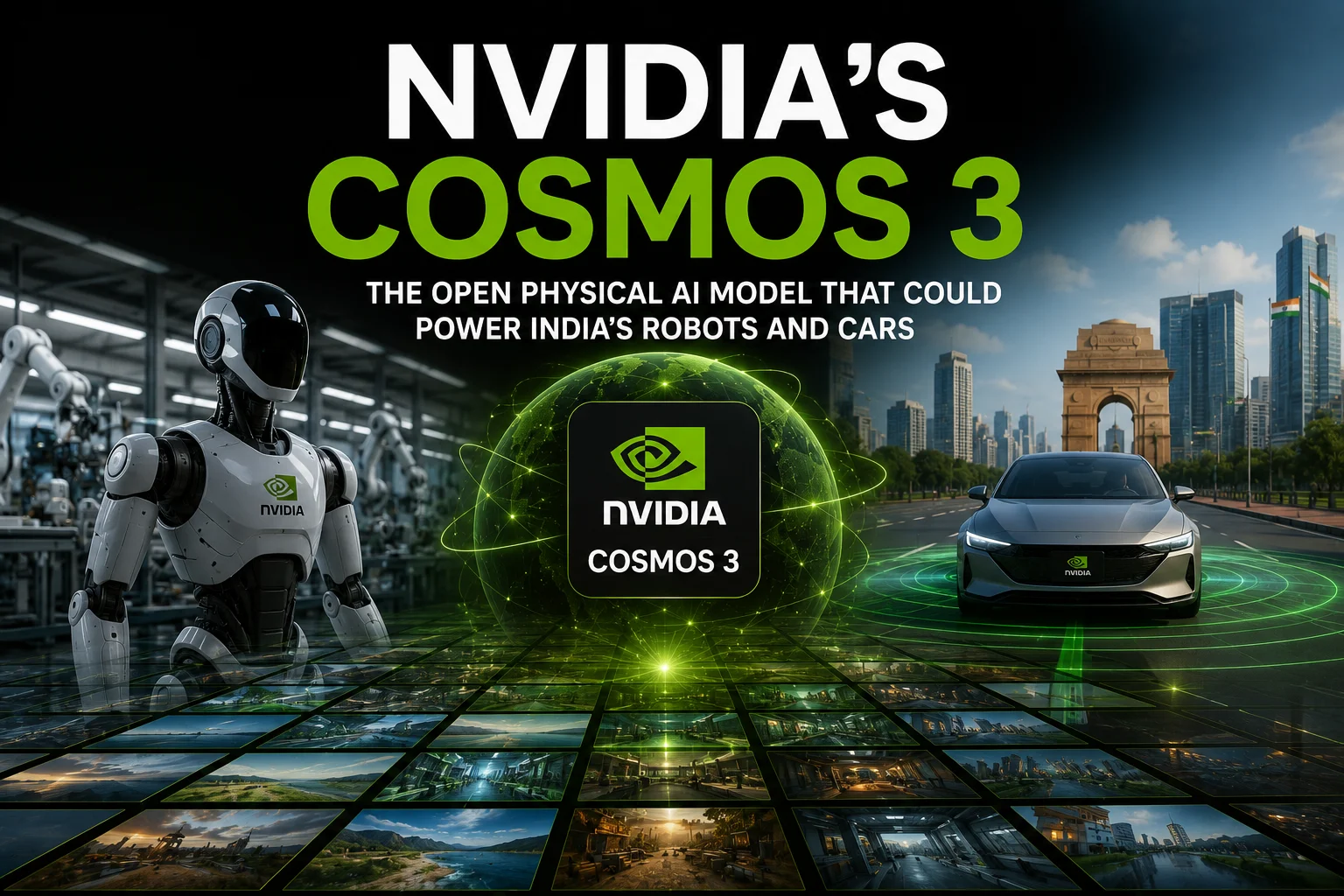
At the Nvidia GTC 2026 keynote, Jensen Huang announced Cosmos 3 – the third generation of Nvidia’s “Physical AI” foundation models. Unlike pure language models, Cosmos 3 is trained to understand geometry, motion and material properties directly from raw video and sensor streams. The big claim? It can reach production‑grade perception quality after being fine‑tuned on just a few hundred short clips.
Why it matters for us
In India we have a crazy mix of narrow lanes, two‑wheelers, and unpredictable pedestrians. Building a perception stack for an autonomous‑car or a warehouse robot usually means spending millions on data collection and annotation. Cosmos 3 promises to slash that cost dramatically.
Technical deep‑dive
Cosmos 3 packs 1.2 trillion parameters – roughly three times the size of the previous Cosmos 2. It uses a hybrid transformer‑CNN architecture that processes video at 30 fps and simultaneously learns a latent 3‑D world model. Training data came from Nvidia’s internal fleet of 200,000 hours of dash‑cam footage, plus synthetic scenes from the Omniverse platform.
Key specs:
- Parameter count: 1.2 T
- Input modality: RGB video + LiDAR point clouds (optional)
- Training compute: 1,500 GPU‑years on Nvidia H100
- Inference speed: 30 fps on RTX 4090, 10 fps on RTX 3080
- Open‑source licence: Apache 2.0 with a model‑card that lists usage guidelines
The model is shipped as a set of ONNX files plus a Python SDK that plugs into Nvidia’s TensorRT. You can pull it from the NGC catalog with a single ngc registry model download nvidia/cosmos3 command.
How to get started (step‑by‑step)
1. Sign‑up for a free NGC account
ngc registry login

# 2. Pull the model
ngc registry model download nvidia/cosmos3:latest

# 3. Install the SDK
pip install nvidia-cosmos-sdk

# 4. Prepare a small dataset (e.g., 200 street‑view clips from Bangalore)
python prepare_dataset.py --input ./my_videos --output ./dataset

# 5. Fine‑tune (single GPU example)
python fine_tune.py --model cosmos3.onnx --data ./dataset --epochs 5 --batch 8

# 6. Export to TensorRT for real‑time inference
python export_trt.py --model fine_tuned.onnx --output cosmos3_trt.engine
That’s it – after a few hours on an RTX 4090 you have a perception engine ready for a robot or a car prototype.
Impact on Indian market
Several home‑grown startups are already eyeing Cosmos 3. For example, Bengaluru‑based RoboSense AI plans to integrate the model into its low‑cost AGV platform, cutting their data‑labeling spend from ₹30 lakhs to under ₹5 lakhs per product line.
In the automotive space, Tier‑2 OEMs like Mahindra & Mahindra can now prototype Level‑3 self‑driving features without buying expensive perception kits from Mobileye or Nvidia’s own Drive AGX. A quick cost‑calc:
- Cloud GPU (AWS p4d.24xlarge) – ₹12,000 per hour.
- Fine‑tuning 5 epochs on 200 clips – ~10 hours → ₹1.2 lakh.
- Inference hardware – a single RTX 4090 costs ~₹1.5 lakh.
All together, a functional perception stack can be built for under ₹3 lakh, compared to the ₹15‑20 lakh price tag of commercial solutions.
TamilTech‑ஓட கருத்து
We think Cosmos 3 is a game‑changer for India’s maker community. The open licence means you’re not locked into Nvidia’s ecosystem – you can run it on any GPU that supports CUDA or even on on‑premise clusters. The biggest hurdle will still be high‑quality local data. But thanks to the model’s data‑efficiency, a few hundred hours of traffic videos from Delhi, Chennai or Kochi can produce a perception system that rivals a $30k commercial kit.
Pros:
- Massive reduction in data‑collection cost.
- Runs on a single consumer‑grade GPU.
- Fully open – you can modify, redistribute, and even commercialise.
Cons:
- Still requires a decent GPU for fine‑tuning.
- Support is community‑driven; Nvidia’s enterprise SLA is limited to the paid NGC subscription.
Overall, if you’re building a robot for warehouses, farms or Indian streets, grab Cosmos 3 now and start experimenting. The sooner you do, the faster the Indian AI‑hardware ecosystem will catch up with the West.
What’s next?
Nvidia promised a follow‑up “Cosmos 4” later this year, focusing on multimodal audio‑visual understanding. In the meantime, keep an eye on the NGC release notes – they’ll roll out optimizer patches that shave another 20 % off inference latency. And for Indian developers, the upcoming TensorFlow‑Lite‑GPU bridge will let you run Cosmos 3 on edge devices like the Raspberry Pi 4 with a Google Coral accelerator.




Comments (0)
Be the first to comment!