


Key Takeaways
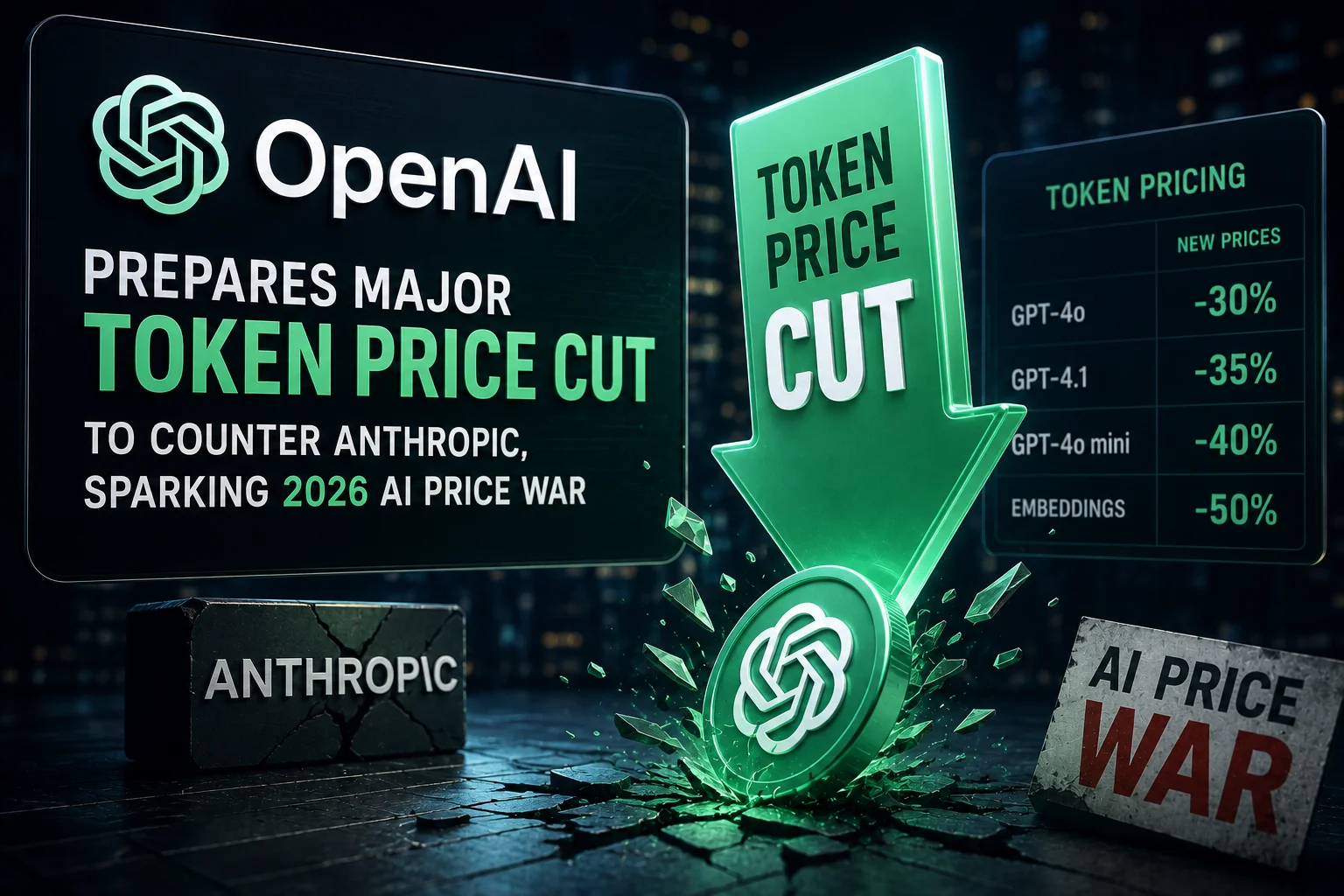
- OpenAI is expected to cut API token prices by up to 50-60% across its flagship models by late 2026.
- The move is a pre-emptive strike against Anthropic, which is rumored to launch a more cost-effective 'Claude 4.5' model next month.
- For Indian developers, this could lower the cost of running AI-powered customer service bots from ₹5,000/month to less than ₹2,000/month.
- The bottom line: AI intelligence is becoming a commodity, and the real value is shifting from the model itself to how you use it.
The AI Price War of 2026 Just Got Real
If you thought AI was already cheap, think again. It is July 2026, and we are witnessing what I can only describe as a 'Jio moment' for the global Artificial Intelligence industry. OpenAI, the creators of ChatGPT, are reportedly preparing to slash their token prices yet again. This isn't just a minor discount; we are talking about a massive, structural price cut that aims to undercut their biggest rival, Anthropic. For those of us tracking the tech space in India, this is huge. Whether you are a developer building the next big SaaS app out of Bengaluru or just someone using AI tools for daily work, the cost of 'thinking' is about to hit an all-time low.
Why is this happening now? Well, the competition has never been fiercer. Back in 2024 and 2025, OpenAI had a comfortable lead, but in 2026, Anthropic's Claude series has become the preferred choice for many enterprise users due to its superior coding abilities and massive context windows. To keep their crown, OpenAI isn't just relying on 'smarter' models; they are going for the jugular—the wallet. By making tokens significantly cheaper, they want to make it financially impossible for developers to switch to any other platform. It’s a classic move: scale up, optimize the hardware, and then drop the price to starve the competition.
How We Got Here: The Path to Cheap Intelligence
To understand why this price cut matters, we have to look at how far we have come. Two years ago, running a high-end LLM (Large Language Model) like GPT-4 was expensive. You had to carefully manage every single token to avoid a massive bill at the end of the month. But since then, several things have changed. First, the hardware has evolved. The latest Blackwell-based AI servers are now fully operational in data centers globally, making the 'inference' (the process of the AI generating an answer) much more efficient. What used to cost a dollar to process now costs OpenAI only a few cents.
Secondly, the architecture of these models has shifted. Instead of one giant, heavy model, companies are using 'Mixture of Experts' or MoE systems. This means the AI only activates the parts of its 'brain' it needs for a specific task, saving massive amounts of energy and computing power. OpenAI has perfected this over the last year, and they are finally ready to pass those savings down to the users. They know that Anthropic is planning a major update to their pricing soon, and OpenAI wants to be the first to move. It is a race to the bottom, and as consumers, we are the winners.
The Numbers: What Does This Mean for Your Wallet?
While the official announcement is still under wraps, insiders suggest that the cost per million tokens for GPT-5 (or its 2026 equivalent) could drop by more than half. Imagine paying ₹80 for something that used to cost ₹200. For a small startup in India, this changes the entire business model. If you are running an AI-based educational platform or a legal tech startup, your biggest overhead is usually the API cost. A 50% reduction means you can either double your user base for the same cost or slash your subscription prices to beat your local competitors.
But it's not just about OpenAI. Anthropic is expected to respond with their own 'Haiku' and 'Sonnet' tier price cuts. We are entering an era where AI tokens are becoming as cheap as electricity or water. In the Indian context, where we are extremely price-sensitive, this is the catalyst that will move AI from 'experimental' to 'essential.' We expect to see a surge in Indian startups building 'AI-first' products specifically for our local languages, as the cost of processing complex Tamil, Hindi, or Telugu scripts—which usually take up more tokens—becomes much more affordable.
India Impact: Why Bengaluru and Chennai Should Care
India is currently the second-largest developer hub for AI globally. When OpenAI cuts prices, the impact is felt immediately in our tech corridors. Most Indian startups are 'wrappers' or 'orchestrators'—they take these powerful models and build specific solutions for things like GST filing, IRCTC automation, or local language customer support. High token prices were the biggest barrier for these companies to scale beyond the 'Pro' user. Now, with these cuts, we might see 'Free' tiers of popular Indian AI apps becoming much more capable.
Furthermore, this price drop makes it feasible to integrate AI into low-cost hardware. Think about budget smartphones under ₹15,000. Previously, running advanced cloud-AI features on these devices was too expensive for manufacturers to subsidize. With token prices crashing, we could see deep AI integration in budget phones from Xiaomi, Realme, and Samsung as a standard feature, rather than a premium luxury. This is how AI truly becomes democratized in a country like ours.
How to Prepare: A Step-by-Step for Developers
If you are a developer or a business owner, you shouldn't just wait for the price cut. You need to be proactive. First, audit your current API usage. If you are currently locked into a long-term contract with a specific provider, you might want to renegotiate or look at multi-model setups. Secondly, start testing 'model routing.' This is a technique where you use a cheaper model for simple tasks and only call the 'expensive' model for complex reasoning. With the upcoming price cuts, the gap between 'cheap' and 'expensive' models will narrow, allowing you to use high-end intelligence for more mundane tasks.
Thirdly, focus on your data. As the models themselves become cheaper and more similar in performance, the only thing that will differentiate your app is the data you feed it. Whether it's custom Indian market data or specific industry knowledge, that’s where the real value lies in 2026. Finally, keep an eye on your latency. Lower prices often lead to higher traffic, which can sometimes slow down API response times. Make sure your infrastructure can handle the increased volume that these lower prices will inevitably bring.
Comparison: OpenAI vs. Anthropic vs. The Rest
Let's look at the landscape. OpenAI has the brand name and the ecosystem (Microsoft/Azure). Anthropic has the 'safety' and 'reliability' reputation, plus a context window that currently feels more robust for long documents. Google’s Gemini is also in the mix, offering deep integration with the Workspace apps we use every day. If OpenAI drops prices, Anthropic has no choice but to follow. If they don't, they risk losing the 'middle-market'—the developers who are loyal to quality but sensitive to cost.
There is also the open-source factor. Meta's Llama 4 (released earlier this year) has already made it possible for companies to host their own models for 'free' (minus the server costs). This is the real pressure point for OpenAI. If they don't lower their prices, people will just switch to open-source models hosted on local Indian cloud providers like Tata Communications or Reliance Jio. The 2026 market is no longer a monopoly; it's a brutal, multi-front war for your attention and your API calls.
TamilTech’s Take: Is AI Finally a Commodity?
Here is what we think at TamilTech. This price cut is the final nail in the coffin for the idea that 'AI is a luxury.' By the end of 2026, we expect AI to be as invisible and as cheap as the internet itself. OpenAI is making a smart move—they are sacrificing short-term margins to ensure they remain the 'operating system' of the AI era. For you, the user, this means the apps you use will get smarter, faster, and hopefully cheaper. But a word of caution: when the product becomes this cheap, you are often the one being analyzed. Stay mindful of your data privacy even as you enjoy these lower costs. The future is bright, and it's definitely getting more affordable!


Comments (0)
Be the first to comment!