


Key Takeaways
- RBI-licensed NBFCs can legally charge annual interest rates as high as 600% if their board approves it.
- The Reserve Bank of India does not currently set a fixed ceiling or 'cap' on interest rates for NBFCs, unlike traditional banks.
- High APRs are often hidden behind small 'sachet' loans where processing fees and short durations inflate the effective cost.
- Always demand and read the Key Fact Statement (KFS) before clicking 'Accept' on any loan app in 2026.
The 600% Interest Reality in 2026
Imagine borrowing ₹5,000 for a week to cover an emergency and ending up owing a total that translates to 600% interest per year. You might think this is the work of some shady underground money lender, but here is the shocker: these are often RBI-licensed Non-Banking Financial Companies (NBFCs) operating through slick mobile apps. We have been looking into the fine print of these digital lending platforms lately, and the numbers are honestly terrifying. While we all focus on 8% or 10% home loans, a massive chunk of India's digital population is falling into a legal debt trap where the interest rates are astronomical.
As of July 2026, the digital lending space in India has exploded. Almost every fintech app offers 'instant credit' or 'Buy Now Pay Later' (BNPL) services. But have you ever sat down with a calculator to see what you are actually paying? When you factor in the processing fees, the documentation charges, and the short repayment window, the effective Annual Percentage Rate (APR) shoots through the roof. What's even more surprising is that when questioned, these companies point to their 'Board Approved' policies, claiming these rates are perfectly legal and 'reasonable' given the risk they take by lending to people without high credit scores.
How the Math Works: The Sachet Loan Trap
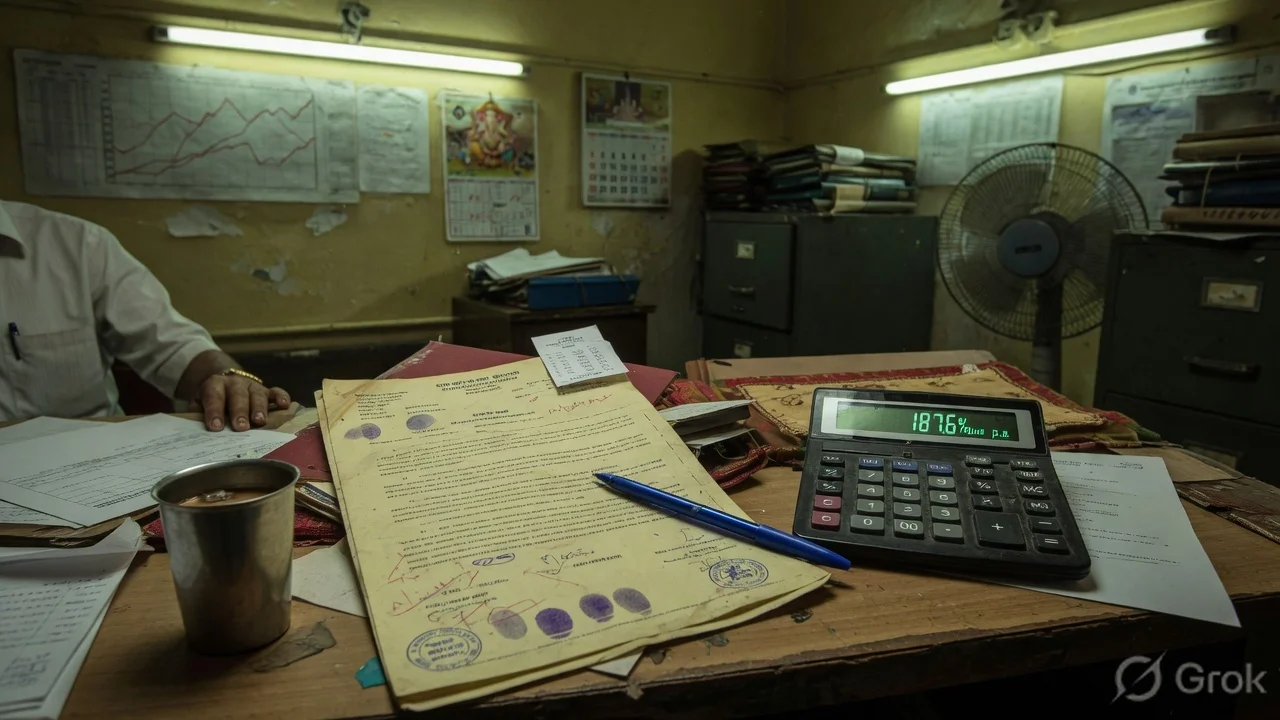
Let's break down how a company can legally charge such high rates. Most of these high-interest loans are 'sachet loans'—small amounts ranging from ₹1,000 to ₹10,000 for very short periods, like 7 to 30 days. Suppose you take a loan of ₹2,000 for 15 days. The lender might charge an interest of ₹60, which sounds small. However, they also add a 'processing fee' of ₹200 and a 'platform fee' of ₹100. You only get ₹1,700 in your bank account, but you have to pay back ₹2,060 in 15 days. If you calculate the APR for this transaction, it easily crosses the 400% to 600% mark.
The trick here is the duration. Because the loan is for a very short time, the absolute rupee amount of interest looks manageable to a desperate borrower. But the law looks at the annual rate. In 2026, many fintechs are using this 'convenience' factor to justify these costs. They argue that the operational cost of processing a ₹2,000 loan is the same as a ₹2,00,000 loan, so the percentage has to be higher. But for the average user in India, this is just a path to permanent debt. Once you take one loan to pay off another, the 600% interest starts compounding, and that is where the real trouble begins.
The Legal Loophole: Why RBI Doesn't Stop This
You might be wondering, "Isn't the RBI supposed to protect us?" Well, here is the technicality. The RBI's 'Fair Practices Code' for NBFCs states that the board of each NBFC must adopt an interest rate model taking into account relevant factors such as cost of funds, margin, and risk premium. Crucially, the RBI says the rate of interest to be charged must be 'reasonable'. However, the RBI has NOT defined what 'reasonable' means in terms of a specific percentage. This lack of a hard cap gives NBFC boards the freedom to approve rates that would otherwise seem predatory.
In the current 2026 regulatory environment, the RBI emphasizes transparency over price control. They want lenders to tell you exactly what the APR is, but they don't necessarily tell the lender they can't charge 500%. The logic is that in a free market, if a borrower is willing to pay and the lender is transparent about it, the regulator shouldn't intervene in the pricing. This 'Board-Approved' loophole is exactly what many high-frequency digital lenders are using to stay within the letter of the law while completely ignoring the spirit of consumer protection.
India Impact: Who is Getting Hit?
The biggest victims of this 600% interest regime are gig workers, students, and low-income families who don't have access to traditional credit cards or bank loans. In cities like Chennai, Bengaluru, and Mumbai, the 'instant cash' craze has led to many people holding 5-10 active loans across different apps. Since these apps are RBI-licensed, they also report to CIBIL. If you miss a payment on a loan that has 600% interest, not only does your debt balloon, but your credit score is destroyed for life, making it impossible to ever get a 'real' loan at 9% interest later.
We are seeing a trend where these NBFCs target the 'New to Credit' (NTC) segment. These are people who have never borrowed before and don't understand terms like APR or compounding interest. They just see '₹5,000 in 2 minutes' and click okay. In the Indian context, where financial literacy is still catching up with digital penetration, this is a recipe for disaster. We've seen cases where a small medical emergency loan of ₹10,000 turned into a ₹50,000 liability within a few months due to these 'legal' but extreme interest rates.
How to Protect Yourself: The TamilTech Checklist
So, how do you avoid falling into this trap? First, never look at the interest amount in rupees; always look at the APR. Since 2023, RBI has made it mandatory for all digital lenders to provide a Key Fact Statement (KFS). This is a simple one-page document that must show the total cost of the loan, including all fees and the effective annual interest rate. If an app is hiding the KFS or making it hard to find, that is a massive red flag. Uninstall it immediately.
Second, check the NBFC's name. Every lending app must disclose which RBI-registered NBFC they are partnering with. You can go to the RBI website and verify if that NBFC actually exists. However, as we've discussed, even being licensed isn't a guarantee of a low interest rate. Third, avoid 'payday' style loans for lifestyle expenses. If you are borrowing at 400% interest to buy a new smartphone or a pair of sneakers, you are making a massive financial mistake that will haunt your CIBIL score for years. Use these apps ONLY for life-and-death emergencies and pay them back the very next day if possible.
TamilTech’s Verdict: Is it a Legal Scam?
At TamilTech, we believe that just because something is 'legal' doesn't mean it's right. Calling 600% interest 'reasonable' is a stretch by any definition of the word. While we understand that lending to high-risk individuals costs more, there has to be a limit. In our opinion, the 'Board Approved' system needs more oversight. If the government can cap the price of essential medicines and petrol, why is there no cap on the 'price' of money for the poorest citizens?
Our honest take is this: stay away from these ultra-short-term loan apps unless you have absolutely no other choice. A credit card's 42% annual interest sounds high, but it is a heaven compared to the 600% these apps are charging. We expect the RBI might introduce a 'usury cap' (a maximum interest limit) by late 2026 or 2027 if the number of defaults continues to rise. Until then, you are your own protector. Read the fine print, calculate the APR, and don't let a 'convenient' app ruin your financial future.

Comments (0)
Be the first to comment!