


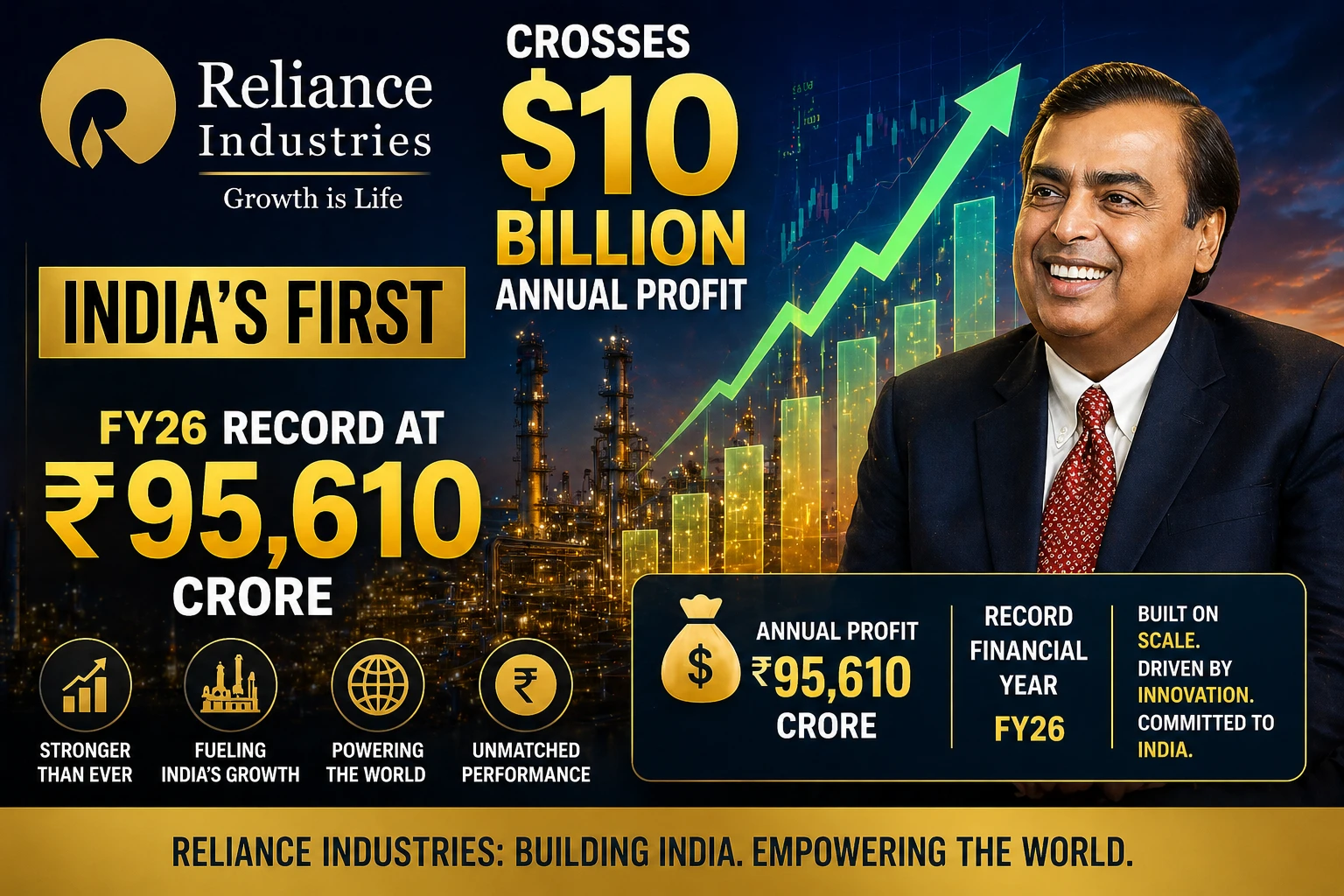
Reliance Industries Limited has just become the first Indian company in history to cross the $10 billion annual profit mark. The conglomerate reported FY26 (year ended March 31, 2026) consolidated profit after tax of ₹95,610 crore — up 18.3% year-on-year — on revenue of ₹11,75,919 crore, up 9.8%.
For context: ₹95,610 crore is roughly $11.5 billion at current exchange rates. No Indian company has ever crossed this threshold before. TCS's record FY25 profit was approximately $5.8 billion. Reliance just doubled the previous Indian corporate ceiling.
The Headline Numbers
| Metric | FY26 | YoY change |
|---|---|---|
| Consolidated Revenue | ₹11,75,919 crore | +9.8% |
| Profit After Tax | ₹95,610 crore | +18.3% |
| EBITDA | ₹2,07,911 crore | +13.4% |
| Q4 FY26 Revenue | ₹2,98,621 crore | +5% |
| Q4 FY26 PAT | ₹16,971 crore | -8.9% |
| Dividend declared | ₹6 per share | — |
What Drove the Record
Two segments did almost all the work:
Reliance Retail
Continued aggressive expansion into Tier-2 and Tier-3 cities. Reliance Retail now operates over 19,000 stores across India, with the JioMart + AJIO + Reliance Trends combination capturing meaningful share from Amazon, Flipkart, and unorganised retail. Quick-commerce (JioMart Express) crossed 1,000 dark stores in FY26.
Reliance Jio (Digital Services)
Subscriber base hit 487 million by Q4. ARPU climbed to ₹202.50 (from ₹181.70 a year earlier) on the back of the July 2024 tariff hike fully flowing through. The Youth & Gaming Plan (₹459, just launched April 2026) is the latest move to push ARPU higher by bundling premium AI subscriptions like Gemini Pro.
The Q4 Wrinkle
Q4 FY26 PAT actually fell 8.9% year-on-year — to ₹16,971 crore. The cause: energy segment (Oil-to-Chemicals + Oil & Gas) margins compressed as global crude prices fell and refining cracks narrowed.
This is the structural story Reliance investors have been watching for three years: the energy business that built the company is increasingly being subsidised (in margin terms) by digital and retail. The transition is on track but isn't painless.
What This Means for India
For the Stock Market
RIL is roughly 11% of the Nifty 50 by weight. A record profit print this large will support the index, though the Q4 weakness will temper enthusiasm. Most brokerage targets sit between ₹3,200-3,600 per share against the current ~₹2,950 level.
For Indian Tech and Startups
The headline number ($10 billion) matters psychologically. It signals that Indian-origin businesses can now generate Silicon Valley-scale profits without selling to a Silicon Valley acquirer. That changes how Indian founders think about endgame. Expect more "build to scale here" narratives in the next funding cycle.
For Consumers
Reliance's strategy of bundling — telecom + AI + entertainment + retail loyalty — is now economically validated. Other Indian conglomerates (Tata, Adani, Bharti) will copy this playbook. Expect more aggressive consumer bundles across telecom and digital services in the next 12 months.
For Competitors
Airtel and Vi face an even tougher 2027. Airtel's ARPU is competitive (around ₹245), but Vi remains structurally weak. Reliance's ability to subsidise Jio plans with retail and energy cash flow is a moat that competitors simply cannot match.
The Strategic Story
Mukesh Ambani's 2016 bet was that Indian consumers would pay for premium digital and retail services if you priced them aggressively enough at first. A decade later, the bet has paid out at scale that exceeded even his most optimistic AGM forecasts.
The next strategic vector is clearly AI. Jio Brain (Reliance's in-house AI initiative), the Gemini Pro bundling deal, and persistent reports of a Reliance-built foundation model in development all point to the same direction: the next ₹95,000 crore-plus profit will need to come from AI services on top of the existing telecom + retail base.
What Investors Should Watch in FY27
- Energy segment margin recovery — if global refining cracks improve, Q1-Q2 FY27 will look very strong. If not, the digital/retail subsidy continues.
- Jio Brain monetisation — does Reliance succeed in turning AI into a paid revenue line, or does it stay a customer-acquisition tool?
- Reliance Retail IPO timing — long-rumoured. A successful retail IPO could unlock significant value separately from the holding company.
- 5G rollout completion — Jio True 5G is now in 9,000+ towns. Full pan-India coverage is the prerequisite for ARPU growth above ₹250.
- JioStar (Disney + Star + JioCinema) profitability — the merged entity is still loss-making. Path to break-even in FY27?
Bottom Line
Reliance crossing $10 billion in annual profit is a landmark for Indian capitalism. The headline is real, the growth drivers are sustainable (digital + retail), and the energy weakness is cyclical rather than structural.
For the average Indian — whether you're a Jio subscriber, a Reliance Retail shopper, or a JioHotstar viewer — your monthly spending on Reliance services is genuinely a meaningful slice of how this number was built. The dividend (₹6 per share) goes to about 35 lakh retail RIL shareholders.
The next milestone everyone is now watching: $15 billion. At current growth rates, that's likely a FY28 question.


Comments (0)
Be the first to comment!