


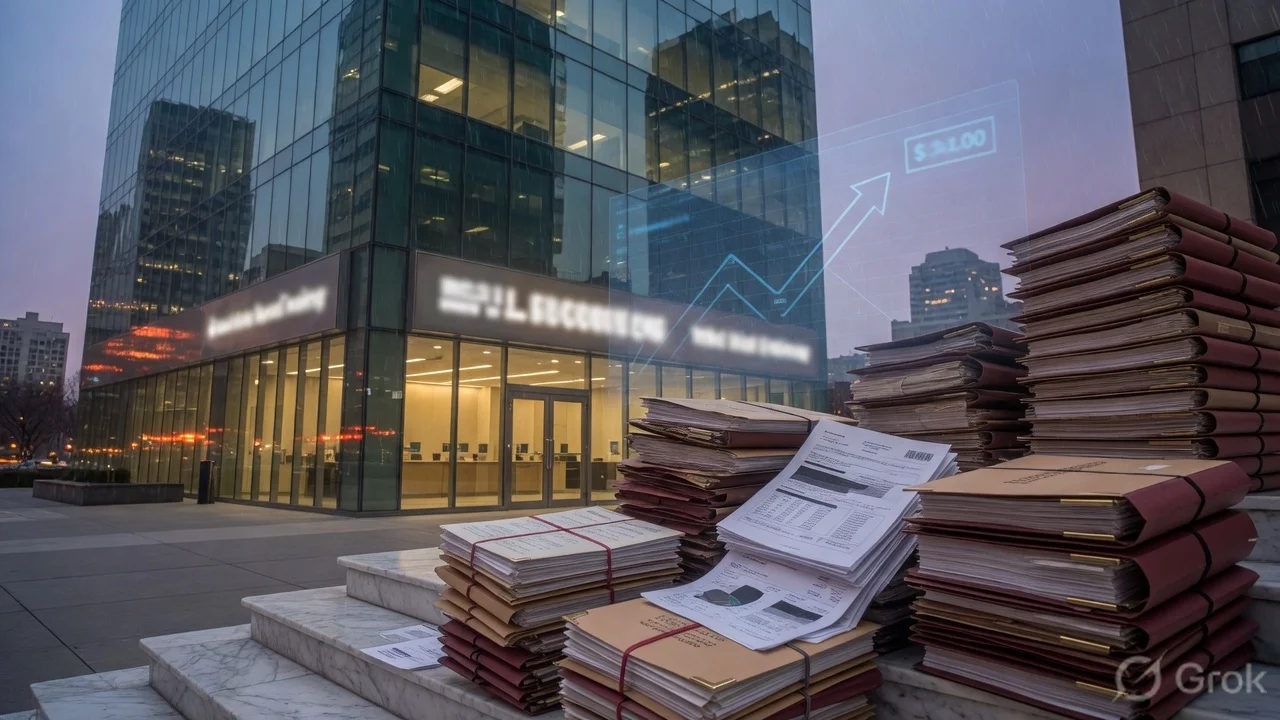
A $40 billion loan that expires in 12 months — that's not an accident
When a company borrows $40 billion, the terms of that loan tell you more than the headline number does. SoftBank just announced it took on a $40 billion unsecured bridge loan to cover its $30 billion commitment to invest in OpenAI. The loan was arranged with JPMorgan Chase, Goldman Sachs, and four major Japanese banks.
Here's the detail that matters: the loan has a 12-month term. It must be repaid or refinanced by March 2027.
Bridge loans — unsecured ones especially — are short-term financing designed to carry you through to a known liquidity event. You borrow now, the event happens, you repay from the proceeds. The fact that some of the world's most sophisticated financial institutions — JPMorgan Chase and Goldman Sachs don't write $40 billion facilities on wishful thinking — agreed to this structure on a 12-month timeline is as clear a signal as the financial world produces: these banks expect OpenAI to go public within the next year.
The numbers behind the bet
SoftBank's $30 billion investment in OpenAI is part of OpenAI's record-breaking $110 billion fundraising round — the largest single funding round in startup history. With this investment, SoftBank's total commitment to OpenAI crosses $60 billion, giving it approximately a 13% ownership stake in the company.
To put $60 billion in context: that's roughly ₹5 lakh crore. That's larger than the market capitalization of most Indian companies on the NSE. SoftBank is not a passive investor making a calculated bet — they have placed a sum that would define the financial trajectory of their entire organization on the success of one AI company.
An OpenAI IPO at the valuations being discussed — estimates range from $800 billion to over $1 trillion — would give SoftBank's 13% stake a paper value of approximately $100-130 billion. That's more than enough to repay the $40 billion loan with room to spare. The math works only if the IPO happens. Which is exactly why the loan is structured on a 12-month timeline.
What an OpenAI IPO would actually mean
OpenAI going public would be one of the largest IPOs in history — potentially the largest tech IPO ever. For scale: Meta's 2012 IPO valued the company at about $100 billion. Alibaba's 2014 IPO was valued at $168 billion. An OpenAI IPO at $800 billion-$1 trillion would dwarf both.
For regular investors, an IPO means the ability to buy shares through a brokerage account. Right now, OpenAI's ownership is limited to institutional investors, venture capital firms, and strategic partners like Microsoft and SoftBank. After an IPO, retail investors in India could potentially buy OpenAI shares through international investing platforms — apps like INDmoney, Vested, or Groww's US stocks section allow Indian investors to buy US-listed stocks directly.
Whether that's a good investment is a separate question. But the access would change dramatically — from exclusively available to billion-dollar institutional investors to purchasable by anyone with a demat account and a few thousand rupees.
SoftBank's history with AI bets — and why this one is different
SoftBank has a complicated track record with large technology bets. The Vision Fund's investment in WeWork became one of the most famous startup disasters in history — a $10 billion+ position that collapsed spectacularly. Masayoshi Son, SoftBank's CEO, has repeatedly bet large on technology waves, sometimes brilliantly (early Alibaba investment), sometimes disastrously (WeWork, various other Vision Fund positions).
The OpenAI bet is different in character. OpenAI's revenue run-rate is real, growing, and accelerating — approximately $14 billion annualized as of early 2026, up from near zero three years ago. ChatGPT has over 300 million weekly active users. OpenAI's enterprise business is growing rapidly, with companies from Goldman Sachs to Indian IT majors integrating its APIs into their products.
This isn't a bet on a vision of future revenue that might materialize. It's a bet on a company generating real revenue at massive scale, growing fast, with a dominant brand position in the most talked-about technology category in a generation. The risk profile is genuinely different from the Vision Fund's worst bets.
What this means for the Indian AI ecosystem
OpenAI's fundraising at $110 billion and a potential IPO at $800 billion-$1 trillion reshapes the entire AI industry's competitive dynamics. The capital gap between OpenAI and everyone else widens with every large funding round. Training competitive frontier AI models requires compute measured in billions of dollars — infrastructure that only a handful of companies globally can afford.
For Indian AI startups and the broader Indian tech ecosystem, this has direct implications. Indian companies building on OpenAI's APIs become more dependent on a single company that will soon have public market shareholders demanding profitability and margin management. API pricing decisions at OpenAI affect hundreds of Indian startups that have built products on top of GPT-4 and o-series models.
For Indian IT giants — TCS, Infosys, Wipro, HCL — who have become significant OpenAI enterprise customers and integration partners, an OpenAI IPO creates a new dynamic. Public company OpenAI means more predictable pricing (hopefully), more formal enterprise contracts, and potentially stock-based partnership structures that private OpenAI can't easily offer.
For the Indian retail investor watching from the sidelines — this is worth tracking. OpenAI's IPO roadshow, when it comes, will generate enormous media coverage. The valuation debate will be intense. Understanding what you'd actually be buying — a company with real revenue but enormous capital requirements, no clear path to profitability in the traditional sense, and a product that's simultaneously its core business and the infrastructure that every AI competitor also needs — matters before deciding whether to participate.
The timeline and what to watch
The 12-month loan term means the pressure for an OpenAI IPO or a major refinancing event is real before March 2027. Given that IPO preparation typically takes 6-9 months from the decision to file, a Q4 2026 listing is the most likely target if the IPO happens on schedule.
Watch for: SEC filing of an S-1 registration statement (this would be the formal public announcement of IPO intent), selection of lead underwriters (banks will compete aggressively for this mandate), and OpenAI's profitability narrative (public market investors will want to understand the path to positive cash flow beyond fundraising).
TamilTech's take
The $40 billion loan is not news on its own — large companies borrow large amounts routinely. What's notable is the structure: unsecured, 12 months, arranged by JPMorgan and Goldman Sachs. Those two banks do not agree to unsecured 12-month bridge loans of this size without high confidence in a specific near-term repayment source.
The most logical repayment source is an OpenAI IPO. The loan structure is, functionally, the banks betting their $40 billion that OpenAI goes public within the year. That's the most credible IPO signal money can produce — because it literally is money, committed to a 12-month bet.
Whether OpenAI at $800 billion-$1 trillion is a good investment at IPO price is a completely separate question that deserves its own analysis. But the IPO itself — 2026 is looking more like a when than an if.

Comments (0)
Be the first to comment!