


Key Takeaways
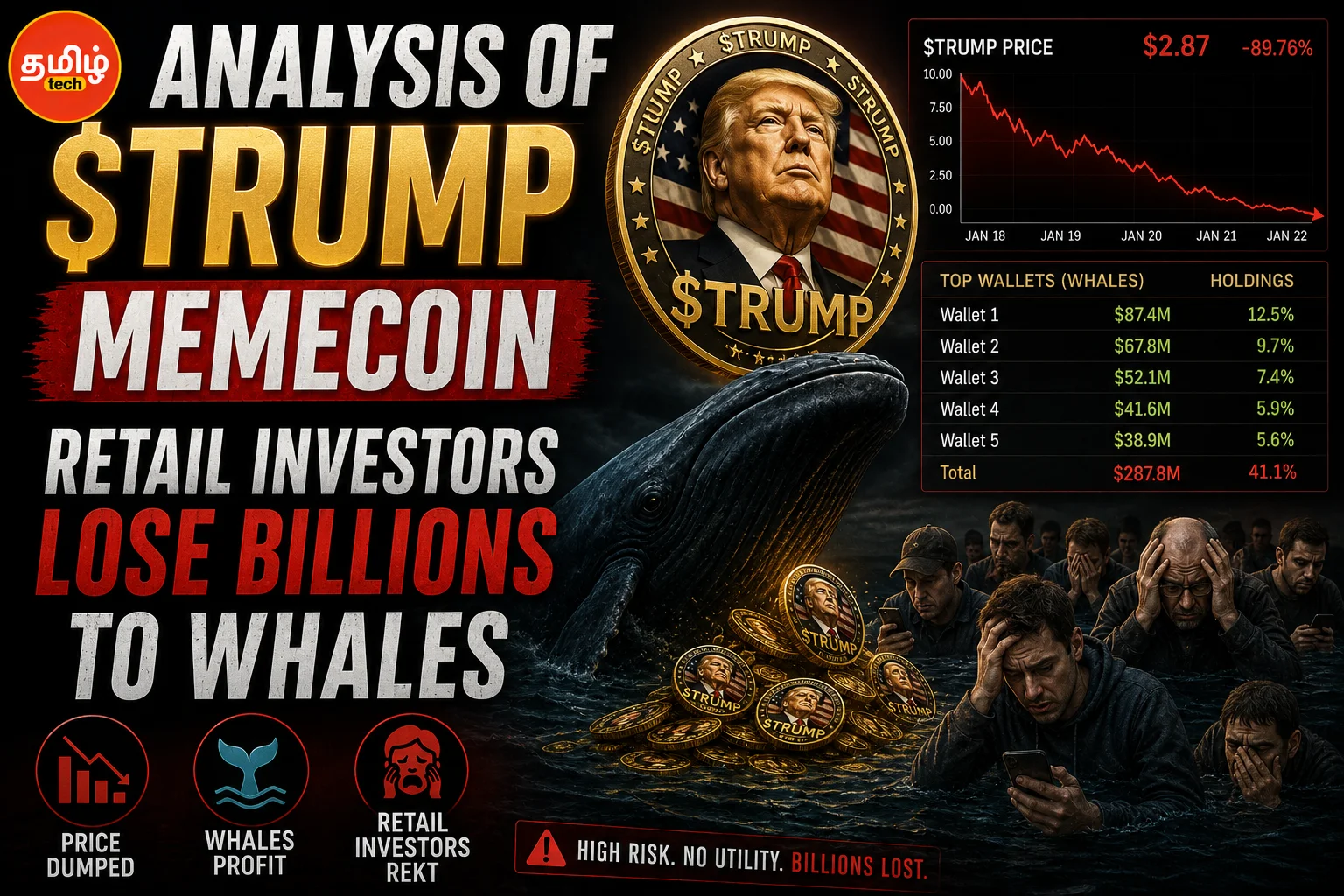
- Approximately 1 million retail investors lost a combined $3.81 billion in the $TRUMP memecoin cycle as of 2026.
- Around 500,000 early-entry wallets, mostly insiders and whales, captured $4 billion in net gains.
- The data confirms a textbook 'wealth transfer' where late buyers provided the liquidity for early sellers to cash out.
- Indian investors face even steeper losses due to the 30% crypto tax and 1% TDS on every transaction.
- The bottom line: Memecoins without utility are zero-sum games where the majority must lose for the minority to win.
The Harsh Reality of the 2026 Memecoin Market
If you have been following the crypto markets lately, you know that the hype around political tokens, especially the $TRUMP memecoin, has been off the charts. But while social media is filled with screenshots of people making millions overnight, the actual data tells a much darker story. At TamilTech, we have been looking into the transaction logs and wallet movements, and the numbers are staggering. We are not just talking about a few people losing money; we are looking at a massive, systemic transfer of wealth from ordinary people to a small group of early movers.
As of July 2026, the analysis shows that nearly 1 million retail buyers—people like you and me who buy small amounts hoping for a 100x return—have lost a combined $3.81 billion. This isn't just 'market volatility.' This is the result of a perfectly executed pump-and-dump cycle where the latecomers were left holding the bag. While these millions of people were losing their savings, a group of about 500,000 wallets, most of which were active right at the launch or even before the public hype, managed to walk away with $4 billion in profit. This is what we call 'Exit Liquidity' in the tech world.
How the $TRUMP Wealth Transfer Actually Happened
To understand this, you have to look at how these tokens are launched. In the case of $TRUMP, the early wallets weren't just lucky; many were 'insider' wallets or 'snipers' that used automated bots to buy the supply within seconds of the contract being deployed. When the marketing machine kicked in on X (formerly Twitter) and Telegram, retail investors started FOMO-ing (Fear Of Missing Out) into the coin. As the price went up, the early buyers didn't just hold; they slowly started 'bleeding' their tokens into the market. Every time a new retail buyer bought $100 worth of $TRUMP, that money was essentially going straight into the pocket of an early whale who was selling.
The math is simple but brutal. For someone to make $1 million in a memecoin, hundreds of people have to lose $1,000 each. There is no underlying business, no product, and no revenue. It is a zero-sum game. The $TRUMP token reached a massive market cap purely on sentiment, but as soon as the hype peaked, the early holders dumped their massive bags, causing the price to crash by over 90%. The 1 million retail buyers who bought at the top or during the 'dips' are now stuck with tokens that are worth almost nothing, while the $4 billion in gains has been moved to stablecoins or cashed out into fiat.
The India Angle: Why Our Losses are Even Worse
For our Indian viewers and readers, the situation is even more painful. In India, as of 2026, we are still under the strict crypto tax regime. If you made a profit on a trade, you have to pay a flat 30% tax with no offset for losses. But here is the kicker: even if you are one of the people who lost money, you have already paid 1% TDS (Tax Deducted at Source) on every single sell transaction. If an Indian retail investor traded $TRUMP ten times trying to 'recover' their losses, they lost 10% of their capital just in TDS, regardless of whether they made a profit or not.
When we convert that $3.81 billion loss into Indian Rupees, it comes to roughly ₹32,000 Crores. A significant portion of these retail buyers are from Tier 2 and Tier 3 cities in India, influenced by YouTube influencers who promise 'easy wealth.' These investors often don't understand the technicals of liquidity pools or 'rug pulls.' They see a name they recognize, like 'TRUMP,' and assume it's a safe bet. In reality, these tokens often have no official affiliation with the people they are named after, making them even more dangerous for the average person who isn't tech-savvy.
TamilTech’s Honest Take: Is it a Scam or Just Business?
Is the $TRUMP token a scam? Technically, if the contract allows you to sell, it might not be a 'rug pull' in the legal sense. However, the way it was marketed and the distribution of wealth makes it a predatory financial product. At TamilTech, we always say: if you don't know who the 'sucker' in the room is, it’s probably you. In the world of 2026 memecoins, the retail investor is the product being sold to the whales. The $4 billion gain captured by the early 500k wallets didn't come from thin air; it came from the pockets of the 1 million people who believed the hype.
Our advice is simple: stop treating crypto like a lottery ticket. If you want to invest in blockchain, look at projects with real-world utility, developers who are 'doxxed' (identity revealed), and a clear roadmap. Avoid tokens that rely solely on political hype or celebrity names. The $TRUMP analysis is a textbook example that will be studied for years as one of the biggest retail wealth destructions in crypto history. Don't let your hard-earned money be part of the next $4 billion transfer to an anonymous whale's wallet. Stay safe, stay informed, and always do your own research before hitting that 'buy' button.



Comments (0)
Be the first to comment!