


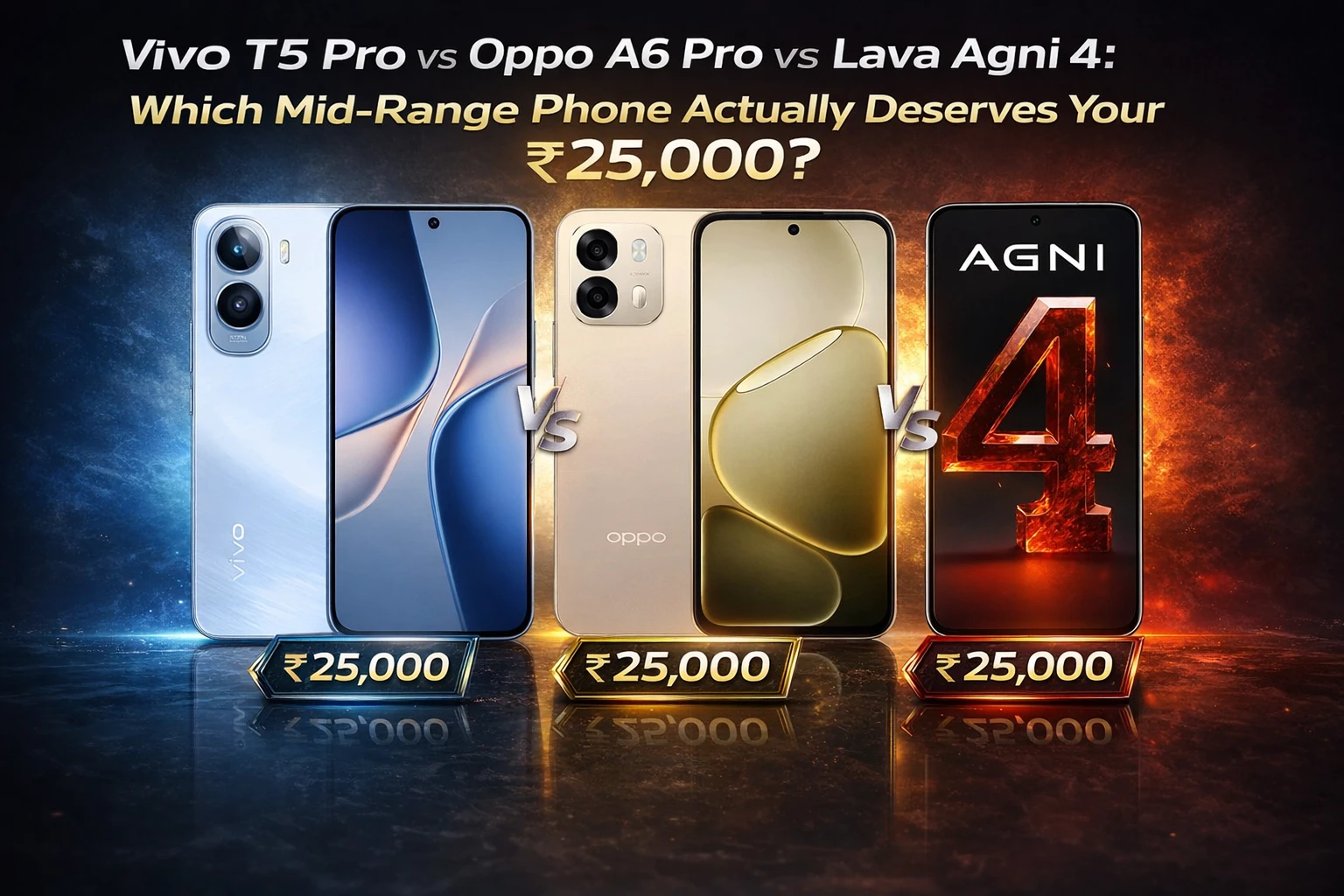
So here's the situation — the mid-range smartphone market in India is absolutely packed right now, and three phones are fighting for your attention around the ₹25,000 mark. The Vivo T5 Pro just launched with a battery so massive it could probably power your house, the Oppo A6 Pro is pushing AI features like there's no tomorrow, and Lava's Agni 4 is trying to prove that Indian brands can compete on performance. But which one should you actually buy?
I've been tracking these launches for months, and the interesting thing is that none of these phones are trying to beat each other directly. They're each targeting completely different user needs, which makes this comparison way more interesting than your typical spec-sheet battle. Let's dig into what each phone brings to the table and figure out where your money should go.
The Battery Monster: Vivo T5 Pro and Its 9,020mAh Beast
Let's start with the elephant in the room — Vivo has stuffed a 9,020mAh battery into the T5 Pro. That's not a typo. Most phones in this segment come with 5,000-6,000mAh batteries, and Vivo just said "hold my chai" and nearly doubled it. For context, that's more battery capacity than some power banks I've used.
The T5 Pro runs on the Snapdragon 7 Gen 3 chipset, which is a solid mid-range processor. It's not going to break any benchmark records, but it handles daily tasks smoothly and can manage most games at medium-high settings. The phone comes with a 6.77-inch AMOLED display with 120Hz refresh rate, which has become pretty standard at this price point. Peak brightness hits around 4,500 nits according to Vivo's claims, though real-world usage will obviously be lower.
Camera setup is where things get interesting. You get a 50MP main sensor with OIS (optical image stabilization), which is great for low-light shots and video stability. There's also an 8MP ultra-wide and a 2MP depth sensor. The front camera is 32MP, which should handle your Instagram stories just fine. But honestly, the camera isn't why you'd buy this phone — it's all about that battery life.
Vivo claims the T5 Pro can last up to three days on a single charge with moderate usage. I'm skeptical of manufacturer claims, but even if you get two full days of heavy usage, that's impressive. The phone supports 80W fast charging, so you can top up quickly when needed. At ₹24,999 for the base 8GB+128GB variant, you're essentially paying for battery endurance above everything else.
The AI Pusher: Oppo A6 Pro's Smart Features
Oppo's taking a different approach with the A6 Pro. Instead of going crazy with battery capacity, they're betting on AI features and software intelligence to differentiate themselves. The phone packs a 5,000mAh battery, which is perfectly adequate but nothing special. Where Oppo is trying to stand out is with their ColorOS AI suite.
The A6 Pro runs on the MediaTek Dimensity 7300 chipset, which is slightly less powerful than Vivo's Snapdragon 7 Gen 3 in raw performance but more efficient in power consumption. You get a 6.7-inch AMOLED display with 120Hz refresh rate and decent brightness levels. The design is sleek with a glass back, and Oppo's always been good at making phones that feel premium even at mid-range prices.
Camera-wise, you're looking at a 50MP main sensor (no OIS though, which is a bummer), an 8MP ultra-wide, and a 2MP macro lens that you'll probably never use. The 16MP front camera is adequate but not spectacular. What Oppo is really pushing are the AI photo enhancement features — AI Eraser to remove unwanted objects, AI Portrait mode, and AI Night mode that supposedly improves low-light shots through computational photography.
The AI features extend beyond the camera. There's AI voice assistant integration, AI text summarization for long articles, and AI call translation. Whether these features are actually useful or just marketing gimmicks depends on your usage patterns. If you're someone who uses Google Lens and Assistant regularly, you might appreciate these additions. If not, they're just bloatware taking up storage space.
Pricing starts at ₹23,999 for 8GB+128GB, making it slightly cheaper than the Vivo T5 Pro. Oppo's also offering 256GB storage variants, which is nice if you store a lot of media locally. The phone comes with 67W fast charging, which is decent but not as fast as Vivo's 80W solution.
The Indian Challenger: Lava Agni 4's Gaming Focus
Now here's where things get interesting. Lava, an Indian brand that's been around forever but mostly known for budget phones, is trying to compete in the performance segment with the Agni 4. And honestly, they've done some homework.
The Agni 4 runs on the MediaTek Dimensity 8350 chipset, which is actually more powerful than what both Vivo and Oppo are offering. This is a proper upper mid-range processor that can handle heavy gaming and multitasking without breaking a sweat. Lava's clearly targeting mobile gamers and power users who need consistent performance.
Display is a 6.67-inch flat AMOLED panel with 120Hz refresh rate. The "flat" part is important — curved displays look fancy but are impractical for gaming because of accidental touch issues. Lava's gone with Gorilla Glass 5 protection, and the display gets bright enough for outdoor visibility. The phone also has a vapor cooling system to prevent thermal throttling during extended gaming sessions.
Camera setup includes a 50MP main sensor with OIS and an 8MP ultra-wide. The 50MP front camera is actually better than what Oppo offers. But let's be real — if you're buying the Agni 4, you're not buying it for the camera. You're buying it for the Dimensity 8350 and the gaming-focused features like customizable action buttons and gaming triggers.
Battery is 5,000mAh with 66W fast charging. Not as impressive as Vivo's massive cell, but adequate for a day of heavy usage. The phone runs on Android 15 with minimal bloatware, which is refreshing compared to the heavily skinned UIs from Chinese manufacturers. Lava's promising three years of Android updates and four years of security patches, which is competitive with what Samsung offers.
The kicker? Pricing starts at ₹26,999 for 8GB+256GB. You're paying a premium compared to Vivo and Oppo, but you're getting more storage and a more powerful processor. Whether that's worth the extra ₹2,000-3,000 depends on your priorities.
Performance Reality Check: What These Specs Actually Mean
Let's talk real-world performance because spec sheets don't tell the whole story. The Snapdragon 7 Gen 3 in the Vivo T5 Pro scores around 700,000 on AnTuTu benchmarks. The MediaTek Dimensity 7300 in the Oppo A6 Pro hits around 650,000. The Dimensity 8350 in the Lava Agni 4 jumps to about 900,000. That's a significant difference on paper.
But here's the thing — for daily usage like scrolling Instagram, watching YouTube, using WhatsApp, and casual photography, all three phones will feel equally smooth. The performance difference becomes noticeable when you're gaming or doing heavy multitasking. If you play BGMI or Genshin Impact regularly, the Agni 4 will give you higher frame rates and better thermal management. If you're a casual user, you won't notice the difference.
Battery life is where the Vivo T5 Pro absolutely dominates. That 9,020mAh battery means you can go on weekend trips without carrying a charger. For delivery riders, field sales people, or anyone who's away from charging points for extended periods, this is a game-changer. The Oppo and Lava phones will get you through a day comfortably, but you'll need to charge every night.
Camera quality is surprisingly similar across all three phones in good lighting. The main differentiator is OIS — both Vivo and Lava have it, Oppo doesn't. This matters for video recording and low-light photography. If you shoot a lot of videos or take photos in dimly lit restaurants and cafes, OIS makes a noticeable difference in reducing blur and shake.
Software and Updates: The Long-Term Investment
This is where things get messy. Vivo's Funtouch OS is heavily customized and comes with a fair amount of bloatware. You'll spend your first hour uninstalling apps you'll never use. Oppo's ColorOS is similar — lots of features but also lots of pre-installed apps. Both companies promise two years of Android updates and three years of security patches, which is okay but not great.
Lava's approach is cleaner. They're running a near-stock Android experience with minimal customization. The Agni 4 comes with very little bloatware, and what's there can be uninstalled. More importantly, Lava's promising three Android updates and four years of security patches, which matches what Google offers with Pixel phones. For a phone you're planning to keep for 3-4 years, this matters.
The AI features Oppo is pushing are hit-or-miss. The AI Eraser tool works decently for removing simple objects from photos, but it's not magic. The AI voice features are mostly rebranded Google Assistant capabilities. Unless you're specifically excited about these AI tools, they're not a compelling reason to choose the A6 Pro over the competition.
Build Quality and Design: What You're Actually Holding
The Vivo T5 Pro is the heaviest of the three at around 210 grams because of that massive battery. It's noticeably chunky, and if you have small hands, it might feel unwieldy. The design is functional rather than premium — plastic back, metal frame, nothing fancy. But it's built to last, and the extra weight gives it a solid feel.
Oppo A6 Pro is the most premium-feeling phone here. Glass back, slim profile at around 7.8mm thickness, and it weighs about 190 grams. It's comfortable to hold and looks more expensive than it is. If aesthetics matter to you, the A6 Pro wins this category. The curved display adds to the premium feel, though as I mentioned earlier, it's not ideal for gaming.
Lava Agni 4 sits in the middle. It's got a metal frame and textured matte glass back that doesn't show fingerprints. The flat display is practical, and the overall build feels sturdy. At 208 grams, it's slightly lighter than the Vivo but heavier than the Oppo. The action button on the side is a nice touch for quick access to camera or flashlight.
All three phones have IP ratings for dust and splash resistance, but none are fully waterproof. You can handle light rain and accidental spills, but don't take them swimming. The Vivo and Lava have IP64 rating, while Oppo claims IP68, which is better on paper but still not full water immersion protection.
Charging and Battery Reality: Beyond the Numbers
Fast charging speeds sound impressive in marketing materials, but real-world experience varies. Vivo's 80W charging can get the T5 Pro from 0-50% in about 25 minutes, but charging that massive 9,020mAh battery fully takes over 90 minutes. Oppo's 67W charging is slower, taking about 45 minutes for a full charge on the 5,000mAh battery. Lava's 66W charging is similar to Oppo.
Here's what matters more than charging speed — battery degradation over time. Larger batteries generally degrade slower in percentage terms. After two years of daily charging, a 9,020mAh battery losing 20% capacity still leaves you with over 7,000mAh, which is more than most new phones. The smaller batteries in Oppo and Lava will degrade to around 4,000mAh, which might not last a full day by year three.
None of these phones support wireless charging, which is disappointing but expected at this price point. If wireless charging is important to you, you'll need to look at more expensive options or older flagships on discount.
The Verdict: Which Phone for Which User?
Look, there's no universal winner here. Each phone makes sense for specific use cases, and buying the "wrong" one will leave you frustrated even though you spent ₹25,000.
Buy the Vivo T5 Pro if battery life is your absolute top priority. If you're constantly away from charging points, travel frequently, or just hate the anxiety of low battery warnings, that 9,020mAh battery is worth the extra weight and bulk. It's also great for content consumption — watching movies and series on long flights or train journeys without worrying about battery. The performance is adequate for most tasks, and the camera is decent enough for social media.
Buy the Oppo A6 Pro if you want a premium-feeling phone with good all-around performance and you actually care about AI features. If you're someone who uses Google Lens regularly, edits photos frequently, and wants a phone that looks expensive, the A6 Pro delivers. The lighter weight and slimmer profile make it more comfortable for daily use. Just be prepared for bloatware and a more heavily customized Android experience.
Buy the Lava Agni 4 if you're a mobile gamer or power user who needs consistent performance. The Dimensity 8350 is genuinely faster than what Vivo and Oppo offer, and the gaming-focused features like vapor cooling and flat display make a difference during extended gaming sessions. The cleaner software experience and longer update commitment are also appealing if you plan to keep the phone for 3-4 years. You're paying a premium, but you're getting better hardware and software support.
What These Phones Tell Us About the Indian Market
The fact that these three phones exist and compete at similar price points tells you something important about where the Indian smartphone market is headed. Manufacturers are realizing that the "jack of all trades" approach doesn't work anymore. Users have specific needs, and phones need to excel in particular areas rather than being mediocre at everything.
Vivo's battery-focused approach acknowledges that charging infrastructure in India is still inconsistent. Power cuts happen, charging points aren't always available, and people want phones that last. The T5 Pro is designed for the Indian reality of unreliable electricity and long commutes.
Oppo's AI push is interesting because it's betting on software differentiation in a hardware-commoditized market. As processors become "good enough" for most tasks, the next battleground is software features and user experience. Whether AI features are actually useful or just marketing fluff remains to be seen, but Oppo's trying to create value beyond specs.
Lava's performance focus is the most ambitious because they're competing directly with established Chinese brands on hardware. The Agni 4 proves that Indian brands can source competitive components and deliver solid products. Whether they can build brand trust and after-sales service networks to compete long-term is the real question.
The Honest Limitations Nobody Talks About
Let's address what these phones can't do. None of them have flagship-level cameras. If photography is your priority, you're better off looking at older flagships on discount or stretching your budget to ₹35,000+ for current-gen camera phones. The 50MP sensors sound impressive, but they're mid-range sensors that struggle in challenging lighting conditions.
Gaming performance on the Vivo and Oppo is limited. You can play popular titles, but don't expect consistent 60fps on high graphics settings in demanding games. The Lava Agni 4 is better but still not flagship-level. If you're serious about mobile gaming, consider phones with Snapdragon 8 Gen series processors.
Build quality is good but not premium. These are plastic and glass phones with metal frames, not the ceramic and titanium builds you get in flagships. They'll survive normal usage and minor drops, but they're not indestructible. Budget for a good case and screen protector.
5G connectivity is present on all three phones, but 5G coverage in India is still limited to major cities. If you're in tier-2 or tier-3 cities, you'll be using 4G for the foreseeable future. Don't buy these phones just for 5G — buy them for what they offer today on 4G networks.
What's Coming Next in This Segment
The mid-range segment is evolving rapidly. We're already seeing rumors of phones with even larger batteries — 10,000mAh+ is apparently in development. AI features will become more sophisticated as on-device processing improves. And Indian brands like Lava are likely to launch more performance-focused phones to compete with Chinese manufacturers.
Pricing pressure is real. With flagship phones from 2-3 years ago available at mid-range prices on sale events, new mid-range phones need to offer compelling reasons to choose them over older flagships. Battery life, software updates, and specific feature focus (like gaming or AI) are how manufacturers are trying to differentiate.
The next 12 months will be interesting. If Lava's Agni series succeeds, expect more Indian brands to enter the performance segment. If Vivo's battery strategy works, other manufacturers will follow with larger batteries. And if Oppo's AI features actually resonate with users, we'll see AI becoming standard across all price points.
For now, your decision comes down to this: Do you value battery life above everything else? Go Vivo. Want a premium-feeling phone with AI features? Choose Oppo. Need gaming performance and clean software? Pick Lava. There's no wrong choice — just the right choice for your specific needs.


Comments (0)
Be the first to comment!