


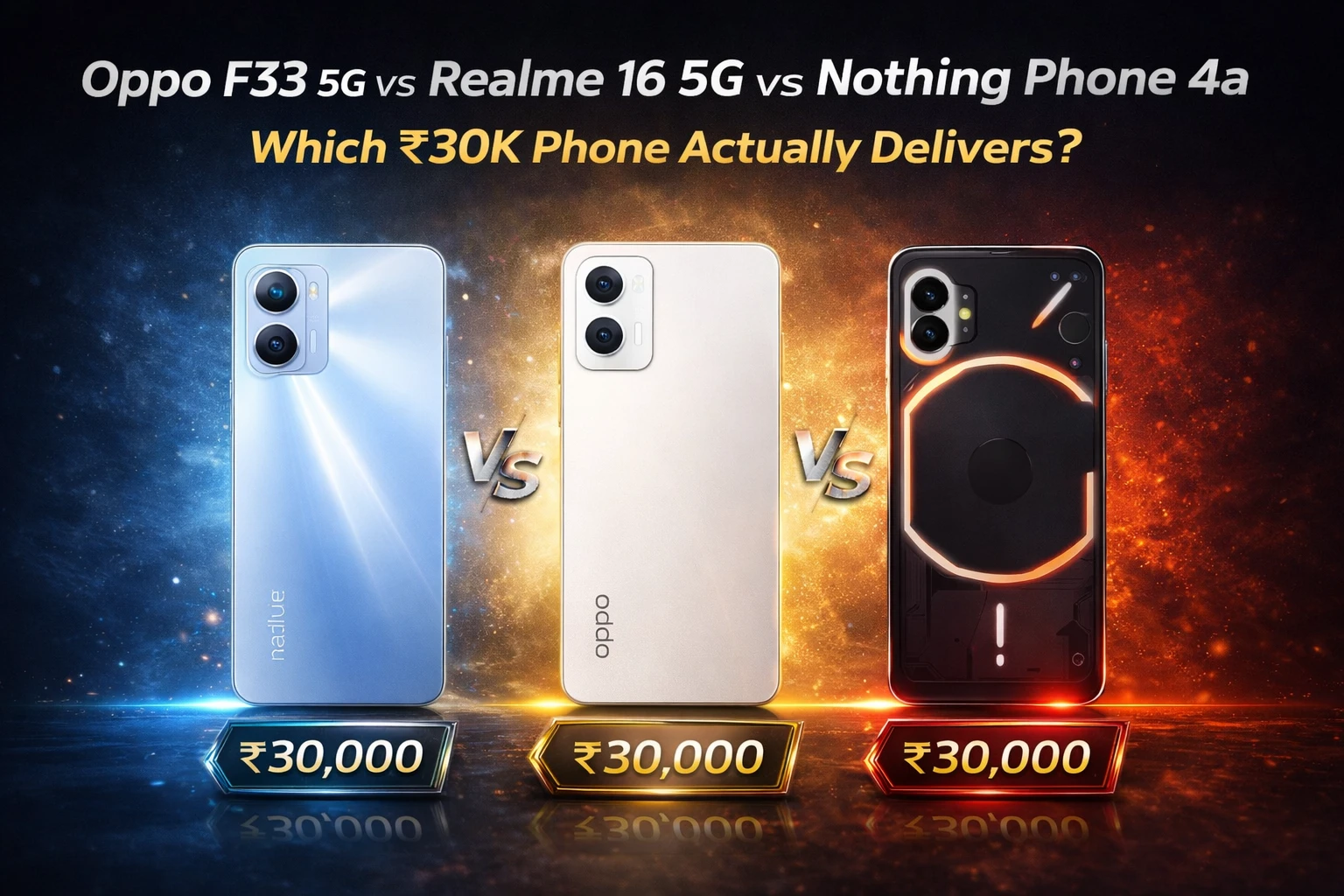
So here's the situation — we've got three phones launched within weeks of each other, all fighting for your attention in that sweet ₹30,000-₹38,000 bracket. The Oppo F33 5G just dropped with a battery that could probably outlast your laptop. Realme 16 5G is pushing a crazy-bright display and promising four years of updates. And Nothing Phone 4a? They're doubling down on cameras and that love-it-or-hate-it Glyph lighting system.
I've spent the last few days digging through specs, comparing real-world pricing on Flipkart and Amazon India, and honestly, each phone makes sense for a completely different type of user. Let me break down what's actually going on here.
The Price Game: Where Your Money Goes
Let's start with the numbers because that's what matters most. Realme 16 5G kicks off at ₹31,999 for the base 8GB+128GB variant. The mid-tier 8GB+256GB sits at ₹33,999, and if you want the full 12GB+256GB experience, you're looking at ₹36,999. It's available in Air Black and Air White — pretty standard stuff.
Nothing Phone 4a starts at the exact same ₹31,999 for 8GB+128GB. But here's where it gets interesting — their 8GB+256GB is priced at ₹34,999 (a thousand rupees more than Realme), and the top 12GB+256GB variant hits ₹37,999. You're paying a premium for that Snapdragon chip and the Glyph interface, basically. Color options are more playful: Black, Blue, Pink, and White.
Oppo F33 5G pricing isn't officially confirmed yet for India, but based on the Chinese launch and typical Oppo positioning, expect it to land somewhere between ₹32,999 and ₹37,999 for similar configurations. The phone comes in Forest Green and Pearl White, and honestly, that green looks pretty slick from the teasers.
Display: Brightness Wars Are Real
This is where things get technical, but it matters more than you think. Realme 16 5G packs a 6.57-inch Full HD+ AMOLED panel with 120Hz refresh rate. Nothing special so far, right? But here's the kicker — Realme claims 4,200 nits peak brightness. That's absolutely bonkers for this price segment. For context, most phones in this range barely hit 1,200-1,500 nits.
Nothing Phone 4a goes bigger with a 6.78-inch display, but the resolution is higher at 1,224x2,720 pixels (versus Realme's 1080x2372). Peak brightness here is rated at 4,500 nits, which is even crazier. The screen-to-body ratio is slightly lower, but you're getting more screen real estate overall. Plus, it's protected by Gorilla Glass 7i, which is the latest iteration.
Oppo F33 5G sits in the middle with a 6.57-inch AMOLED display, 120Hz refresh, and reportedly 1,400 nits peak brightness. That's more realistic and honestly more believable than the inflated numbers from the other two. The display is flat, which I personally prefer over curved edges that just collect accidental touches.
Real talk: Unless you're constantly using your phone in direct sunlight, you won't notice the difference between 1,400 and 4,500 nits. What matters more is color accuracy and touch response, which we'll only know after proper reviews.
Performance: Chipset Battle Explained
Here's where the phones diverge significantly. Realme 16 5G runs on the MediaTek Dimensity 6400 Turbo. This is a relatively new chipset built on a 6nm process. It's not a flagship by any means, but it's optimized for efficiency and handles daily tasks smoothly. Think scrolling Instagram, playing BGMI on medium settings, multitasking between apps — all perfectly fine.
Nothing Phone 4a brings out the Snapdragon 7s Gen 4, which is a step up in raw performance. This is a 4nm chip with better GPU performance, which means gaming will be noticeably smoother. If you're someone who plays Genshin Impact or other demanding games regularly, this is the chip you want. It's also paired with faster LPDDR5x RAM (versus LPDDR4x on Realme).
Oppo F33 5G uses the MediaTek Dimensity 6360 Max, which is basically a slightly tweaked version of the 6300 series. Performance-wise, it's similar to what Realme is offering — good enough for most users, but not a gaming powerhouse. The Mali-G57 MC2 GPU handles casual gaming fine but will struggle with high graphics settings.
My take: If you're a mobile gamer, Nothing Phone 4a is worth the extra ₹1,000. For everyone else, the MediaTek chips will do just fine and probably give you better battery life.
The Battery Situation: Oppo's Massive Advantage
This is where Oppo F33 5G absolutely dominates. A 7,000mAh battery in a phone that's only 8mm thick? That's engineering magic right there. For comparison, most phones in this segment pack 5,000-5,500mAh cells. Oppo is claiming two full days of heavy usage, and honestly, I believe them.
The charging is equally impressive — 80W SuperVOOC wired charging. That means you can go from 0 to 100% in under 50 minutes, which is faster than most budget phones. Plus, it supports reverse charging, so you can juice up your earbuds or smartwatch in a pinch.
Realme 16 5G also has that same 7,000mAh battery, which is fantastic. But the charging is capped at 60W, so you're looking at closer to 70 minutes for a full charge. Still fast, but not as fast as Oppo. Realme also supports reverse charging, which is a nice touch.
Nothing Phone 4a is the weakest here with a 5,400mAh battery and 50W charging. That's still decent — you'll get through a full day easily — but if battery anxiety is real for you, this isn't the phone. The smaller battery is likely a trade-off for the slimmer design and lighter weight (204.5g versus 189g for Oppo).
Real-World Battery Math
Let's put this in perspective. A 7,000mAh battery can theoretically give you:
- 10-12 hours of continuous video streaming on YouTube or Netflix
- 8-9 hours of gaming (BGMI, Free Fire, etc.)
- 15-18 hours of mixed usage (calls, WhatsApp, browsing, social media)
A 5,400mAh battery gets you roughly 70-75% of those numbers. So if you're a heavy user who's constantly on their phone, that extra 1,600mAh makes a tangible difference.
Camera Setup: Nothing Pulls Ahead
This is where Nothing Phone 4a justifies its higher price. The rear camera system includes a 50MP primary sensor (Samsung GN9, 1/1.57-inch), a 50MP periscope telephoto camera, and an 8MP ultrawide. That periscope lens is the real differentiator — it allows for optical zoom without losing quality, something you rarely see under ₹40,000.
The front camera is a 32MP shooter with autofocus, which is great for selfies and video calls. The Glyph interface on the back can also act as a fill light for selfies, which is a clever use of the LEDs.
Realme 16 5G keeps it simple with a 50MP primary camera and a 2MP monochrome sensor. That second sensor is basically useless — it's there to pad the spec sheet. The front camera is a 50MP ultrawide, which is overkill but nice for group selfies. The "Selfie Mirror" feature on the back is a neat touch, letting you use the rear camera for selfies by seeing yourself in a small mirror.
Oppo F33 5G matches Realme with a 50MP primary and 2MP depth sensor setup. The front camera is 16MP, which is more reasonable. Oppo's camera software has always been solid for portraits and night shots, so I expect good results here despite the modest hardware.
Bottom line: If photography is a priority, Nothing Phone 4a is the clear winner. The periscope lens alone makes it worth considering. For casual shooters, all three will perform similarly in good lighting.
Software and Updates: Realme's Long-Term Promise
This is a huge factor that people often overlook. Realme 16 5G ships with Android 16 and Realme UI 7.0, and the company is promising four years of security updates plus three major Android OS upgrades. That means you'll get Android 17, 18, and 19 — taking you all the way to 2029.
Nothing Phone 4a also runs Android 16 with Nothing OS 4.1. The update commitment here is three years of OS updates and six years of security patches. That's actually better for long-term security, even if you get one fewer major OS upgrade.
Oppo F33 5G is expected to run Android 16 with HyperOS 3 (since Oppo is transitioning away from ColorOS). Update commitments aren't confirmed yet, but Oppo typically offers 2-3 years of OS updates and 3-4 years of security patches.
If you're planning to keep your phone for 3-4 years, Realme and Nothing are the safer bets. Oppo's track record on updates has been inconsistent in the past.
Build Quality and Durability
All three phones claim some level of water and dust resistance, but the ratings vary. Realme 16 5G has an IP69 rating, which is the highest level of protection. It can withstand high-pressure water jets and complete dust ingress. That's overkill for most users, but if you work outdoors or are clumsy around water, it's reassuring.
Nothing Phone 4a has an IP64 rating, which protects against dust and water splashes but not full submersion. It's adequate for rain or accidental spills, but don't take it swimming.
Oppo F33 5G is rated IP66, IP68, and IP69 — basically covering all bases. It's fully dustproof and can handle submersion in water up to 1.5 meters for 30 minutes, plus high-pressure water jets. Oppo is clearly targeting users who need a rugged phone.
Weight-wise, Realme is the lightest at 183g, followed by Oppo at 189g, and Nothing at 204.5g. That 20g difference is noticeable when you're holding the phone for extended periods.
The Glyph Factor: Gimmick or Game-Changer?
Let's address the elephant in the room — Nothing's Glyph interface. It's a series of LED strips on the back that light up for notifications, calls, and charging status. Some people love it, some think it's a gimmick. I'm somewhere in the middle.
The Glyph interface on Phone 4a has 63 mini-LEDs arranged in six zones, which is more refined than previous versions. You can customize light patterns for different contacts, apps, and notifications. It's genuinely useful when your phone is face-down on a table — you can tell who's calling without picking it up.
But here's the thing: after the novelty wears off, most people just use it as a fancy notification light. It doesn't fundamentally change how you use your phone. If you're paying ₹1,000 extra for the Glyph interface alone, that's probably not worth it. But if you value the overall package (better processor, periscope camera, higher resolution display), then the Glyph is a nice bonus.
Storage and RAM: What You Actually Need
All three phones offer similar RAM and storage configurations: 8GB/128GB, 8GB/256GB, and 12GB/256GB. The base 128GB is fine if you rely heavily on cloud storage (Google Photos, Google Drive) and don't download a ton of apps or games. But honestly, in 2026, 256GB should be the minimum.
Here's why: Modern games like Genshin Impact take up 20-25GB. Add your photos, videos, WhatsApp media, and offline Netflix downloads, and 128GB fills up fast. The ₹2,000 jump to 256GB is worth it for peace of mind.
The 12GB RAM variant is overkill for most users. Android's memory management is good enough that 8GB handles multitasking smoothly. Save that extra ₹3,000 and put it toward accessories or a good case.
Availability and Offers: Where to Buy
Realme 16 5G is available on Realme's official website, Flipkart, and Amazon India. Launch offers typically include bank discounts (₹1,500-₹2,000 off with ICICI or HDFC cards) and exchange bonuses (up to ₹3,000 extra for your old phone).
Nothing Phone 4a is sold through Nothing's website, Flipkart, and select offline stores. Nothing often bundles their Ear (2) earbuds at a discount with phone purchases, which is a nice perk if you're in the market for TWS earbuds anyway.
Oppo F33 5G will likely be available through Oppo's website, Flipkart, and their extensive offline retail network. Oppo's strength is offline availability — you can walk into a store, try the phone, and walk out with it the same day.
So Which One Should You Actually Buy?
Here's my honest verdict after looking at everything:
Buy Oppo F33 5G if: Battery life is your top priority. You need a phone that lasts two full days without charging. You work outdoors or in harsh conditions and need that IP69 durability. You prefer buying phones offline and want strong after-sales support.
Buy Realme 16 5G if: You want the brightest display for outdoor use. Long-term software support matters to you (four years of updates). You want the best balance of battery life, performance, and price. You're okay with a slightly slower charging speed compared to Oppo.
Buy Nothing Phone 4a if: You're a mobile gamer and need that Snapdragon 7s Gen 4 performance. Camera quality is a priority, especially zoom capabilities. You want the highest resolution display. You genuinely like the Glyph interface aesthetic and find it useful. You're willing to pay a small premium for better hardware.
What They're Not Telling You
Look, all three companies are inflating their brightness numbers. Those 4,200 nits and 4,500 nits figures? That's peak brightness in a tiny portion of the screen under specific test conditions. Real-world brightness is probably closer to 1,200-1,500 nits, which is still excellent but not the miracle they're advertising.
The 2MP depth sensors on Realme and Oppo are basically useless. They're there to make the spec sheet look better. A single good 50MP sensor would produce better results than a 50MP + 2MP combo.
None of these phones have wireless charging, which is disappointing at this price point. Even budget phones in China are getting 15W wireless charging now. Indian brands are lagging behind here.
The Bigger Picture: What This Means for the Market
These three launches signal a shift in the mid-range segment. Battery capacity is becoming the new battleground — we've gone from 4,000mAh being standard to 7,000mAh in just two years. That's great for consumers but puts pressure on manufacturers to innovate on charging speeds and thermal management.
The focus on durability (IP ratings, military-grade testing) shows that brands are listening to Indian consumers who keep their phones for 3-4 years on average. We're not the US market where people upgrade every year.
Software update commitments are finally improving. Three to four years of support should be the baseline, not a premium feature. Apple has been doing this for a decade; Android OEMs are finally catching up.
What's missing across the board: Better ultrawide cameras, wireless charging, and faster storage (UFS 3.1 or 4.0). These are areas where the next generation needs to improve.
Final Thoughts
If I had to pick one for myself, I'd probably go with Realme 16 5G. The combination of massive battery, bright display, and four-year update promise makes it the most well-rounded package. The ₹31,999 starting price is aggressive, and the IP69 rating is overkill in the best way possible.
But I completely understand why someone would choose Nothing Phone 4a for the camera and performance, or Oppo F33 5G for the fastest charging and offline availability. There's no wrong choice here — it really depends on what you prioritize.
The good news? Competition is fierce, which means we're getting better phones at lower prices. Just a year ago, a 7,000mAh battery and 120Hz AMOLED display would've cost ₹45,000+. Now it's under ₹35,000. That's the power of brands fighting for market share in India.
Whichever phone you choose, you're getting solid value for money. Just make sure to buy the 256GB variant, get a good case, and apply for those bank discounts. Every rupee saved is a rupee earned.




Comments (0)
Be the first to comment!