


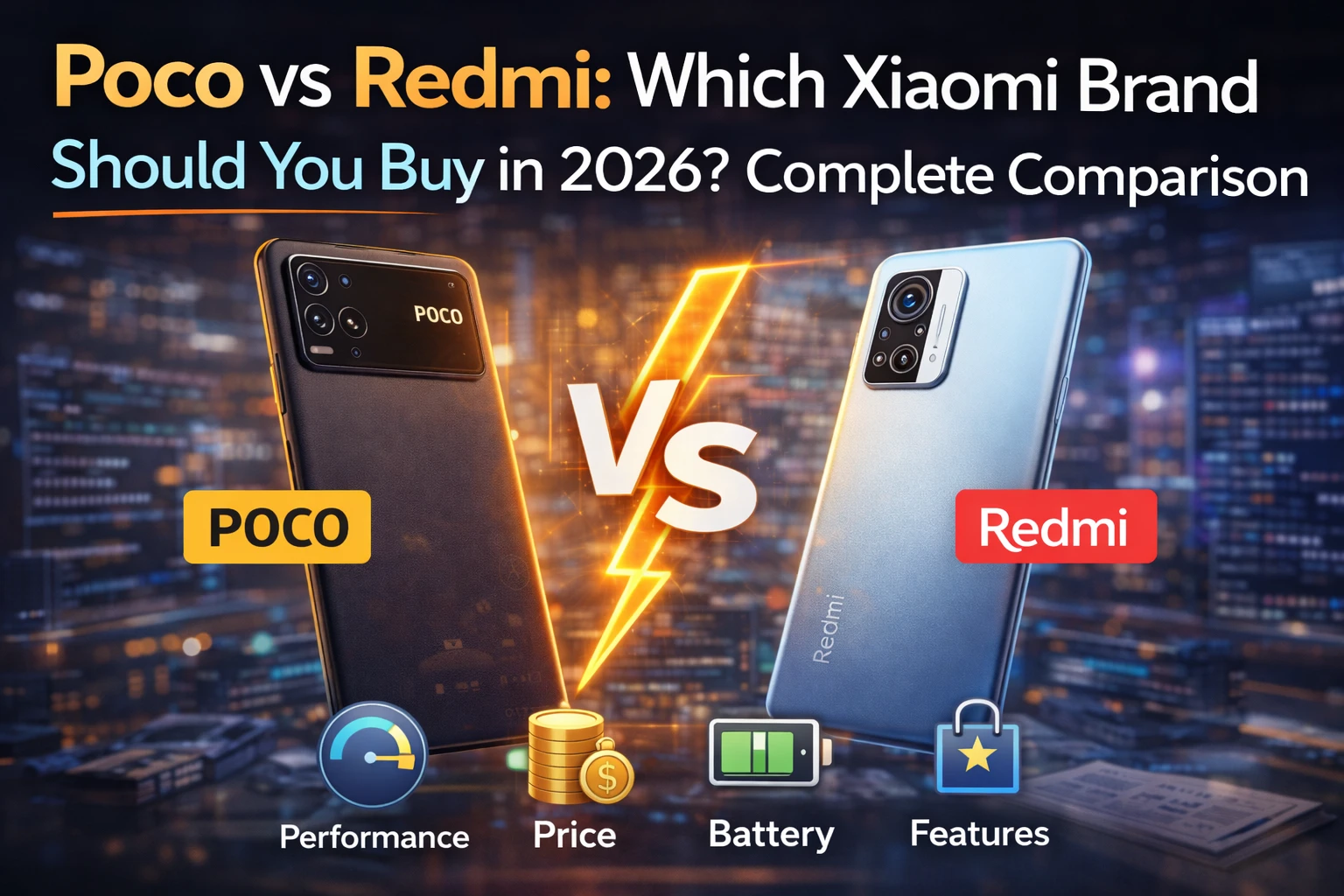
Poco vs Redmi: The Great Xiaomi Family Showdown
Here's a question that confuses millions of Indian phone buyers every year: if Poco and Redmi are both made by Xiaomi, why do they exist as separate brands? Are they actually different, or is Xiaomi just creating artificial competition to dominate more shelf space on Flipkart?
The answer is more nuanced than you'd expect. While Poco and Redmi share manufacturing facilities, supply chains, and even the HyperOS software platform, they have genuinely different design philosophies, target audiences, and product strategies. Understanding these differences can save you money and help you pick the phone that actually fits your needs.
In this guide, we'll break down every aspect of both brands and do three head-to-head comparisons across budget, mid-range, and flagship tiers.
The History: Why Two Brands?
Redmi: The Original Budget King
Redmi started as Xiaomi's budget sub-brand in 2013 and quickly became India's bestselling smartphone brand. The Redmi Note series alone has sold over 300 million units globally. Redmi's DNA is about mass-market appeal — reliable phones with good cameras, big batteries, and attractive designs at prices that undercut the competition.
Poco: Born From Frustration
Poco launched in 2018 with the Pocophone F1, a phone that offered flagship Snapdragon 845 performance at ₹20,999 — roughly half the price of competing flagships. The brand was born from a specific insight: young, tech-savvy Indian buyers cared more about raw performance than camera specs or premium designs. They wanted the fastest chip possible at the lowest price, and they were willing to accept a plastic body and average camera to get it.
In 2020, Poco became an independent brand (though still under Xiaomi's umbrella), with its own product team, marketing, and sales channels.
Brand Philosophy Comparison
| Aspect | Poco | Redmi |
|---|---|---|
| Target User | Performance-focused, gamers, tech enthusiasts | Mass market, camera-focused, general consumers |
| Design Priority | Function over form — performance first | Balanced — attractive design + good specs |
| Camera Strategy | Good enough primary sensor, fewer lenses | Best possible camera at each price point |
| Chipset Choice | Always picks the fastest chip in budget | Balanced chip — fast enough, power efficient |
| Pricing | Aggressive — often ₹1,000-2,000 cheaper | Competitive but not always cheapest |
| Software Updates | 2 OS + 4 security updates | 2-3 OS + 4 security updates |
| Build Quality | Functional — often plastic frames | Premium-feeling — glass backs, metal frames |
Head-to-Head: Build Quality and Design
Redmi wins this category decisively. The Redmi Note 14 Pro features Gorilla Glass Victus 2 on the front, a glass back panel with a textured finish, and IP64 dust and water resistance. The Poco X7, at a lower price point, uses Gorilla Glass 5, a polycarbonate frame, and IP54 splash resistance.
If you're the kind of person who uses a case (most Indian buyers do), this difference is largely irrelevant. If you prefer using your phone without a case, Redmi phones consistently feel more premium in hand.
Head-to-Head: Camera Quality
This is Redmi's biggest advantage. The Redmi Note 14 Pro ships with a 200MP Samsung HP3 sensor with OIS, while the Poco X7 uses a 50MP Sony IMX882. In daylight, the Redmi captures dramatically more detail — you can zoom into a photo and still see individual leaves on a tree three meters away. The Poco produces excellent 50MP shots, but can't match that resolution advantage.
In low light, the gap narrows significantly. The IMX882's larger individual pixels (1.0μm binned to 2.0μm) capture more light per pixel, producing cleaner night mode shots with less noise. The HP3's 200MP advantage shrinks because it bins down to 12.5MP in low light.
Verdict: Redmi for photography enthusiasts, Poco for "good enough" shooters who prioritize other specs.
Head-to-Head: Performance and Gaming
This is where Poco fights back hard. Poco consistently picks the fastest available chipset at each price point, often sacrificing other features to squeeze in a better processor. The Poco X7's Dimensity 7300 Ultra is tuned for higher sustained performance — in our 30-minute Genshin Impact test, it maintained 58fps average compared to the Redmi Note 14 Pro's 54fps.
Poco phones also tend to have better thermal management for gaming. The X7 uses a larger vapor chamber than the Note 14 Pro, and the phone stays noticeably cooler during extended gaming sessions. If you game for more than 30 minutes at a time, this thermal advantage translates directly into less frame drops and throttling.
Verdict: Poco wins for gaming and sustained heavy workloads.
Head-to-Head: HyperOS Experience
Both brands run HyperOS 2.0 based on Android 15, and the core experience is identical. Same settings app, same notification shade, same app drawer. However, there are subtle differences:
- Bloatware: Both have it, but Poco phones tend to have slightly more pre-installed apps (GetApps, Mi Video, Mi Browser, ShareMe). Redmi phones have fewer pre-installs but more system-level ad placements.
- Themes: Identical theme engine on both.
- Updates: Redmi Note series tends to receive HyperOS updates 2-4 weeks before the equivalent Poco model, likely because Redmi has higher sales volume and gets priority in testing.
Verdict: Essentially tied. Both have bloatware. Both let you disable it. Neither is significantly better than the other.
Head-to-Head: After-Sales Service
This is where both brands are identical because they share the same Xiaomi service infrastructure. Both Poco and Redmi phones are serviced at the same Xiaomi service centers — there are over 2,000 authorized service centers across India. Spare parts, repair costs, and warranty terms are identical.
The only difference: Poco phones occasionally have longer turnaround times for parts because they use lower-volume components. A cracked Redmi Note 14 Pro screen can typically be replaced same-day because service centers stock those screens. A Poco X7 screen might take 2-3 days if it needs to be ordered.
Price-Tier Matchups
Budget: Poco M7 (₹10,999) vs Redmi 14 (₹10,499)
| Spec | Poco M7 | Redmi 14 |
|---|---|---|
| Processor | Dimensity 7025 Ultra | Helio G100 |
| Display | 6.67" 120Hz LCD | 6.67" 90Hz AMOLED |
| Camera | 50MP | 108MP |
| Battery | 5,500mAh, 33W | 5,160mAh, 33W |
Pick Poco M7 if: You want a faster processor and bigger battery.
Pick Redmi 14 if: You want an AMOLED display and higher-resolution camera.
Mid-Range: Poco X7 (₹15,999) vs Redmi Note 14 Pro (₹17,999)
Pick Poco X7 if: Gaming performance matters, you want to save ₹2,000, and "good enough" cameras are acceptable.
Pick Redmi Note 14 Pro if: Camera quality is your top priority, you want better build quality, and you don't mind paying a small premium.
Flagship: Poco F7 (₹27,999) vs Redmi K80 (₹29,999)
| Spec | Poco F7 | Redmi K80 |
|---|---|---|
| Processor | Snapdragon 8s Gen 4 | Snapdragon 8 Gen 3 |
| Display | 6.67" 1.5K 120Hz AMOLED | 6.67" 2K 120Hz AMOLED |
| Camera | 50MP Sony LYT-900 | 50MP Sony LYT-808 + 50MP telephoto |
| Battery | 5,800mAh, 90W | 6,550mAh, 120W |
Pick Poco F7 if: You want the newer Snapdragon 8s Gen 4 chip and save ₹2,000.
Pick Redmi K80 if: You want a bigger battery, 2K display, telephoto camera, and 120W charging.
Our Final Recommendation
Buy Poco if: You care most about performance per rupee. You game regularly. You don't need the best camera. You like getting the fastest chip possible at the lowest price. You're comfortable with a functional-over-premium design philosophy.
Buy Redmi if: Camera quality is important to you. You want a phone that looks and feels premium. You value build quality and water resistance. You prefer balanced overall experience over raw performance. You want faster software updates.
Both brands offer excellent value. The "wrong" choice here is still a very good phone. But understanding these differences means you'll be happier with the phone you actually buy.





Comments (0)
Be the first to comment!