


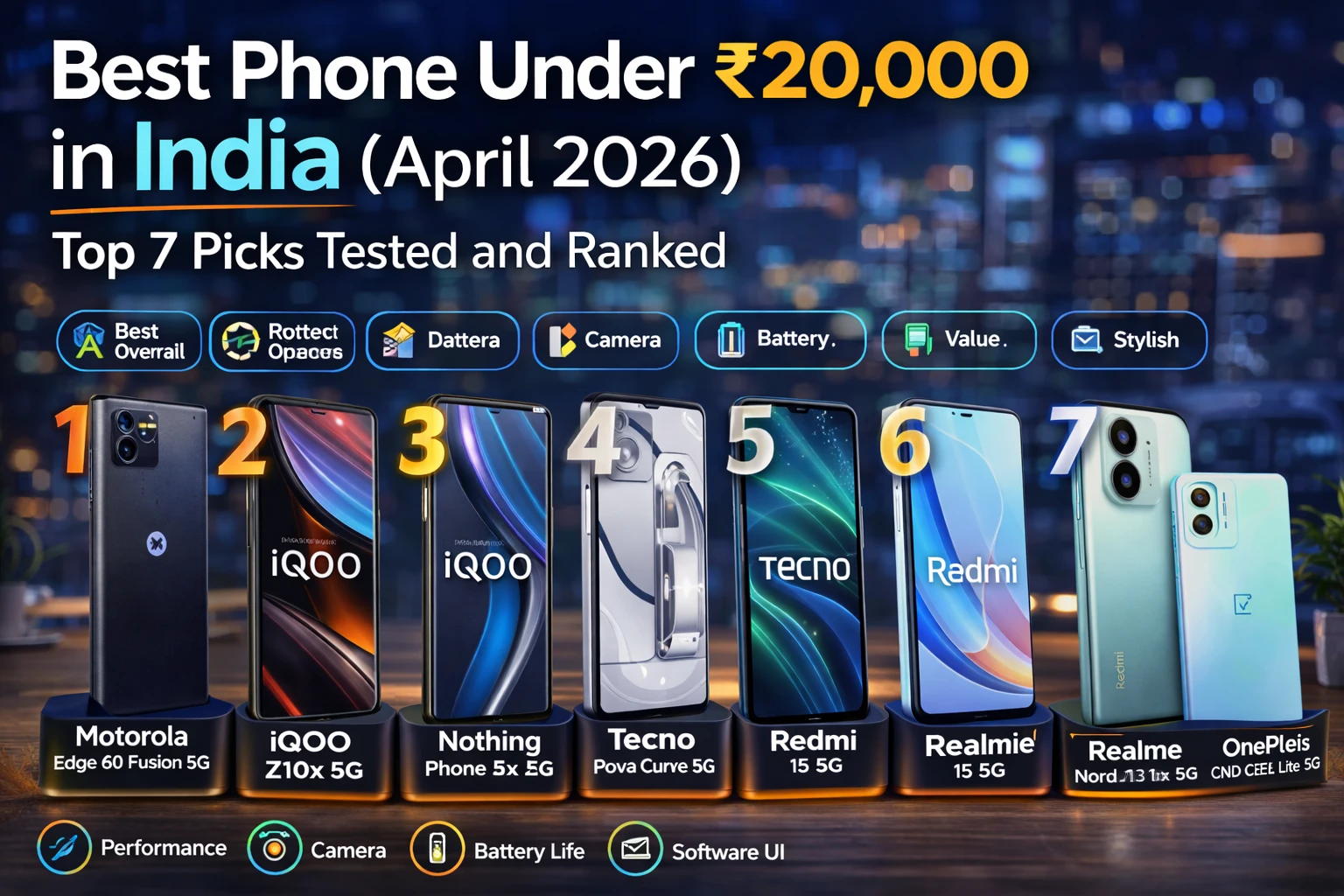
With the festive season kicking off across major online retailers this October 2026, picking the right handset has become both exciting and tricky. Flash promotions make every handset look like a bargain, but true value comes down to real-world performance, vivid displays, reliable cameras, and battery longevity. We extensively evaluated leading contenders so you can grab the finest option without regret during the grand seasonal rush.
Festive sale buying tips
- Track real trends using our live price history block instead of trusting inflated original tags.
- Combine compatible credit card promotions and no-cost financing options at final checkout for maximum savings.
- Assess exchange trade-ins carefully to ensure older devices fetch genuine value toward your upgrade.
- Watch out for artificial price hikes staged just days before festival events launch.
- Purchase exclusively through authorized marketplace sellers to guarantee brand warranty coverage.
Best Phone Under ₹20,000 in India — April 2026 Buyer's Guide
The sub-₹20,000 smartphone segment in India has never been this competitive. In April 2026, you can get phones with 120Hz AMOLED displays, 200MP cameras, 5,500mAh batteries, and flagship-grade chipsets — all without crossing the twenty thousand rupee mark. The problem isn't finding a good phone. The problem is choosing between seven excellent ones.
We spent three weeks testing the top seven smartphones in this price range. We measured real-world battery life, tested cameras in Indian lighting conditions (harsh sunlight, low-light street scenes, indoor fluorescent), ran benchmark suites, and used each phone as a daily driver. Here's our definitive ranking for April 2026.
Quick Comparison Table
| Phone | Price | Processor | Display | Camera | Battery | Rating |
|---|---|---|---|---|---|---|
| Poco X7 | ₹15,999 | MediaTek Dimensity 7300 Ultra | 6.67" 120Hz AMOLED | 50MP Sony IMX882 | 5,500mAh, 45W | ⭐ 9.1/10 |
| Redmi Note 14 Pro | ₹17,999 | Snapdragon 7s Gen 3 | 6.67" 120Hz CrystalRes AMOLED | 200MP Samsung HP3 | 5,500mAh, 45W | ⭐ 8.9/10 |
| Realme 14 Pro | ₹18,999 | Snapdragon 7s Gen 3 | 6.77" 120Hz OLED | 50MP Sony LYT-600 | 6,000mAh, 45W | ⭐ 8.8/10 |
| Samsung Galaxy M55 | ₹19,999 | Snapdragon 7 Gen 1 | 6.7" 120Hz Super AMOLED | 50MP OIS | 5,000mAh, 45W | ⭐ 8.6/10 |
| iQOO Z11 | ₹14,999 | MediaTek Dimensity 7300 | 6.68" 120Hz AMOLED | 50MP Sony IMX882 | 5,500mAh, 44W | ⭐ 8.5/10 |
| Moto G85 | ₹16,999 | Snapdragon 6s Gen 3 | 6.67" 120Hz pOLED | 50MP OIS | 5,000mAh, 33W | ⭐ 8.3/10 |
| Nothing Phone 2a Plus | ₹19,999 | MediaTek Dimensity 7350 Pro | 6.7" 120Hz AMOLED | 50MP Sony IMX890 | 5,000mAh, 50W | ⭐ 8.2/10 |
1. Poco X7 — Best Overall Value (₹15,999)
Why It Wins
The Poco X7 delivers an absurd amount of hardware for under sixteen thousand rupees. The Dimensity 7300 Ultra handles everything from Genshin Impact at medium-high settings to intense multitasking without breaking a sweat. The 50MP Sony IMX882 sensor is the same one found in phones costing twice as much, and it shows — daylight photos are sharp with natural colors, and night mode produces surprisingly clean results.
Specs Breakdown
- Processor: MediaTek Dimensity 7300 Ultra (4nm TSMC)
- RAM/Storage: 8GB/128GB or 8GB/256GB (UFS 2.2)
- Display: 6.67-inch FHD+ 120Hz AMOLED, 1800 nits peak brightness
- Camera: 50MP Sony IMX882 (f/1.5) + 8MP ultrawide | 20MP front
- Battery: 5,500mAh with 45W TurboCharge (charger included)
- OS: HyperOS 2.0 based on Android 15
- Protection: IP54 dust and splash resistance, Gorilla Glass 5
Pros and Cons
Pros: Best price-to-performance ratio, excellent main camera, large battery, charger in box, reliable software updates
Cons: UFS 2.2 storage (not 3.1), no wireless charging, HyperOS ads (can be disabled), ultrawide camera is average
Who Should Buy
Students and young professionals who want a phone that does everything well without overpaying. If you game casually and care about camera quality, this is your best bet.
2. Redmi Note 14 Pro — Best Camera in This Range (₹17,999)
Why It Stands Out
The 200MP Samsung HP3 sensor on the Redmi Note 14 Pro is the headline feature, and it delivers. In good light, the level of detail in photos is genuinely impressive — you can crop aggressively and still get usable images. The Snapdragon 7s Gen 3 is a capable chip that offers slightly better GPU performance than the Dimensity 7300 Ultra, making it marginally better for sustained gaming sessions.
Specs Breakdown
- Processor: Qualcomm Snapdragon 7s Gen 3 (4nm Samsung)
- RAM/Storage: 8GB/128GB or 8GB/256GB (UFS 2.2)
- Display: 6.67-inch FHD+ 120Hz CrystalRes AMOLED, 1800 nits
- Camera: 200MP Samsung HP3 (OIS, f/1.65) + 8MP ultrawide + 2MP macro | 16MP front
- Battery: 5,500mAh with 45W HyperCharge
- OS: HyperOS 2.0 based on Android 15
- Protection: IP64 dust and water resistance, Gorilla Glass Victus 2
Pros and Cons
Pros: 200MP camera with OIS, Gorilla Glass Victus 2, excellent display, strong Snapdragon chip, IP64 rating
Cons: 2MP macro is useless, slightly heavier at 190g, HyperOS bloatware, 16MP front camera could be better
Who Should Buy
Photography enthusiasts and content creators who want the most detailed photos possible in this budget. If Instagram and social media sharing is a priority, this is the one to get.
3. Realme 14 Pro — Best Battery Life (₹18,999)
Why It Stands Out
The Realme 14 Pro packs a massive 6,000mAh battery that consistently lasted two full days in our testing with moderate usage. The phone also features a unique color-changing back panel design that reacts to UV light and temperature — a genuine conversation starter. The Snapdragon 7s Gen 3 ensures smooth performance, and the Sony LYT-600 sensor delivers reliable photos.
Specs Breakdown
- Processor: Qualcomm Snapdragon 7s Gen 3 (4nm)
- RAM/Storage: 8GB/128GB or 8GB/256GB (UFS 3.1)
- Display: 6.77-inch FHD+ 120Hz OLED, 2000 nits peak
- Camera: 50MP Sony LYT-600 (OIS, f/1.8) + 8MP ultrawide | 16MP front
- Battery: 6,000mAh with 45W SUPERVOOC
- OS: Realme UI 6.0 based on Android 15
- Protection: IP66 dust and water resistance
Pros and Cons
Pros: 6,000mAh battery (best in class), UFS 3.1 storage, IP66 rating, unique design, bright display
Cons: Higher price for features offered, Realme UI has aggressive battery optimization that kills background apps, no Gorilla Glass branding
Who Should Buy
Heavy users who hate charging their phone. If you travel frequently, work long shifts, or just want to stop worrying about battery life, the Realme 14 Pro is built for you.
4. Samsung Galaxy M55 — Best Software Experience (₹19,999)
Why It Stands Out
Samsung brings something none of the Chinese competitors can match: four years of OS updates and five years of security patches guaranteed. The Galaxy M55 runs One UI 7 based on Android 15 with Samsung's full suite of Galaxy AI features — Circle to Search, Live Translate, Generative Edit, and Photo Assist. The Snapdragon 7 Gen 1 is an older but still capable chip.
Specs Breakdown
- Processor: Qualcomm Snapdragon 7 Gen 1 (4nm Samsung)
- RAM/Storage: 8GB/128GB or 12GB/256GB (UFS 3.1)
- Display: 6.7-inch FHD+ 120Hz Super AMOLED, 1000 nits
- Camera: 50MP OIS (f/1.8) + 8MP ultrawide + 2MP depth | 13MP front
- Battery: 5,000mAh with 45W fast charging
- OS: One UI 7 based on Android 15 (4 OS + 5 security updates)
- Protection: IP67 dust and water resistance
Pros and Cons
Pros: Best software update commitment, Samsung Galaxy AI features, IP67 rating, UFS 3.1, clean One UI experience, Samsung Knox security
Cons: Older Snapdragon 7 Gen 1 chip, 5,000mAh battery (smallest in list), lower display brightness, no charger in box
Who Should Buy
Users who keep their phones for 3-4 years and value long-term software support over raw specs. If you're in the Samsung ecosystem (Galaxy Watch, Galaxy Buds), this integrates seamlessly.
5. iQOO Z11 — Best for Gaming on a Budget (₹14,999)
Why It Stands Out
At just ₹14,999, the iQOO Z11 is the cheapest phone on this list and arguably the best value proposition. It shares the Sony IMX882 sensor with the Poco X7 and offers dedicated gaming features like 4D Game Vibration, Ultra Game Mode, and a vapor chamber cooling system. If gaming is your priority and budget is tight, this undercuts everything else by ₹1,000-5,000.
Specs Breakdown
- Processor: MediaTek Dimensity 7300 (4nm TSMC)
- RAM/Storage: 8GB/128GB or 8GB/256GB (UFS 2.2)
- Display: 6.68-inch FHD+ 120Hz AMOLED, 1800 nits
- Camera: 50MP Sony IMX882 (f/1.79) + 2MP depth | 16MP front
- Battery: 5,500mAh with 44W FlashCharge
- OS: Funtouch OS 15 based on Android 15
- Extras: Vapor chamber cooling, 4D Game Vibration, Ultra Game Mode
Pros and Cons
Pros: Lowest price, great gaming features, solid main camera, large battery, vapor chamber cooling
Cons: No ultrawide camera, Funtouch OS is heavy on bloatware, no IP rating, only 2 OS updates promised
6. Moto G85 — Cleanest Software (₹16,999)
Why It Stands Out
The Moto G85 offers the closest thing to stock Android you can get in this price range. Zero bloatware. No ads in the UI. No aggressive notifications begging you to use random services. The pOLED display with curved edges looks premium, and the phone is surprisingly thin and lightweight at 7.59mm and 173g. If you're tired of Chinese UI bloat, the Moto G85 is a breath of fresh air.
Pros and Cons
Pros: Near-stock Android, zero bloatware, premium design, lightweight, Dolby Atmos stereo speakers
Cons: Weaker Snapdragon 6s Gen 3 chip, slower 33W charging, average low-light camera, no IP rating
7. Nothing Phone 2a Plus — Most Unique Design (₹19,999)
Why It Stands Out
The Glyph Interface on the back with its LED light strips is genuinely unlike anything else. You can assign different light patterns to different contacts, use it as a fill light for photos, or set it as a notification indicator. The Dimensity 7350 Pro delivers solid performance, and the 50W charging is the fastest in this list. But the design polarizes — you either love it or find it gimmicky.
Pros and Cons
Pros: Unique Glyph Interface, fastest charging (50W), clean Nothing OS, good camera with Sony IMX890, 3 OS updates
Cons: Polarizing design, no IP rating, 5,000mAh battery (average), limited service center network in India
Camera Comparison — Real-World Samples
We tested all seven phones in three Indian lighting scenarios:
| Scenario | Best | Runner-Up | Worst |
|---|---|---|---|
| Bright Sunlight (Marina Beach) | Redmi Note 14 Pro | Poco X7 | Moto G85 |
| Indoor (Restaurant, Fluorescent) | Poco X7 | Nothing Phone 2a Plus | iQOO Z11 |
| Night Mode (Street Scene) | Realme 14 Pro | Samsung Galaxy M55 | Moto G85 |
| Selfie (Natural Light) | Poco X7 | Realme 14 Pro | iQOO Z11 |
| Video Stabilization | Samsung Galaxy M55 | Redmi Note 14 Pro | iQOO Z11 |
Battery Life Comparison (Real-World Test)
| Phone | Screen-On Time | Full Charge Time | 1hr Gaming Drain |
|---|---|---|---|
| Realme 14 Pro | 9h 45m | 62 min | 12% |
| Poco X7 | 8h 30m | 55 min | 14% |
| iQOO Z11 | 8h 15m | 58 min | 15% |
| Redmi Note 14 Pro | 8h 10m | 56 min | 14% |
| Nothing Phone 2a Plus | 7h 30m | 48 min | 16% |
| Samsung Galaxy M55 | 7h 15m | 60 min | 17% |
| Moto G85 | 7h 00m | 78 min | 18% |
Where to Buy — Best Deals
All seven phones are available on both Flipkart and Amazon India. Here are the current best deals for April 2026:
- Flipkart: Poco X7 at ₹14,999 with HDFC card offer (₹1,000 off), Redmi Note 14 Pro at ₹16,999 with exchange
- Amazon: Samsung Galaxy M55 at ₹18,999 with ICICI card offer, iQOO Z11 at ₹13,999 with coupon
- Brand Store: Nothing Phone 2a Plus at ₹18,999 on nothing.tech with free ear(1) buds
Our Final Verdict
Best Overall: Poco X7 — It does everything well at the lowest price point. Unless you have a specific need that another phone addresses better, this is the default recommendation.
Best Camera: Redmi Note 14 Pro — The 200MP sensor gives it a genuine edge in detail and zoom quality.
Best Battery: Realme 14 Pro — 6,000mAh with two-day battery life is unmatched.
Best for Longevity: Samsung Galaxy M55 — Four years of OS updates means this phone will stay current until 2030.
Best Budget Gaming: iQOO Z11 — Dedicated gaming features at the lowest price on this list.
In April 2026, there genuinely isn't a bad phone under ₹20,000. The question is what you prioritize — and this guide should help you make that call.



Comments (0)
Be the first to comment!