


முக்கிய விஷயங்கள்
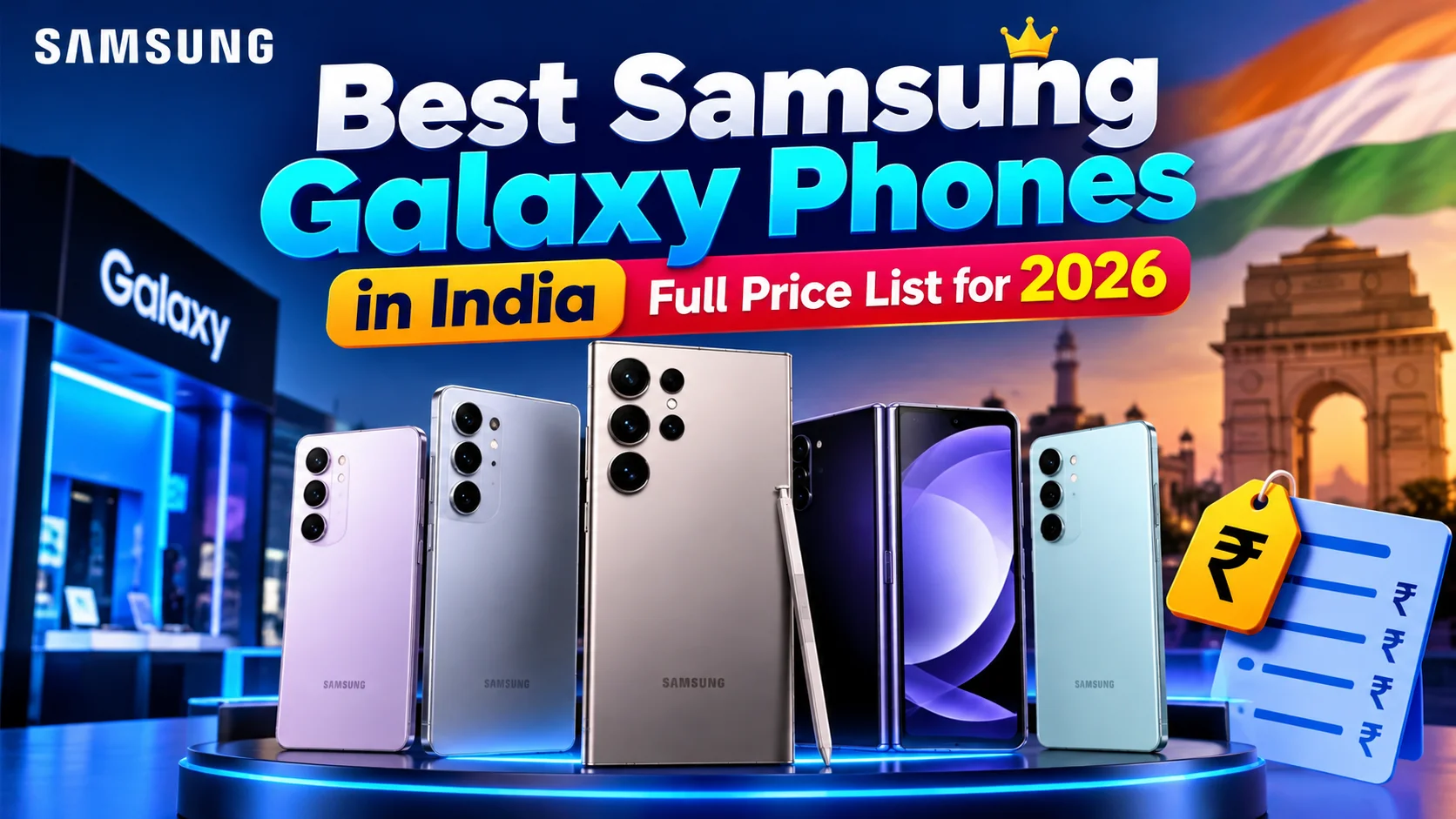
- Galaxy S25 series starts around ₹79,999, S25 Ultra goes up to ₹1,29,999.
- Foldables (Z Fold7, Z Flip7) sit in the ₹1,09,999 - ₹1,74,999 bracket.
- Budget shoppers should look at the A-series (A16, A36, A56) between ₹14,999 and ₹33,999.
- Bank card offers, exchange bonus and festive sales can cut the sticker price by ₹5,000-₹15,000.
- Always check the base storage variant - Samsung's 'starting price' usually means the smallest storage.
What is Samsung Galaxy pricing in India, in one line?
Samsung's Galaxy lineup in India runs from roughly ₹14,000 for an entry A-series phone to over ₹1.7 lakh for the top foldable, with the flagship S-series sitting in the ₹80,000-₹1.3 lakh zone. That's the honest answer to 'Samsung Galaxy விலை' - there isn't one number, there's a ladder, and where you land on it depends on which Galaxy family you're even talking about.
People searching this usually have one of three phones in mind without realising it: the S-series (flagship), the A-series (mid-range mass seller), or the Z-series (foldables). The M-series, sold mostly online on Amazon and Flipkart, is the budget cousin of the A-series. Knowing which bucket you're shopping in saves you half the confusion right there.
Which Galaxy should you pick for your budget?
If your budget is under ₹20,000, you're basically looking at the Galaxy A16 5G or M35 5G. These give you a decent AMOLED screen, okay cameras, and Samsung's long software update promise - which, honestly, is the best reason to buy Samsung at this price over a random Chinese brand.
Between ₹25,000 and ₹35,000, the A36 and A56 5G take over. This is where most Tamil Nadu buyers actually land - good enough camera for Instagram reels, 120Hz screen, and a build that doesn't feel plasticky in hand.
Above ₹75,000, you're in flagship territory with the S25 family. Here the jump isn't really about the screen or the chip anymore - it's about the camera system, Galaxy AI features, and that S-Pen on the Ultra. If you're not someone who notices camera zoom quality or edits photos seriously, the S25+ is more sensible than stretching for the Ultra.
Foldables are a different conversation entirely. The Z Flip7 and Z Fold7 are lifestyle purchases first, phones second. Buy one only if the folding form factor itself excites you - not because you think it's 'the next big thing' every phone will become.
What does each Galaxy model cost right now?
Here's a realistic street-price snapshot. Treat these as approximate - actual price depends on storage variant, city, and whether a bank offer or festive sale is live that week.
| Model | Approx Price (₹) | Why pick it |
|---|---|---|
| Galaxy A16 5G | ₹14,999 | Cheapest 5G Galaxy, long update support |
| Galaxy M35 5G | ₹16,999 | Bigger battery, online-only pricing is sharper |
| Galaxy A36 5G | ₹27,999 | Best camera under ₹30k in the Galaxy lineup |
| Galaxy A56 5G | ₹33,999 | Flagship-like design, 120Hz AMOLED |
| Galaxy S25 | ₹79,999 | Compact flagship, Galaxy AI features |
| Galaxy S25+ | ₹99,999 | Bigger screen, same core experience as S25 |
| Galaxy S25 Ultra | ₹1,29,999 | Best camera and S-Pen, top-tier chip |
| Galaxy Z Flip7 | ₹1,09,999 | Compact foldable, fashion-forward buy |
| Galaxy Z Fold7 | ₹1,74,999 | Tablet-phone hybrid, productivity focus |
Notice the gap between A56 and S25 - nearly ₹46,000. Samsung doesn't really have a 'budget flagship' slot filled right now, which is exactly why the occasional Galaxy S FE launch (when it happens) tends to sell out fast. If one's available when you're shopping, it's worth checking before committing to the full-price S25.
Which mistakes get buyers into trouble?
The biggest mistake is comparing the 'starting price' you saw in a headline with a storage variant you actually want. Samsung's launch price is always for the base RAM/storage combo. Jump to 256GB or 512GB and the price can climb ₹8,000-₹15,000 extra - so always check the exact variant before you get excited about a number.
Second mistake: ignoring exchange value math. Flipkart and Samsung's own store often show a flat exchange bonus on top of your old phone's value during sale periods. If you're upgrading from an older Galaxy, waiting for one of these windows (festive sales, Samsung's own anniversary sale) can genuinely save a few thousand rupees over buying on a random weekday.
Third - don't buy the Ultra just because it's 'the best one'. If you don't use the S-Pen and don't zoom into photos at 10x, you're paying ₹30,000 extra for features that'll sit unused. Be honest with yourself about what you'll actually use.
Fourth, watch for grey-market or 'imported' Galaxy units sold suspiciously cheap online. These often don't carry valid Samsung India warranty. Buy from Samsung's own site, Flipkart, Amazon, Croma or Reliance Digital so warranty and after-sales service aren't a headache later.
What should you do now?
Decide your bucket first - budget, mid-range, flagship, or foldable - before you even look at a specific model name. That single step eliminates 80% of the confusion people have when they type 'Samsung Galaxy விலை' into Google.
Then check live prices on Samsung's official India site plus Flipkart and Amazon side by side, since bank card discounts differ by platform on any given day. If you can wait a few weeks for a festive sale, you'll likely save more than by hunting for a 'secret cheap source' that probably doesn't carry a real warranty anyway.
Is it worth buying on EMI or waiting for a price drop?
No-cost EMI is everywhere on Flipkart, Amazon and Samsung's own site, and for a ₹1,00,000+ phone it genuinely changes how people shop. The catch most buyers miss is that 'no-cost' usually assumes a specific card and tenure - go for 12 months instead of 6, or use a card that isn't on the approved list, and the processing fee or interest quietly creeps back in. Always check the exact EMI calculator on the checkout page rather than trusting the banner headline, because the fine print differs between HDFC, SBI Card, ICICI and Bajaj Finserv tie-ups.
If you're buying an S-series or a foldable, a 10% instant discount on select bank cards plus no-cost EMI can together bring the effective price down meaningfully compared to paying full cash upfront on a non-sale day. The flip side is simple - EMI makes an expensive phone feel affordable in the moment, but you're still paying the same sticker price (or more, if the fine print trips you up) over several months. Treat EMI as a cash-flow tool, not a discount, and you won't regret the decision three months later.
On the waiting question - Samsung phones do get cheaper over time, but not on a fixed schedule. The A-series and S-series typically see real price cuts 6-9 months after launch, usually timed around the next model's announcement or a big sale like Flipkart's Big Billion Days or Amazon's Great Indian Festival. If your current phone still works fine, it's rarely a bad idea to wait for one of these windows rather than paying launch-day price. But if you need a phone right now, don't lose sleep chasing a ₹3,000 difference - by the time the 'perfect' sale window opens, the model you wanted might already be a generation old.

Comments (0)
Be the first to comment!