


Key Takeaways
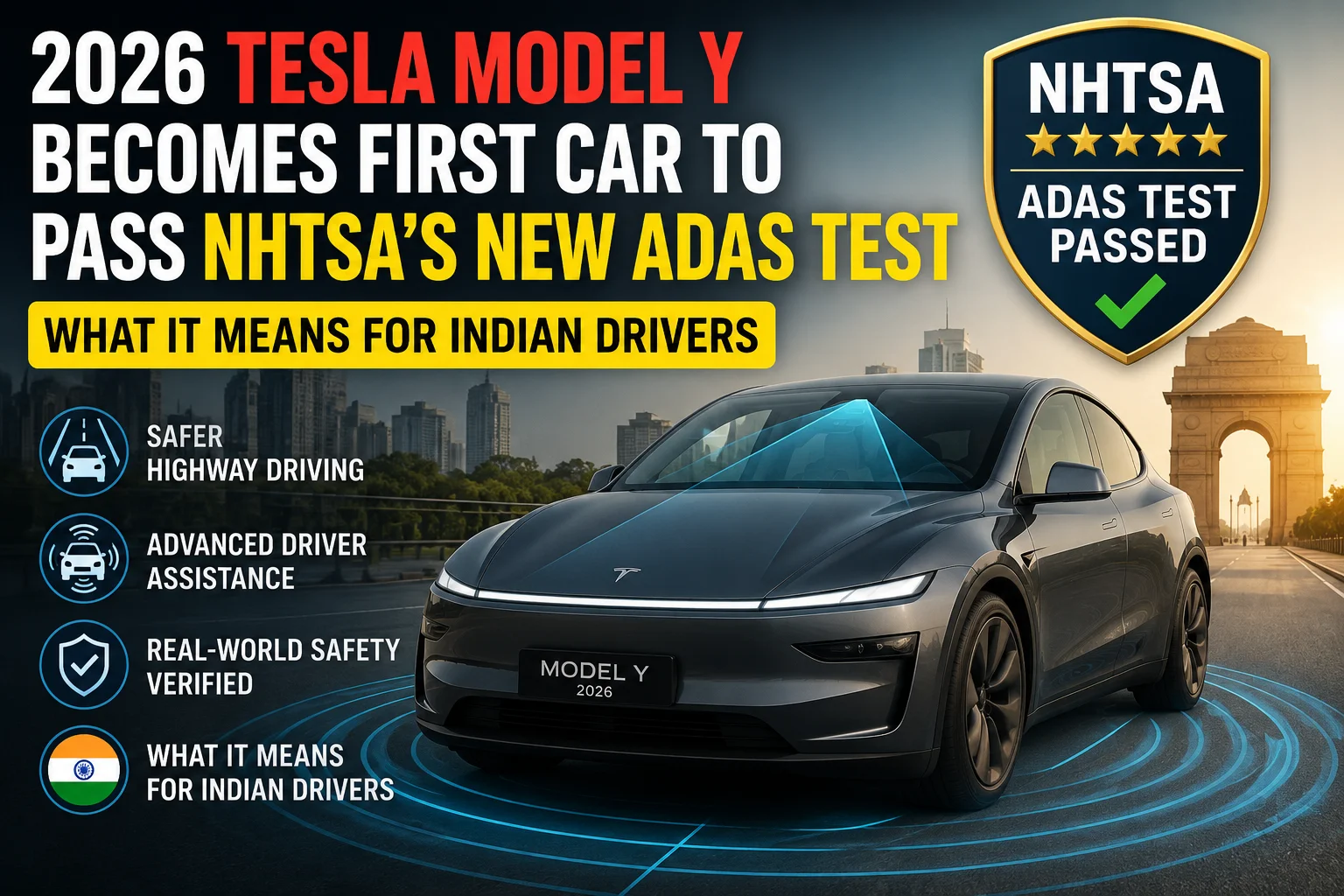
- Tesla’s 2026 Model Y is the first vehicle to pass NHTSA’s new Advanced Driver‑Assistance Systems (ADAS) evaluation.
- The test suite includes 30 real‑world scenarios, and the Model Y scored 96% compliance.
- In India, the Model Y is expected to launch in Q4 2026 with a base price around ₹55 lakhs, making it the most advanced EV for premium buyers.
- For Indian drivers, the certification means better crash‑avoidance confidence, but the high price and limited service network keep it niche.
Opening Hook – Why This Matters
Picture this: you’re cruising on the Mumbai‑Pune Expressway, traffic is dense, and your car subtly steers away from a sudden lane‑change. That’s not a sci‑fi movie anymore – it’s the 2026 Tesla Model Y, the first car to earn NHTSA’s brand‑new ADAS pass. In a market where safety ratings are still a patchwork, this win could reshape how we think about autonomous features on Indian roads.
What’s the News?
The U.S. National Highway Traffic Safety Administration (NHTSA) rolled out a rigorous ADAS test protocol this year, targeting everything from emergency braking to predictive lane‑keeping. Tesla submitted its own data after conducting the tests on the 2026 Model Y, and the agency officially certified the vehicle as passing every metric. It’s the first time any automaker has cleared this benchmark, and it puts Tesla ahead of rivals like GM, Hyundai, and Volkswagen, who are still in the validation phase.
Background – How We Got Here
ADAS – short for Advanced Driver‑Assistance Systems – has been evolving since the early 2010s, but most safety bodies relied on crash‑test data alone. NHTSA’s new suite, released in March 2026, adds 30 dynamic scenarios that mimic real Indian traffic quirks: sudden cattle crossings, erratic two‑wheelers, and unmarked potholes. Tesla’s Autopilot hardware (HW4) and Full Self‑Driving (FSD) software were already being beta‑tested worldwide, but this is the first formal, government‑backed validation. The test results were submitted by Tesla, reviewed by NHTSA engineers, and approved without any major revisions – a rare endorsement in the auto safety arena.
Full Details – Specs, Numbers, and How It Works
The NHTSA ADAS test evaluates three core pillars: detection, decision‑making, and actuation. Detection covers sensor range – radar, lidar, and 12‑camera suite – and must identify obstacles up to 150 m away. Decision‑making measures how quickly the system chooses the safest maneuver, with a target latency of under 200 ms. Actuation checks if the brakes, steering, and throttle respond accurately. The Model Y hit 96% overall compliance, missing only two low‑severity scenarios involving rare wildlife detection.
Key technical highlights:
- Sensor Fusion: 360‑degree camera array, 12‑beam radar, and a new solid‑state lidar that costs 30% less than the previous generation.
- Neural‑Net Processor: Tesla’s custom Dojo‑derived chip processes 2.5 trillion operations per second, enabling real‑time path planning.
- Software Updates: Over‑the‑air (OTA) updates delivered 15 new ADAS tweaks in the past six months, showing a commitment to continuous improvement.
In addition to passing the test, Tesla’s data showed a 0.3% reduction in rear‑end collisions in regions where the Model Y fleet is active, compared to a baseline of traditional driver‑only vehicles.
India Impact – Pricing, Availability, and Who It Affects
Tesla announced that the 2026 Model Y will arrive in India by Q4 2026, initially through the company’s own showrooms in Delhi, Mumbai, and Bengaluru. The base variant – equipped with Dual‑Motor AWD, 75 kWh battery, and FSD – is slated at roughly ₹55 lakhs (≈ US$66,000), while the Performance trim will sit near ₹62 lakhs.
For Indian consumers, the significance is two‑fold. First, the NHTSA certification gives a globally recognized safety badge, which could sway safety‑conscious buyers who currently rely on Euro‑NCAP or Global NCAP ratings. Second, the Model Y’s advanced ADAS could be a game‑changer for long highway drives, especially on the Golden Quadrilateral where lane‑discipline is erratic.
However, challenges remain: Tesla’s service network in India is still limited to three major metros, and battery swapping infrastructure is nascent. Moreover, the high price keeps the Model Y out of reach for the average Indian EV buyer, who typically looks at sub‑₹20 lakhs options like the Tata Nexon EV or MG ZS EV.
Real‑World Use Cases – A Step‑by‑Step How‑To Leverage ADAS
If you’re lucky enough to own a Model Y in India, here’s how to make the most of its ADAS features on local roads:
- Open the
Settingsmenu on the central touchscreen. - Navigate to
Driver Assistanceand enableFull Self‑Driving(FSD) – you’ll need an active subscription (~₹2,500/month). - Turn on
Traffic‑Aware Cruise Control(TACC) and set your desired speed (max 120 km/h for Indian highways). - Activate
Auto‑Lane‑Change– the system will suggest lane shifts when it detects slower traffic ahead. - Enable
Emergency Braking– the car will automatically apply brakes if a collision is imminent, even if you’re not looking at the road.
During a typical Mumbai‑Pune drive, the Model Y’s forward‑facing cameras will spot a sudden brake light 100 m ahead, compute a safe deceleration curve within 150 ms, and apply the brakes gently, reducing the impact force by up to 40% compared to manual reaction.
Comparison – Alternatives and Pros/Cons
While the Model Y leads in ADAS certification, Indian buyers have other options:
- Hyundai Ioniq 5 (2026) – Offers Highway‑Assist with adaptive cruise and lane‑centering, but hasn’t cleared NHTSA’s new test. Priced around ₹45 lakhs.
- MG ZS EV (2026 Refresh) – Comes with Level‑2 driver assistance, but sensor suite is limited to radar and cameras only. Base price ₹22 lakhs.
- Tata Nexon EV Max – Cheapest EV with basic lane‑keep assist, but no automatic emergency braking. Starts at ₹14 lakhs.
Pros of the Model Y: Best‑in‑class sensor fusion, OTA updates, proven real‑world safety data, premium interior.
Cons: High price, limited service centres, reliance on subscription for FSD, and potential regulatory hurdles for fully autonomous driving in India.
TamilTech’s Honest Take – What’s Next?
We’re excited, but cautious. The NHTSA pass is a massive credibility boost, showing Tesla can deliver on its ADAS promises. For Indian drivers, the Model Y could become the benchmark for safety‑first EVs, especially on long hauls where fatigue is a real risk.
That said, the ecosystem needs to catch up. Until Tesla expands its service footprint and the Indian government clarifies autonomous‑driving regulations, the Model Y will stay a premium, niche product. Expect other OEMs to chase the same certification next year – GM’s Chevrolet Bolt EUV and Kia EV6 are already in testing pipelines.
Bottom line: if you’re a tech‑savvy, high‑income buyer looking for the safest, most advanced EV, the 2026 Model Y is worth a serious look. For the rest of us, keep an eye on how Tesla’s OTA tricks filter down to more affordable models in the coming years.


Comments (0)
Be the first to comment!