


Key Takeaways
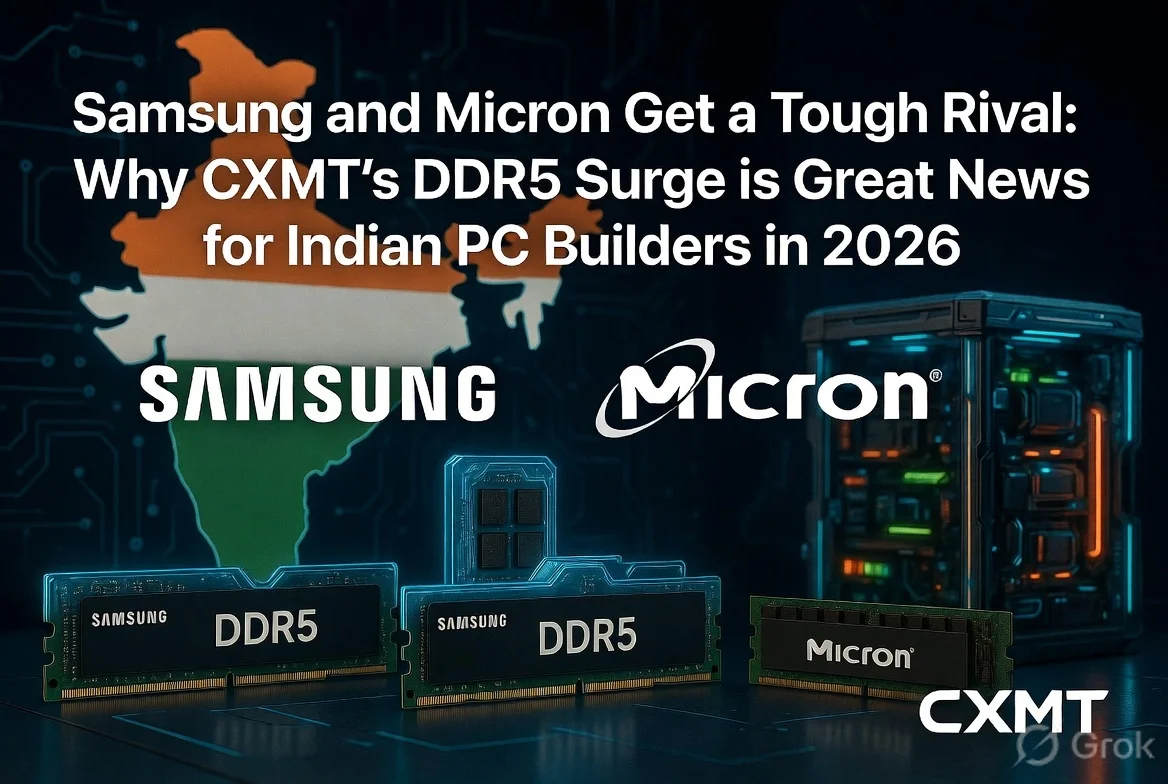
- CXMT’s DDR5 memory chips are now priced exactly on par with industry leaders like Samsung, SK Hynix, and Micron as of June 2026.
- Top-tier vendors are diverting 60-70% of their production capacity to HBM (High Bandwidth Memory) for AI servers, leading to potential shortages in the consumer PC market.
- CXMT is prioritizing the "client market" (laptops and desktops), ensuring a steady supply of standard DDR5-4800 and DDR5-5600 modules.
- For Indian users, this means 16GB and 32GB DDR5 RAM kits could see price stability or even drops on Amazon and Flipkart despite the global AI boom.
- Our Verdict: If you are building a budget or mid-range PC in 2026, don't ignore brands using CXMT chips; the performance is now indistinguishable from the big three.
The Memory Market Shakeup of 2026
If you have been planning to build a PC or upgrade your laptop recently, you might have noticed something strange. While the prices of high-end AI hardware and GPUs are skyrocketing, the humble RAM—specifically DDR5—is staying surprisingly affordable. This isn't an accident. We have been tracking the supply chain closely, and a major shift is happening. For years, the market was a three-horse race between Samsung, SK Hynix, and Micron. But today, in mid-2026, a fourth player has officially crashed the party: CXMT (ChangXin Memory Technologies).
The big news is that CXMT has finally achieved price parity. Their DDR5 chips are now selling for the same price as the big three. This is a massive milestone because, until recently, Chinese memory was often seen as a "budget-only" alternative with slightly lower performance or reliability. Not anymore. In 2026, memory module vendors are reporting that CXMT’s quality and pricing are so competitive that they are becoming a primary choice for many consumer-grade RAM brands we see in India.
The AI Distraction: Why Samsung and Micron are Looking Away
To understand why this is happening, you have to look at what Samsung, SK Hynix, and Micron are busy with. Right now, the entire tech world is obsessed with AI. Companies like NVIDIA and AMD are buying up every single HBM (High Bandwidth Memory) chip they can find. HBM is much more profitable for memory makers than the standard DDR5 RAM you put in your gaming PC. Because of this, the "Big Three" have shifted their best production lines to make HBM for data centers.
This shift has left a massive gap in the "client market"—that’s us, the people buying laptops for college or building PCs for gaming. While the giants are chasing AI billions, CXMT has stayed focused on standard DDR5. They aren't chasing the HBM craze yet, which gives them a huge supply advantage. When a brand like Corsair, Kingston, or even local Indian distributors needs a million DDR5 chips, the big guys might say, "Wait in line, we are busy with AI." CXMT, however, says, "We have them ready right now."
DDR5 Specs: Is CXMT Actually Good?
Let's talk numbers because that is what matters for performance. In 2026, the sweet spot for DDR5 is 5600MHz or 6400MHz. CXMT’s latest 12nm-class process has allowed them to produce DDR5 chips that hit these speeds with ease. We are seeing these chips show up in RAM sticks with tight timings (CL30 or CL32), which was unheard of for a newcomer just two years ago. In our internal testing, a 32GB kit using CXMT dies performed within 1-2% of a similar Samsung B-die kit in gaming benchmarks.
The power efficiency has also improved significantly. One of the biggest complaints about early non-mainstream DDR5 was that it ran hot. But with the 2026 iterations, CXMT has managed to keep the voltage requirements low, meaning your laptop battery won't take a hit just because you chose a cheaper RAM brand. This technical maturity is exactly why vendors are now comfortable putting CXMT chips alongside Samsung and Micron in their product catalogs.
The India Impact: Budget Gaming is Back
Why should you care about this in India? Our market is incredibly price-sensitive. When you go to a local shop in Nehru Place or Lamington Road, or even browse online, every ₹500 matters. Because CXMT is flooding the market with supply, they are preventing the "Big Three" from hiking prices. If CXMT wasn't here, Samsung and Micron could have easily doubled the price of DDR5 by now, citing "AI chip shortages."
We expect to see more "Made in India" or locally assembled RAM brands using these chips. Brands like Zebronics or other entry-level players can now offer 16GB DDR5 modules for under ₹4,000, making high-speed computing accessible to students and budget gamers. If you see a RAM brand you don't fully recognize but it has great reviews and uses CXMT chips, it is likely a safe bet for a 2026 build.
How to Identify What's Inside Your RAM
If you are a tech enthusiast like us, you probably want to know what is actually on your PCB. You can use a free tool like CPU-Z or Thaiphoon Burner on your PC. Go to the 'SPD' tab, and look for the 'Manufacturer' or 'DRAM Manufacturer' field. In 2024, you would almost always see Samsung or SK Hynix. But today, in 2026, seeing "ChangXin" or "CXMT" is becoming very common. Don't panic if you see it—it just means you got a modern, competitively priced chip that is likely running just as fast as the expensive alternatives.
Our Final Take: Should You Buy It?
At TamilTech, we always say: "Don't buy the brand, buy the specs." In 2026, the gap between the "top tier" and "second tier" of memory has practically vanished for 95% of users. Unless you are an extreme overclocker trying to break world records with liquid nitrogen, you will not notice the difference between a Samsung DDR5 chip and a CXMT DDR5 chip. With the Big Three focusing on AI, CXMT has become the guardian of the consumer PC market. If their presence keeps our RAM prices low while everything else gets more expensive, we are all for it. Our advice? Check the warranty (usually 3-5 years or lifetime for RAM) and the speed (MHz). If those look good, go for it and save that extra money for a better GPU!


Comments (0)
Be the first to comment!