


Key Takeaways
- Ola Electric’s board has approved up to Rs 1,500 crore capital raise through equity shares or convertible securities, with the nod coming on September 5, 2026.
- COO Hyun Shik Park has resigned, exiting the day-to-day operator role at Bhavish Aggarwal’s two-wheeler empire.
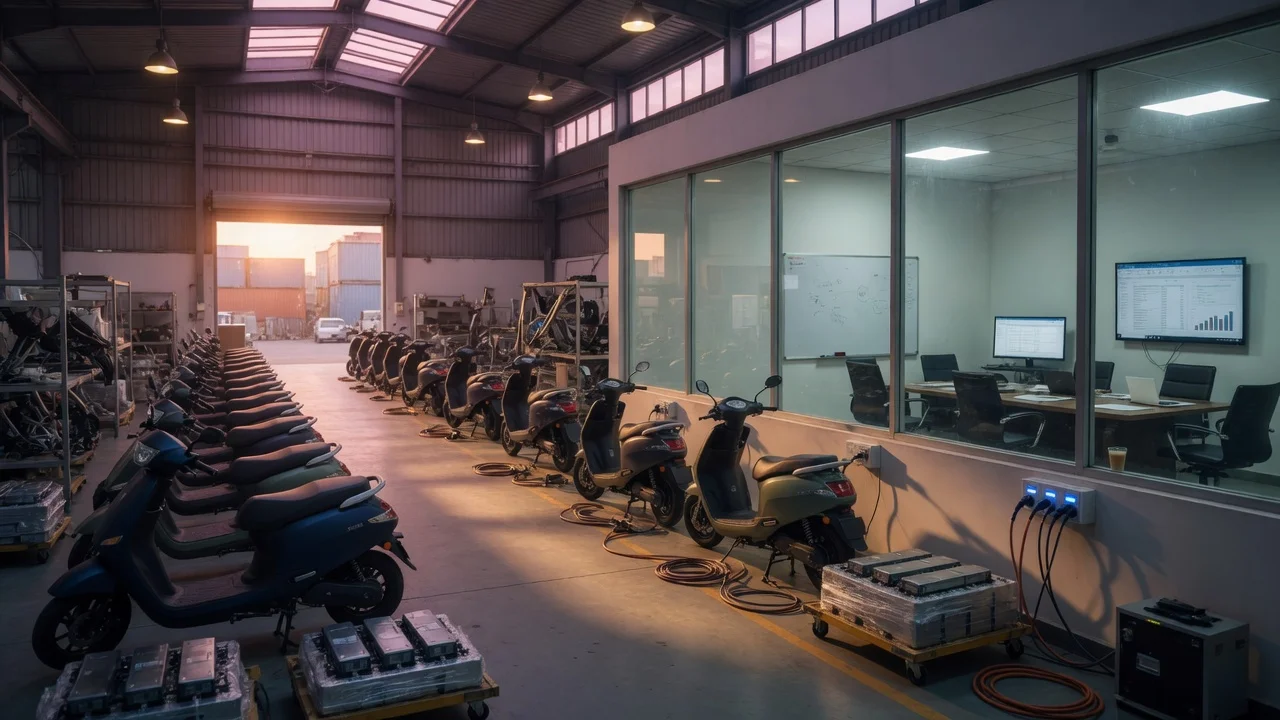
- The fresh pool of capital is likely aimed at production scaling at the Krishnagiri facility, inventory cleanup, and a long-awaited listing.
- Existing shareholders face dilution risk if the raise leans on fresh equity rather than convertible debt.
- Rivals such as Ather Energy, TVS, and Bajaj Auto are likely watching to gauge Ola’s financial sharpness.
What's the news
Ola Electric is moving ahead with a major fundraise. The board signed off on raising up to Rs 1,500 crore on September 5, 2026. The company can use equity shares or convertible securities. The methods include a further public offer, rights issue, qualified institutional placement, or private placement. This is the classic pre-IPO dance every startup does when it thinks the window is open.
And then there is the leadership shake-up. COO Hyun Shik Park has resigned. Park was the person translating Bhavish Aggarwal’s big ideas into daily manufacturing targets. His exit is unusual because it does not usually happen right before an equity raise. It could be a friendly departure, a parting of ways over strategy, or simply the pressure of running an assembly line in Krishnagiri. In startup lore, when a COO leaves and a mega-raise lands in the same breath, the market smells a reset.
Details
Let us look at the numbers. 1,500 crore is serious money. For a company that has already sold thousands of S1 Pro and S1 Air units, this is not survival cash; it is expansion cash. The balance sheet will feel lighter if the money reaches suppliers who have been waiting months. It also means Ola can buy components in bulk before global commodity prices spike again.
The board approved two instruments: equity shares or convertible securities. Equity is fresh stock sold to new owners. It brings cash into the door but dilutes existing ownership. Convertible securities are different. They are debt instruments that lenders can later swap for equity. This is a tactical choice. Ola gets cash today without giving away too much control immediately, but the conversion pressure builds for future shareholders.
A public offer would open the door to retail investors across India. A rights issue gives existing shareholders first rights to participate. Both are transparent but slow. A QIP or private placement targets a few large institutions. It is fast but concentrates power in fewer hands.
Park’s resignation also raises questions about succession. Ola has cycled through leadership since it pivoted from ride-hailing to two-wheelers. Each shift was supposed to fix a broken floor. If the new COO is not handpicked by the funders, that could be the first test.
India impact
For Indian roads, Ola Electric is a household name in the EV segment. It is not just a startup; it is a symbol of the two-wheeler EV wave. If this Rs 1,500 crore actually flows to the factory, the Krishnagiri plant stays busy and thousands of workers keep their salaries under the government’s PLI scheme.
Competition is breathing down its neck. Ather Energy owns the premium mindshare. TVS is pushing the iQube through its deep dealer network. Bajaj is not sitting idle either. Any sign of weakness at Ola is an open door for rivals. The fundraise window sends a clear message to the market: Ola is sharpening its weapons before a potential listing.
Consumers could see faster deliveries and better stock availability if the money fixes the supply chain headaches that plagued Ola in recent quarters. Service networks may get back on track. UPI payments for charging and maintenance could also gain momentum if Ola cuts deals with network operators. The ripple effect of a funded Ola reaches far beyond its balance sheet.
Use cases
First, production scaling. Capital allows double shifts, more buffer inventory for spare parts, and fewer months spent waiting on international component orders. That directly benefits buyers who have paid a deposit and are staring at a delayed delivery date.
Second, battery and R&D. Ola has been talking about its own cells for years. Money can buy better raw material contracts and fast-track pilot lines for higher-density packs or better thermal management. The result is longer range and fewer safety worries on Indian summer roads.
Third, geographic expansion. A funded company can open experience centres in tier-2 and tier-3 cities that it currently reaches only through online leads. It can also upgrade service contracts in semi-urban zones where mechanics are scarce but demand is rising fast.
Fourth, digital and IoT. While no official partnership is confirmed, startups with this kind of cash often explore telematics, over-the-air updates, and remote diagnostics. If that happens, owners get software that does not rely on third-party apps.
Fifth, network stability. Working capital ensures service partners do not drop out. A stable network means smoother UPI-based payments for maintenance and parts, which is a big deal in a country where cash and digital still coexist.
Honest take
Let us be real. Ola Electric is in a tough spot that many competitors would envy. The brand is famous, but execution has been messy. A Rs 1,500 crore raise is not a flex; it is a lifeline. The company has burned through capital to build its FutureFactory and to keep the service lights on.
When a COO resigns while a mega-fundraise is announced, there are two stories. One is that the COO cashed out and the new funders wanted a different operator. The other is that the leadership sold out under real pressure. We do not have inside information, so both readings are valid.
What matters is what the money does next. If it lands on factory lines, battery cells, and software fixes, ordinary Indian buyers win. If it goes to pay off prior debts and existing investors, it is just a rerouting exercise. Bhavish Aggarwal’s visibility helps sell units, but unit sales without supply chain health do not last long.
The next 12 to 18 months will tell us whether this funding saved the company or just delayed the crash. The paper is signed. The COO has left. The capital is approved. What happens on the factory floor is still uncertain.

Comments (0)
Be the first to comment!