


Key Takeaways
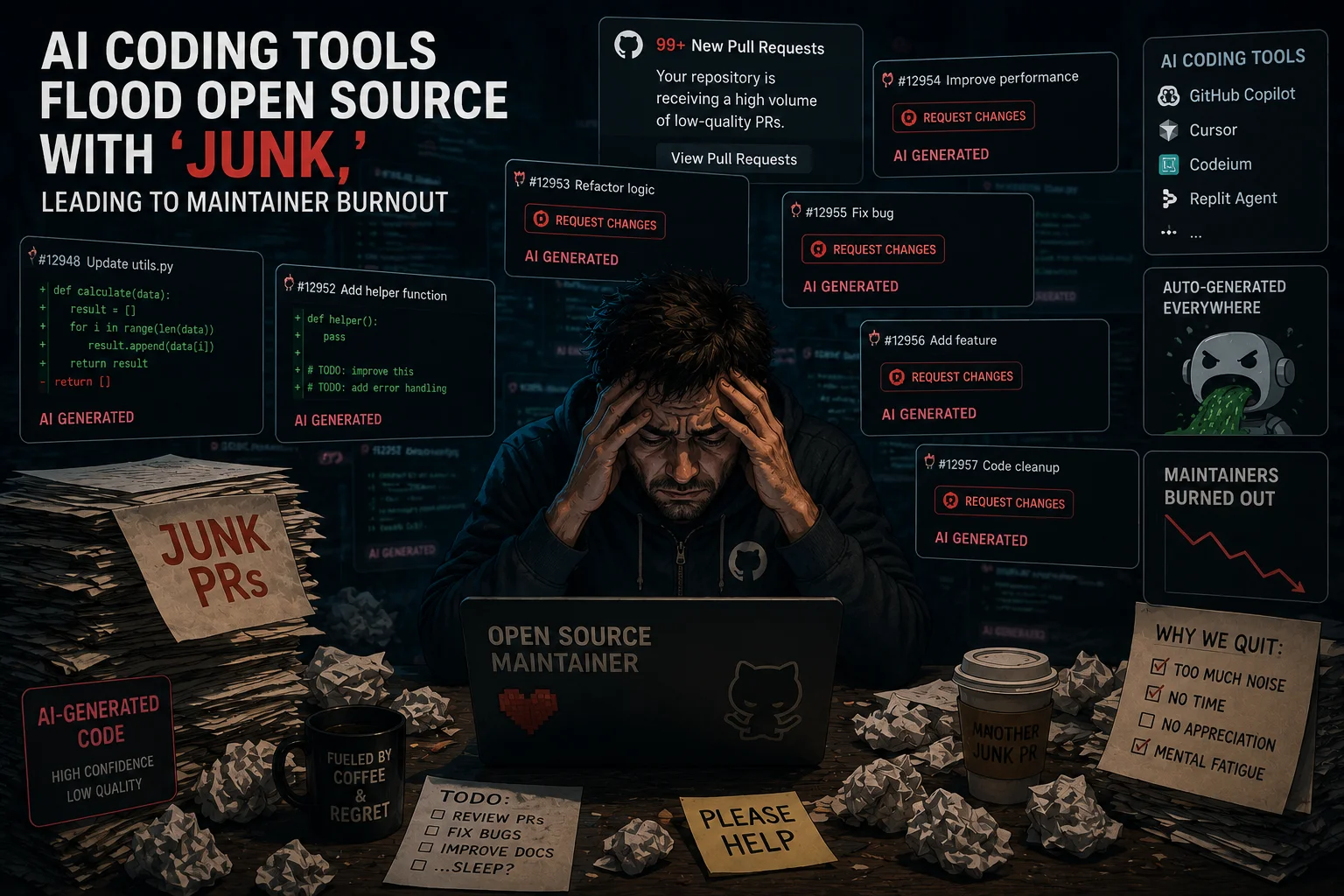
- Over 60% of open-source maintainers report a significant increase in low-quality Pull Requests (PRs) generated by AI tools this year.
- AI-generated code often contains 'hallucinations'—functions that don't exist or security vulnerabilities that are hard to spot.
- In India, the pressure for 'GitHub Green Squares' to land tech jobs is driving students to submit thousands of automated, low-value contributions.
- Major projects are now implementing 'AI-Contribution Policies' to block or strictly vet any code not written by a human from scratch.
The AI Revolution's Dark Side
We’ve been talking about how AI is going to make everyone a programmer. In 2026, that dream has partially come true. With tools like GitHub Copilot, Cursor, and various LLMs, anyone can generate a thousand lines of code in seconds. But here is the problem: just because you can generate code doesn't mean you should ship it. Open-source projects, the very foundation of the internet, are currently drowning in what maintainers are calling 'AI Slop.' It’s like someone sending a thousand AI-written letters to a busy office and expecting a personalized reply to each one.
The issue isn't the AI itself, but how people are using it. Instead of using these tools to learn or solve complex problems, a new wave of 'developers' is using them to spam repositories with minor, often incorrect, changes just to boost their profile stats. This isn't just a minor annoyance; it’s a systemic threat to how software is built and maintained globally. We are seeing a massive shift where the quantity of contributions is skyrocketing, but the quality is hitting rock bottom.
The 'One-Click' Pull Request Nightmare
How did we get here? A few years ago, contributing to a project like React or Linux meant spending weeks understanding the codebase. You had to find a bug, reproduce it, and write a clean fix. Today, you can just point an AI agent at a 'Good First Issue' tag and tell it to 'fix this.' The AI generates a Pull Request (PR) in seconds. The user, often not fully understanding the code, hits 'Submit.' Multiply this by ten thousand users, and you have the current state of GitHub in 2026.
Maintainers, who are mostly volunteers working for free, now have to spend hours every day filtering out these low-effort submissions. Many of these AI-generated PRs look correct at a glance but fail in edge cases or, worse, introduce subtle security bugs. The mental load of reviewing code that the author didn't even write themselves is causing a massive burnout crisis. We’re seeing legendary developers simply walking away from projects they’ve managed for a decade because they can't handle the noise anymore.
The India Angle: The Race for 'Green Squares'
This problem hits home specifically in India. With the tech job market being more competitive than ever in 2026, engineering students are under immense pressure to show an active GitHub profile. Recruiters often look at the 'Contribution Graph'—those little green squares—as a proxy for talent. This has led to a culture where students use AI to make hundreds of meaningless 'documentation updates' or 'refactors' just to keep their streak alive. I’ve seen profiles with 365 days of activity where not a single line of logic was actually thought through by the human owner.
This 'resume padding' is backfiring. Top-tier companies like Zoho, TCS, and global giants are starting to ignore GitHub stats entirely because they are so easily faked now. If you're a student reading this, understand that one high-quality, human-written contribution is worth more than a thousand AI-spammed PRs. Maintainers are starting to 'blackball' users who submit AI-generated junk, which could actually ruin your career prospects instead of helping them.
Hallucinations and Security: The Real Danger
It’s not just about 'bad' code; it’s about dangerous code. AI models in 2026 still suffer from hallucinations. They might suggest a library that doesn't exist (which hackers then create to inject malware) or use deprecated functions that have known security holes. When a human writes code, they usually search StackOverflow or documentation and understand the context. When an AI generates it, it's just predicting the next token. If a maintainer misses one of these AI-introduced vulnerabilities, the entire software supply chain is at risk. We are talking about potential leaks in banking apps, government portals, and everyday tools we rely on.
How to Use AI Coding Tools Correctly
Look, we at TamilTech aren't saying 'don't use AI.' We use it too! But there's a right way to do it. If you want to contribute to open source using AI, follow these steps: First, use the AI to explain the existing code to you, not to write the fix. Second, once you think you have a solution, write the code yourself. Third, use the AI to 'Review' your code for bugs before you submit it. This way, you are the pilot and the AI is just the co-pilot. Never, ever submit code that you cannot explain line-by-line to someone else. That is the golden rule of 2026 programming.
TamilTech’s Verdict
Open source is a community built on trust. AI is currently eroding that trust. If we don't change how we interact with these tools, we might see the end of the 'open' era, with projects moving to private, invite-only models to escape the spam. Our take? GitHub and other platforms need to introduce 'AI-Generated' labels and better filtering tools immediately. For developers, the message is clear: AI is a tool for productivity, not a shortcut for thinking. The real value in 2026 isn't in writing code—it's in understanding it. Stay smart, keep learning, and don't be a part of the 'AI Slop' problem.





Comments (0)
Be the first to comment!