


Key Takeaways
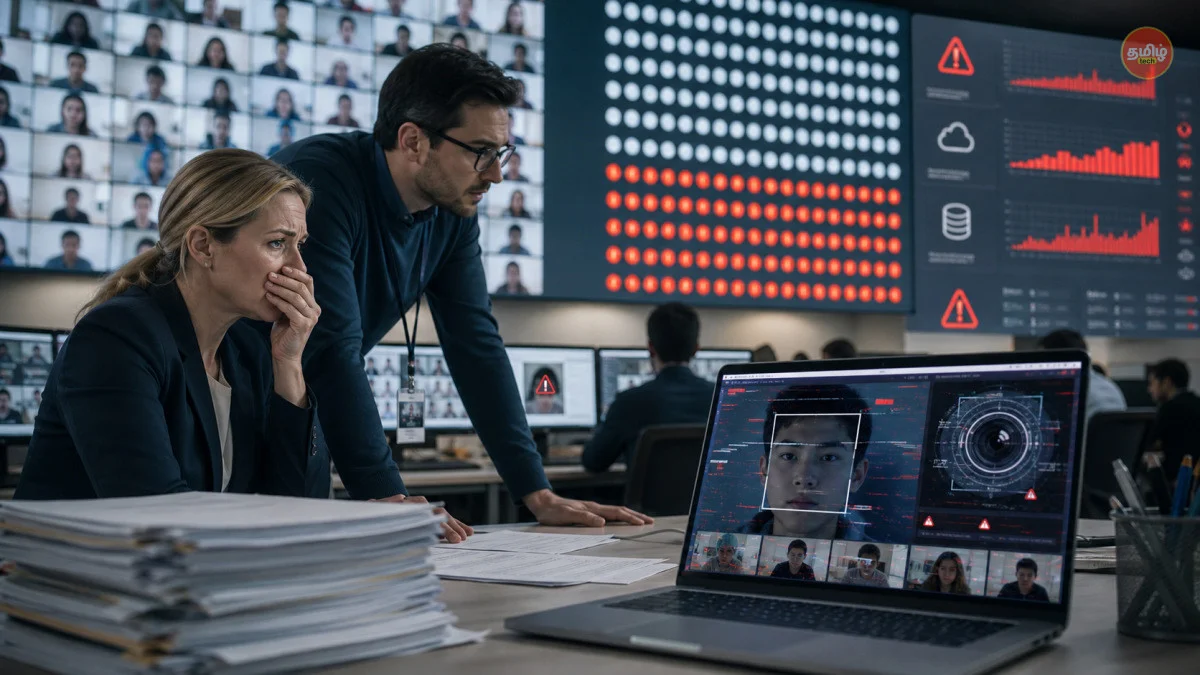
- A total of 58,000 students have been ordered to retake their final examinations after an AI-based remote proctoring system failed.
- The AI software incorrectly flagged thousands of students for 'suspicious behavior' due to lighting changes, background noise, and even blinking patterns.
- Technical glitches and server overloads caused the AI to crash mid-exam for nearly 15% of the candidates.
- This incident highlights the massive 'trust gap' in AI education tools and serves as a warning for Indian competitive exam boards.
The Nightmare Every Student Fears
Imagine this: You’ve spent the last six months buried in books, surviving on coffee, and skipping weekend hangouts to prepare for the most important exam of your life. You sit down in front of your laptop, finish the paper, and breathe a sigh of relief. But a week later, you get an email saying your results are void and you have to do it all over again. Why? Because an AI algorithm thought you were cheating when you were actually just adjusting your glasses or looking at the ceiling to think. This isn't a sci-fi movie plot; it’s a reality for 58,000 students right now in 2026. This massive failure has sparked a global debate on whether we are handing over too much power to machines that don't understand human behavior.
The scale of this disaster is unprecedented. We are not talking about a small classroom test; we are talking about a high-stakes professional certification that affects careers and livelihoods. The fallout has been so severe that the authorities had no choice but to scrap the entire session. For the students, it’s not just about the extra work; it’s about the mental trauma of having to prove their integrity to a piece of code that couldn't tell the difference between a cheat sheet and a shadow on the wall. At TamilTech, we’ve always said that technology should assist humans, not blindly replace them, and this incident is the perfect example of why.
How Did We Get Here? The Rise of AI Proctors
To understand what went wrong, we need to look at how we got here. Since the early 2020s, the world has been obsessed with moving everything online. Remote exams became the norm, but there was one big problem: how do you stop people from cheating? Hiring thousands of human proctors to watch students via webcam is expensive and hard to manage. Enter AI proctoring. By 2024 and 2025, companies were selling 'Advanced AI Supervisors' that promised to track eye movements, detect unauthorized devices, and even analyze 'stress levels' to catch cheaters. It sounded like the perfect solution for scaling education.
By 2026, these systems became the standard. Schools and universities globally started using them for everything from weekly quizzes to final degrees. The promise was simple: 'Unbeatable security with zero human bias.' But as we’ve seen, AI has its own set of biases. These systems are trained on datasets that often don't account for the diversity of real-world environments. If your room is too dark, the AI thinks you’re hiding something. If you have a habit of reading questions out loud to yourself, the AI flags it as 'communicating with an external person.' We’ve moved from human supervision to 'algorithmic policing,' and the transition has been anything but smooth.
The Technical Breakdown: What Actually Failed?
So, what exactly happened in this specific case? According to our analysis, it was a 'perfect storm' of technical failures. First, the AI’s sensitivity was tuned too high. The algorithm was instructed to flag any 'anomaly' in the video feed. This included things as simple as a pet walking into the frame, a family member talking in the next room, or the student looking away from the screen for more than three seconds. Because the AI didn't have a 'human-in-the-loop' to verify these flags, it automatically marked thousands of sessions as 'high risk.' When the human reviewers eventually checked the flags, they realized the AI had flagged over 40% of the entire student population. It was impossible to manually verify that many cases.
Second, there was a massive server-side crash. With 58,000 students logging in simultaneously, the AI’s real-time processing requirements overwhelmed the infrastructure. The system started lagging, which caused the AI to misinterpret the lag as 'video tampering.' Imagine being a student and seeing your screen freeze, only for the AI to record that freeze as an attempt to hack the system. This technical incompetence is what forced the authorities to declare the entire exam invalid. It wasn't just a software bug; it was a total systemic collapse of the testing environment.
The India Context: Is Our Exam System Safe?
This news should be a massive wake-up call for us in India. In 2026, we are seeing more Indian competitive exams—from bank exams to university entrances—moving toward remote or hybrid models. While we have giants like TCS iON handling massive loads, many private ed-tech firms and universities are adopting cheaper, third-party AI proctoring tools. If a global exam with 58,000 students can fail this badly, imagine the chaos if this happened during a JEE or a UPSC-level remote assessment. In India, factors like fluctuating internet speeds and power cuts are already huge challenges. Adding a 'trigger-happy' AI to the mix is a recipe for disaster.
We also need to talk about the 'digital divide.' In India, not every student has a dedicated, quiet, well-lit room to take an exam. Many students in rural areas might be taking exams in shared spaces. If an AI is programmed to flag noise or movement, these students are unfairly penalized. We’ve already seen reports of students being flagged because they were using a fan that made noise or because their lighting wasn't 'studio quality.' If we don't fix these biases, AI proctoring will become a tool that only works for the wealthy, while the rest of the country suffers from 'false positives.'
Real-World Impact: The Human Cost
Beyond the technical jargon, there is a real human cost to this. 58,000 students now have to put their lives on hold. Job offers that were contingent on passing this exam are being rescinded. Graduation ceremonies are being delayed. The level of anxiety this causes is immeasurable. Students have reported feeling 'watched' and 'hunted' by the software. Instead of focusing on the complex math or science problems in front of them, they were more worried about whether their eye movements would trigger an alarm. This is not a healthy environment for learning or assessment.
Furthermore, the 'retake' isn't free. Even if the exam fee is waived, students have to spend more on travel, internet data, and time away from work. For many, the mental exhaustion of preparing for the same exam twice is enough to make them quit. This incident has damaged the reputation of the institution involved so badly that it might take years to recover. It proves that in our rush to automate everything, we forgot to ensure that the automation is actually reliable and fair.
Our Take: AI is a Tool, Not a Judge
Here at TamilTech, we are big fans of AI. We use it for editing, research, and coding. But there is a clear line that shouldn't be crossed. AI should be a tool that helps a human proctor, not the final judge, jury, and executioner. A human proctor can see that a student is just nervous and sweating, whereas an AI might flag that sweat as a sign of 'deceptive behavior.' We believe that 'Hybrid Proctoring' is the only way forward. AI can flag potential issues, but a human must be the one to make the final call after reviewing the context.
What should you do if you’re a student facing an AI-proctored exam in 2026? First, ensure your environment is as 'AI-friendly' as possible—good lighting and zero noise. Second, if you get flagged, don't panic. Document everything. Take screenshots if the system lags. Most importantly, demand that a human reviews your case. Don't let a machine's mistake ruin your career. The tech industry needs to do better, and we need stricter regulations on how these AI tools are deployed in the education sector. This 58,000-student disaster should be the last of its kind.
What Happens Next?
Looking ahead, we expect a massive wave of lawsuits against the proctoring company. This will likely lead to new laws regarding 'Algorithmic Accountability' in education. We might see a shift back to physical exam centers for high-stakes testing, or at least a much more robust human-verification process. The 'AI hype' is meeting the 'AI reality,' and it’s a painful lesson for everyone involved. For now, those 58,000 students have a long month of re-studying ahead of them. Let’s hope the next system they use is a lot smarter—or at least a lot more human.



Comments (0)
Be the first to comment!