


Key Takeaways
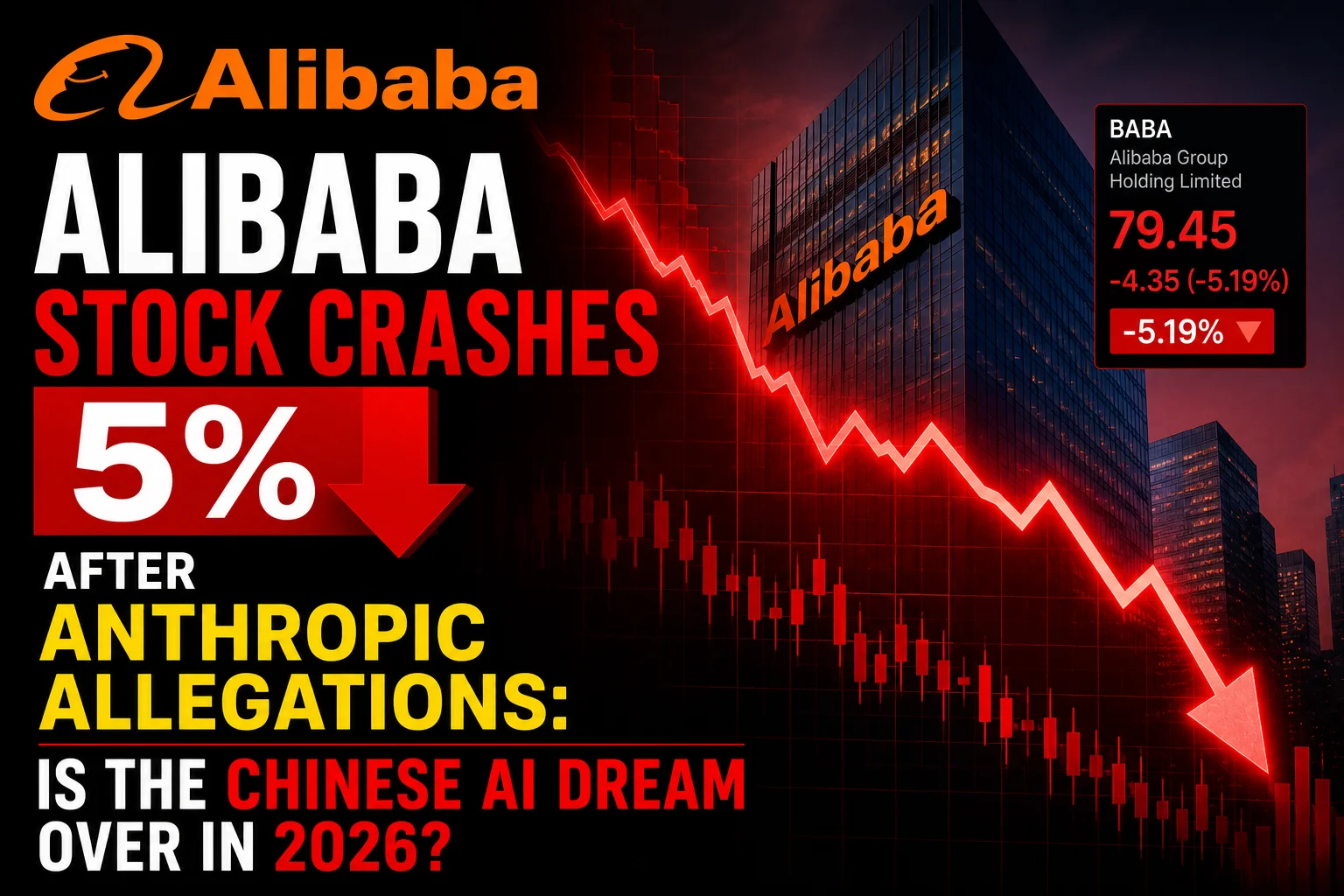
- Alibaba's stock fell nearly 5% in Hong Kong today, bringing its total year-to-date (YTD) decline in 2026 to a massive 33%.
- The crash was triggered by Anthropic accusing Alibaba of 'illicitly' accessing its proprietary AI models to train Alibaba's own LLM, Tongyi Qianwen.
- The contagion spread to other Chinese tech giants, with Baidu and Xiaomi both seeing their share prices drop by over 3% in a single session.
- For Indian retail investors holding international ETFs or tech-heavy mutual funds, this volatility signals a high-risk period for Chinese ADRs.
The AI War Just Got Ugly: Alibaba Under Fire
So, here is the thing — the global AI race has officially moved from 'friendly competition' to 'legal warfare' in 2026. Today, the Hong Kong stock market witnessed a bloodbath for Chinese tech stocks, and the catalyst wasn't a bad earnings report or a government crackdown. Instead, it was a heavy-hitting accusation from the US-based AI powerhouse, Anthropic. They've essentially called out Alibaba for 'cheating' in the AI exam. Anthropic claims that Alibaba has been 'illicitly' accessing its proprietary models to fine-tune and train its own AI systems, like Tongyi Qianwen. This isn't just a minor disagreement; it's an allegation of intellectual property theft at the highest level of technology.
When a company like Anthropic, which is backed by billions in investment and known for its strict 'AI safety' protocols, points a finger at a giant like Alibaba, the market listens. And boy, did it react. Alibaba’s stock price plummeted by nearly 5% within hours of the news breaking. If you've been tracking Alibaba this year, you know the story hasn't been great anyway. This latest dip takes their 2026 year-to-date (YTD) fall to a staggering 33%. Investors who were hoping for a 'recovery year' for Jack Ma's co-founded empire are now staring at a sea of red. It’s not just Alibaba either; the fear of potential US sanctions or legal bans on these AI models has caused a domino effect, pulling down Baidu and Xiaomi by more than 3% each.
How Did We Get Here? The 'Model Scraping' Scandal
To understand why this is such a big deal, we need to look at how AI models are built today. In 2026, the cost of training a top-tier Large Language Model (LLM) is in the billions of dollars. Companies like Anthropic spend years and massive compute power to develop their models. Anthropic’s allegation is that Alibaba didn't just 'learn' from their public research but actually bypassed security layers to access the 'weights' or the core logic of their models. Think of it like a restaurant stealing a secret recipe by hacking into the competitor's kitchen instead of just trying to recreate the dish by tasting it. Alibaba, of course, has been pushing hard to prove that its AI is on par with GPT-5 and Claude 4, but this accusation casts a massive shadow over their technical achievements.
This isn't the first time Chinese companies have been accused of using Western data to jumpstart their AI, but the scale of the Anthropic claim is what’s rattling the cages. In the past, we saw 'model distillation' where a smaller model learns from a bigger one, which is generally a grey area. But 'illicit access' implies a breach of terms of service or technical safeguards. For investors, this is a nightmare scenario. If Anthropic manages to prove these claims, we could see Alibaba’s AI services being restricted in international markets, or worse, facing a fresh wave of US export controls that could cripple their cloud computing division. The market is currently pricing in the worst-case scenario, which explains why the sell-off was so aggressive.
Numbers That Sting: 33% Down and Counting
Let’s talk numbers because they are wild. Alibaba was once the 'Amazon of the East,' but in 2026, it’s fighting for relevance in a market that is increasingly skeptical of Chinese tech. A 33% fall in less than six months is not just a correction; it’s a crisis of confidence. When you lose one-third of your market value in half a year, your ability to raise capital and invest in future tech like quantum computing or advanced robotics takes a massive hit. Baidu, which has been betting its entire future on the 'Ernie' AI bot, saw its stock slide 3.2%, while Xiaomi, which recently integrated AI deep into its EV (Electric Vehicle) ecosystem, fell 3.5%. The message from the market is clear: if your AI isn't 'clean,' your stock isn't safe.
The ripple effect is also hitting the broader Hang Seng Tech Index. Investors are worried that this is just the tip of the iceberg. If Alibaba is doing it, are others? This 'guilt by association' is what’s hurting Xiaomi and Baidu. Xiaomi, in particular, had a great start to 2026 with its SU7 Ultra car sales, but even that wasn't enough to shield it from the AI-related panic. For these companies, AI isn't just a side project anymore; it’s the core of their valuation. When the integrity of that core is questioned, the stock price becomes a house of cards. We are seeing a massive rotation of capital out of Hong Kong and into other markets like Japan or even India, where the regulatory environment feels a bit more stable for tech giants.
The India Impact: Should You Be Worried?
Now, why should you care about this in India? Well, if you have a portfolio that includes international mutual funds or ETFs like the Mirae Asset NYSE FANG+ ETF or any 'Greater China' focused funds, your money is directly in the line of fire. Many Indian retail investors have been diversifying into US and Hong Kong markets over the last couple of years to capture the AI boom. If you're holding Alibaba or Baidu through these routes, you've likely seen a significant dent in your returns this quarter. The 33% fall in Alibaba isn't just a number on a screen; it’s real wealth being wiped out for thousands of Indian investors who thought they were buying the 'dip' earlier this year.
Beyond the stock market, there’s a deeper impact on the Indian tech ecosystem. Many Indian startups use Alibaba Cloud or integrate with Chinese AI APIs because they are often cheaper than AWS or Google Cloud. If Alibaba faces legal heat or technical bans, these Indian businesses might have to migrate their entire infrastructure overnight. This is a wake-up call for Indian CTOs to look at 'sovereign AI' and local cloud providers. We've seen how quickly apps can get banned in India; imagine if the AI powering your customer service bot suddenly becomes 'illegal' or 'unsupported' due to an international IP dispute. It’s time to double-check where your AI 'brain' is actually hosted.
How to Protect Your Data: A Guide for Developers
If you are a developer or a business owner in India using these AI models, this scandal highlights the importance of data residency and model provenance. Here’s a quick checklist to ensure you don’t get caught in the crossfire. First, always check the 'Terms of Service' of the AI API you are using. Are they allowed to train on your data? Second, consider using open-source models like Llama 3 or Mistral, which you can host on your own servers in India. This gives you 100% control over the 'weights' and ensures no third party can claim 'illicit access' to your proprietary fine-tuning.
Another step is to implement robust API monitoring. If you're using a foreign AI model, keep an eye on how much data is being sent back and forth. Use tools that can anonymize sensitive customer info before it even hits the AI's server. In 2026, data is the new oil, but 'stolen data' is like toxic waste — it can destroy your reputation if you're found using it. Alibaba’s current mess shows that even the biggest players aren't immune to these risks. By keeping your AI stack transparent and locally hosted where possible, you protect your business from the volatile geopolitics of the US-China tech war.
The Comparison: Alibaba vs. Baidu vs. Western AI
When we compare the current state of Chinese AI to the West, the gap seems to be widening again. While OpenAI and Anthropic are pushing towards AGI (Artificial General Intelligence), Chinese firms are struggling with hardware limitations due to GPU export bans and now, ethical allegations. Baidu’s Ernie Bot is great for the Chinese language, but it lacks the global versatility of Claude or GPT. Xiaomi’s AI is mostly focused on 'Internet of Things' (IoT) integration, which is useful but not 'groundbreaking' in the same way. Alibaba’s Tongyi Qianwen was supposed to be the bridge, but if it was built on 'borrowed' logic, its credibility is shot.
The pros of Chinese AI have always been cost and speed. They can deploy features faster because they have fewer regulatory hurdles within China. However, the cons are now becoming glaringly obvious: lack of transparency, high geopolitical risk, and potential IP issues. In contrast, Western models are more expensive and come with more 'safety' guardrails, but they are generally seen as more reliable for enterprise use. For an Indian business, the choice used to be about 'price vs performance,' but in 2026, it’s now about 'compliance vs risk.' Most sane businesses are now leaning towards the latter, even if it costs a bit more upfront.
TamilTech’s Honest Take: What’s Next?
Honestly, we think Alibaba is in for a very rough ride for the rest of 2026. This isn't just a 'bad day' at the office; it’s a fundamental challenge to their identity as a tech leader. If they can't prove their AI is original, they lose the trust of the global developer community. We wouldn't recommend 'buying the dip' here. The 33% fall might look like a discount, but in the world of tech, a falling knife has no handle. There is a high chance of more legal filings from other US companies if Anthropic’s case gains traction. It feels like a coordinated effort to slow down China's AI progress, and Alibaba is the easiest target.
What should you expect next? Watch out for a formal response from the Chinese government. They might retaliate by accusing US firms of similar practices, leading to a 'tit-for-tat' data war. For us in India, the lesson is clear: we need to build our own. We can't keep relying on the US or China for the core 'intelligence' of our digital economy. The volatility in Hong Kong today is a reminder that when giants fight, it’s the smaller investors and dependent businesses that get crushed. Stay cautious, diversify your tech stack, and maybe keep your money away from Alibaba for a while.





Comments (0)
Be the first to comment!