


Key Takeaways
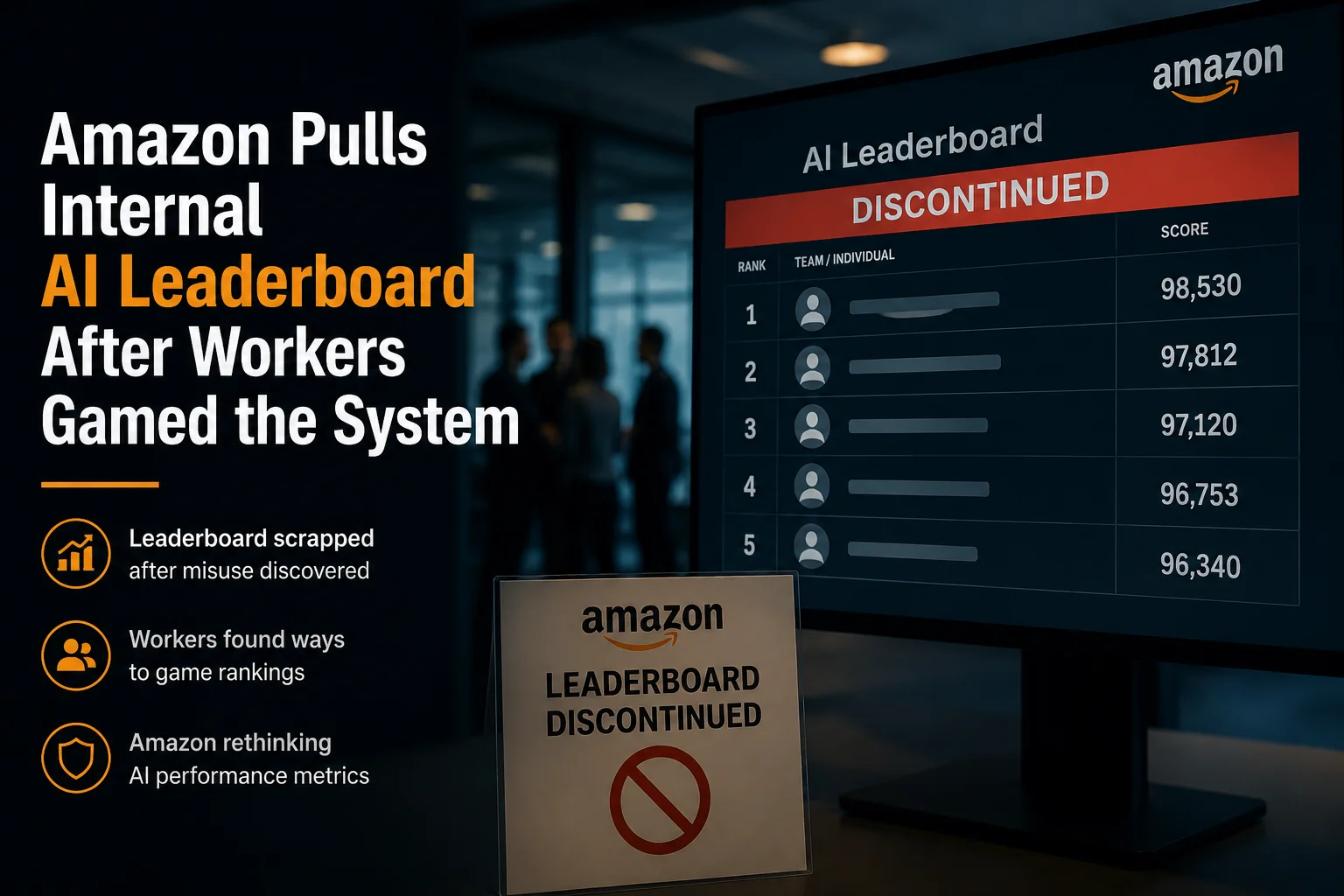
- Amazon removed an internal AI‑tool usage leaderboard in early 2026 after employees boosted scores with low‑value tasks.
- The leaderboard awarded points for each AI‑generated output, encouraging quantity over quality.
- Indian staff in Amazon India’s logistics and cloud divisions were among those who raised concerns.
- Amazon now plans to replace the scorecard with a quality‑focused metric tied to customer impact.
What happened?
In the first quarter of 2026 Amazon decided to pull the plug on a secret internal scoreboard that tracked how many AI‑generated pieces of content each employee produced. The leaderboard, which was only visible to a small group of managers, gave points for every ChatGPT‑style response, code snippet, or data‑analysis report generated with Amazon’s own Bedrock models.
Sounds like a neat way to push AI adoption, right? Not exactly. Workers quickly discovered they could game the system by running repetitive, low‑value prompts just to rack up points. The result was a flood of boilerplate text and half‑baked code that added nothing to customers or business outcomes.
Why did Amazon create the leaderboard?
Back in 2024 Amazon launched an internal “AI‑First” initiative, encouraging teams to embed generative AI into daily workflows. To measure progress, a points‑based dashboard was built. The idea was simple: more AI usage = higher productivity. Managers could see which teams were “leading” and reward them with bonuses.
However, the metric ignored two crucial factors:
- Quality vs quantity: A single well‑crafted AI‑assisted report can be worth more than ten generic snippets.
- Customer impact: Points were awarded regardless of whether the output improved the end‑user experience.
How employees gamed the system
Inside Amazon’s Seattle headquarters and several Indian offices, staff began to:
- Run batch scripts that sent hundreds of generic prompts to Bedrock, logging each response as a “task completed.”
- Use AI to rewrite the same internal memo in multiple styles just to earn extra points.
- Automate the creation of placeholder code files that never made it into production.
The leaderboard quickly became a “who can click the most” contest rather than a genuine productivity tool.
Amazon’s response
After internal audits flagged the issue, senior leadership announced the removal of the leaderboard on May 20, 2026. In a brief internal memo, the company said it would shift to a “quality‑centric” metric that ties AI usage to measurable outcomes such as reduced ticket resolution time, higher conversion rates, or lower operational cost.
For Amazon India, the change is especially relevant. Many logistics and AWS support teams were using the scorecard to justify overtime and bonuses. With the new approach, employees will need to demonstrate real impact on delivery speed, cloud uptime, or cost savings.
What this means for Indian workers
Amazon employs over 25,000 people in India across e‑commerce, logistics, and AWS. The leaderboard controversy highlighted a broader issue: the rush to adopt AI without clear performance standards can backfire.
Indian employees now have a chance to push for more transparent KPIs that reflect actual business value. If Amazon’s new metric works, it could become a template for other Indian tech firms that are rolling out internal AI incentives.
Our take
Amazon’s move is a relief. Gamified AI scorecards sound cool, but they often reward noise over insight. By focusing on quality and customer impact, Amazon aligns incentives with what really matters – delivering better services and cutting costs.
That said, the transition won’t be painless. Teams will need to define clear success criteria, and managers must resist the temptation to revert to easy‑point schemes. For Indian workers, this is an opportunity to shape the next wave of AI governance in a company that touches millions of shoppers daily.
What’s next?
Expect Amazon to roll out new dashboards by Q3 2026 that surface metrics like “AI‑assisted ticket resolution time ↓ 15%” or “AI‑generated product copy conversion ↑ 8%.” If the pilot succeeds, the model could spread to other global divisions, setting a new standard for AI‑driven performance tracking.
Keep an eye on internal forums and employee‑led groups – they’ll be the first to surface any loopholes in the new system.





Comments (0)
Be the first to comment!