


Key Takeaways
- Amazon Now, Amazon’s quick commerce arm in India, is reporting a clear sales surge as it adds dark stores and pushes 10-minute delivery.
- The Indian government continues to defend a free-UPI stance for consumers even as merchant fee talks surface from time to time.
- Quick commerce rivalry in India remains fierce, with Blinkit, Zepto, Swiggy Instamart and Flipkart Minutes all fighting for the same 10-minute window.
- UPI already underpins a massive share of everyday digital payments, so any charge discussion is politically and commercially sensitive.
- Free rails plus deep-pocketed platforms are reshaping how urban India buys milk, snacks and essentials after 10 pm.
What's the news
Amazon Now is having a moment. The company’s quick commerce push in India is scaling fast, with a visible sales surge as more dark stores come online and more pin codes get 10-minute delivery promises. For shoppers in metros and a growing list of Tier-1 cities, that means groceries, snacks, personal care and small electronics showing up before the chai cools.
At the same time, the older, quieter story around UPI charges is back in the air. India built the world’s most used real-time payment system and kept it free for end users. That choice turbocharged adoption. Every few months the merchant-side fee debate returns — who pays for the rails, should large platforms contribute more, will small shops get squeezed — while the government’s public line stays consistent: consumers should not be charged for UPI.
Put the two together and you get a very Indian tech week. On one side, a global giant pouring money into ultra-fast delivery. On the other, a public digital infrastructure that still refuses to put a toll booth on the user. Both shape how money and goods move in 2026.
Details
Amazon Now is Amazon’s answer to India’s quick commerce boom. Think mini warehouses (dark stores) stocked for speed, not assortment theatre. The promise is simple: order from the app, pay digitally, get essentials in minutes. The sales surge being talked about tracks with denser store networks, better inventory for high-frequency SKUs, and the same habit shift that lifted Blinkit and Zepto — people now treat 10-minute delivery as normal for milk, bread, batteries and late-night Maggi.
Amazon already had logistics muscle from Amazon.in. Quick commerce is a different game. It needs hyperlocal density, high order frequency, and ruthless control of last-mile cost. A sales surge helps on the revenue line; the harder question is whether contribution margins can hold once the novelty fades and every competitor matches the SLA.
On the payments side, UPI’s design choice matters. Peer-to-peer and most consumer-to-merchant flows have stayed free for users for years. The National Payments Corporation of India (NPCI), RBI guidance and successive governments treated zero consumer MDR as a feature, not a bug. That kept friction near zero and helped everyone from street vendors to Amazon checkout. When industry voices float limited charges for large merchants or value-added flows, the political instinct in Delhi has been to protect the free consumer experience first.
None of this needs invented drama. The pattern is familiar: platforms want sustainable unit economics; the state wants mass digital adoption and financial inclusion. Amazon Now’s growth sits on top of that free rail. Most quick commerce checkouts in India settle on UPI or UPI-linked wallets. Remove free UPI and you add friction exactly where impulse orders live.
Competition is not abstract. Blinkit (Zomato), Zepto, Swiggy Instamart and Flipkart Minutes are all in the same 10-minute cage fight. Reliance’s retail stack and local kirana digitisation plays add more pressure. Amazon’s advantage is brand trust, AWS-backed tech, and capital. Its challenge is proving that a global e-commerce giant can win a neighbourhood game that rewards local density and insane operational discipline.
India impact
For Indian consumers, a surging Amazon Now means more choice at 11 pm and less need to keep a fully stocked fridge. That convenience is real. It also changes footfall for neighbourhood kiranas that cannot match 10-minute SLAs on every SKU. Many small shops already accept UPI; the free rail helped them digitise. If quick commerce keeps stealing high-frequency baskets, those shops need sharper assortment, credit, and delivery of their own — or they become pickup points in someone else’s network.
Jobs shift too. Dark stores hire pickers, packers and riders. Gig work expands. Traditional retail roles get squeezed in dense urban pockets. Cities that already struggle with traffic and parking feel the extra two-wheeler load from stacked deliveries.
On payments, India’s free-UPI stance remains a strategic asset. It lowered the cost of collecting money for every app, from food delivery to insurance renewals. Amazon Now, Flipkart, JioMart and countless D2C brands all ride that rail. Keeping consumer UPI free supports volume. The open question for 2026 and beyond is how the ecosystem funds upgrades, fraud controls and merchant tools without quietly taxing the user or crushing tiny sellers with new fees.
Policy tone matters. When the government signals that consumer UPI stays free, platforms plan around high conversion. When fee rumours circulate, fintechs and large merchants lobby, and startups worry about checkout drop-offs. Clarity helps everyone — especially a quick commerce category that lives or dies on impulse.
There is also a Make-in-India and digital public infrastructure angle. UPI, Aadhaar-linked KYC and account aggregators together make onboarding and payouts cheap. Amazon Now’s India growth is not only about American capital; it sits on Indian rails that competitors abroad often envy.
Use cases
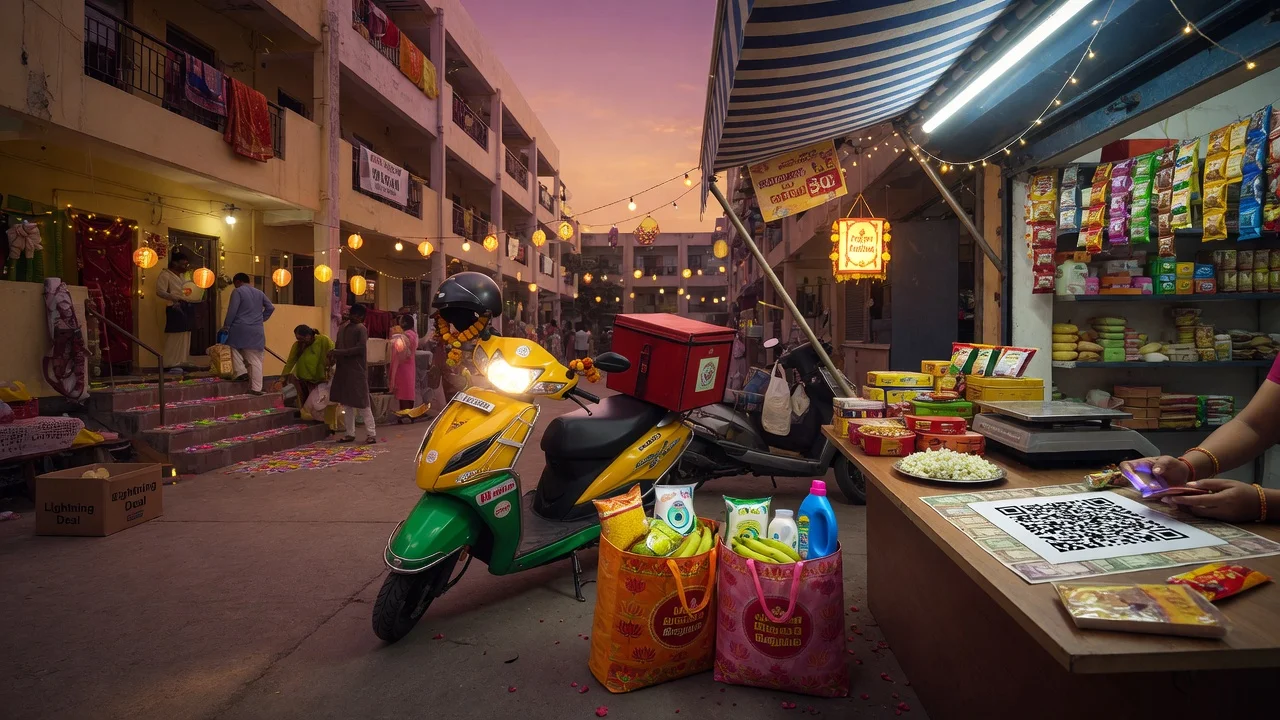
Everyday use is boring in the best way. A parent orders baby wipes and milk after the store closes. A student grabs earphones before a late class. An office team restocks snacks between meetings. Payment is usually UPI — scan, approve, done — with no extra charge on the user side. That loop is why sales can surge when dark store coverage improves: the habit already exists; supply just caught up.
Small merchants use the same free UPI to collect from walk-in customers while watching quick commerce apps eat evening demand. Some list on multiple platforms. Others double down on personal service and credit for regulars. A few partner with larger apps as mini dark stores.
For Amazon, the use case expands beyond grocery. Once the 10-minute muscle exists, high-velocity electronics accessories, beauty, pet food and OTC health SKUs fit the same model. Cross-sell from Amazon.in memberships and ads can thicken the revenue stack if the ops hold.
Banks and fintechs see rising UPI volumes from quick commerce peaks — lunch, evening, late night. That data helps credit and offer engines, again without charging the consumer per tap. The whole stack works because the rail stayed free at the user edge.
Honest take
Amazon Now’s sales surge is good news for anyone who likes convenience and for Amazon’s India narrative after years of heavy investment. It is also a reminder that quick commerce is still a brutal, capital-intensive land grab. Speed is table stakes. Profitability is the exam. Deep pockets help Amazon stay in the fight longer than a thinly funded startup, but they do not repeal the laws of last-mile physics or Indian traffic.
On UPI charges, the government’s consumer-first stance has been one of India’s smartest digital calls. Free UPI turned payments into a utility. Taxing users now would feel like putting a coin slot on drinking water. Merchant-side economics can and should be debated — large platforms can contribute to a healthy network — without breaking the zero-friction promise that made UPI a national habit.
Watch three things next. One: whether Amazon Now’s surge converts into durable market share against Blinkit and Zepto, not just a temporary promo spike. Two: whether dark store density reaches smaller cities without destroying unit economics. Three: whether any UPI fee framework that emerges stays surgically away from the consumer and the smallest merchants.
India does not need slower checkouts. It needs faster delivery that eventually pays for itself, and payment rails that stay open and cheap for the next hundred million users. Amazon can chase the first. Delhi should keep guarding the second.

Comments (0)
Be the first to comment!