


Key Takeaways
- Enterprise AI spending in 2026 has shifted from 'innovation at any cost' to 'efficiency and ROI' as CFOs scrutinize monthly API bills.
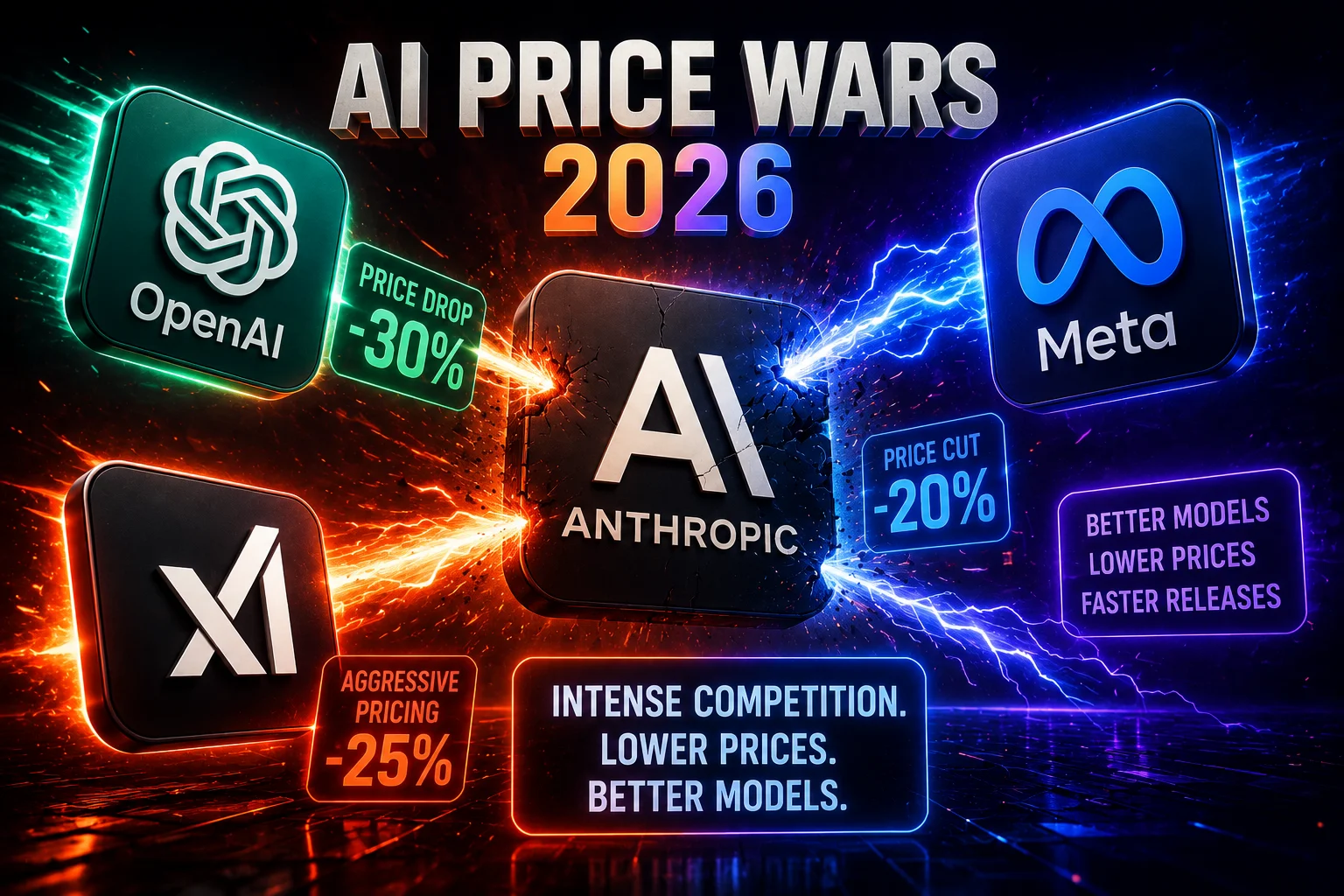
- OpenAI has reduced GPT-5-class API costs by 40% compared to last year, making it harder for Anthropic to justify Claude's premium pricing.
- Meta's Llama 4 (released early 2026) is now the default choice for Indian startups looking to avoid high per-token costs.
- The bottom line: Anthropic must pivot to a high-efficiency 'Claude Light' model or risk losing the enterprise market to cheaper, faster alternatives.
The Party is Over: AI Spending Gets Real in 2026
Remember 2024 and 2025? Back then, every company was throwing money at AI like it was going out of style. If a model was smart, businesses bought it, no questions asked. But now, in July 2026, the vibe has completely changed. We've entered the era of the 'AI Reality Check.' Companies are no longer impressed by just a chatbot that can write poems; they are looking at their monthly cloud bills and asking, 'Is this actually making us money?' This shift is putting a massive target on Anthropic's back. While Claude has always been the 'intellectual' favorite for its nuance and safety, it’s becoming the expensive luxury car in a world where everyone suddenly wants a high-mileage hybrid.
The pressure isn't just coming from one side. It’s a pincer movement. On one side, you have OpenAI, which has turned into a cost-optimization machine. On the other, you have Meta, which is basically giving away the 'engine' for free with Llama. And then there's Elon Musk's xAI (often called SpaceXAI due to its heavy integration with SpaceX's compute clusters), which is using raw hardware power to drive prices into the ground. If you are a developer in India building a startup, the choice is getting harder: do you pay for the 'soul' of Claude, or do you go for the sheer economic power of the others?
How We Got Here: The Efficiency Revolution
For the last two years, the race was about 'Parameters' and 'Emergent Abilities.' We wanted models that could pass the Bar exam or solve complex physics. We got those. But as of 2026, the hardware has caught up. Specialized AI chips from NVIDIA and internal silicon from Google and Microsoft have made running these models significantly cheaper. OpenAI was the first to realize that the 'moat' isn't just intelligence—it's the price per million tokens. By optimizing their inference stack, they've managed to drop prices so low that smaller startups can now run complex agents for pennies.
Anthropic, meanwhile, has doubled down on 'Constitutional AI' and safety. While that's great for avoiding PR disasters, it comes with a 'compute tax.' Safety layers and complex reasoning paths take more processing power, which translates to higher costs for the end user. In a 2026 market where enterprise customers are cutting 20% of their tech overhead, that extra 'safety margin' is starting to look like an expensive add-on rather than a necessity. The industry is moving from 'can it do it?' to 'can it do it for $0.001?'
The Competitor Playbook: OpenAI, Meta, and xAI
Let's look at what the big three are doing to squeeze Anthropic. OpenAI has launched what they call 'Dynamic Tiering.' Their models now automatically adjust their complexity based on the task, saving users up to 50% on simple queries. They aren't just selling intelligence; they are selling 'managed intelligence' that fits your budget. If you're just summarizing an email, you don't pay for the full GPT-5 brain. This flexibility is exactly what businesses are craving right now.
Meta is the biggest disruptor for the Indian market. Llama 4 is out, and it’s a beast. Because it's open-source (or 'open-weights'), companies like Zomato or Swiggy can host it on their own servers. They don't have to pay a 'tax' to a US-based company for every single customer interaction. Meta’s strategy is simple: make the software free so that the industry standard is built on their tech. This leaves Anthropic in a tough spot—how do you compete with 'free' when your main product is a paid API?
Then there's xAI. By leveraging the massive 'Colossus' supercomputer cluster, they've achieved a level of vertical integration that even Google envies. They own the chips, the power, and the data pipeline. This allows them to offer Grok-3 at a flat rate that is nearly impossible for a software-focused company like Anthropic to match without burning through their VC cash. They are turning AI into a commodity, like electricity or water.
The India Impact: Why This Matters for Us
In India, we are seeing a massive surge in 'AI-First' services, from automated legal aid to localized agricultural advice. But here’s the thing: India is a price-sensitive market. An Indian SaaS startup charging $20 a month can't afford to spend $15 of that on Anthropic’s API calls. We are seeing a clear trend where Indian developers are using Claude for the 'design' phase—to figure out the prompts and the logic—but switching to Llama or OpenAI’s 'mini' models for the actual production. It’s a 'Designed by Anthropic, Powered by Meta' world.
If Anthropic wants to stay relevant in the Indian ecosystem, they need more than just a better model; they need an India-specific pricing strategy. We've seen this with Netflix and Spotify—global giants had to slash prices to win here. AI will be no different. If the cost of a 'token' doesn't align with the 'Average Revenue Per User' (ARPU) in India, Anthropic will remain a niche tool for high-end researchers while the rest of the country runs on Meta and OpenAI.
TamilTech’s Verdict: Can Anthropic Survive the Squeeze?
Look, we love Claude. For creative writing and nuanced coding, it’s still arguably the best. But 'best' doesn't always win the market—'good enough and cheap' usually does. Anthropic is currently in a 'luxury trap.' They have a premium product, but their competitors are rapidly closing the quality gap while widening the price gap. Our take at TamilTech? Anthropic needs to release a 'Claude Nano' or a drastically cheaper 'Haiku' successor by the end of 2026. If they don't, they might find themselves becoming the 'BlackBerry of AI'—technically secure and respected, but ultimately replaced by more flexible, affordable alternatives. For now, if you're a developer, our advice is to keep your architecture 'model-agnostic.' Don't lock yourself into one provider, because the price wars are just getting started, and the best deal might change by next month!

Comments (0)
Be the first to comment!