


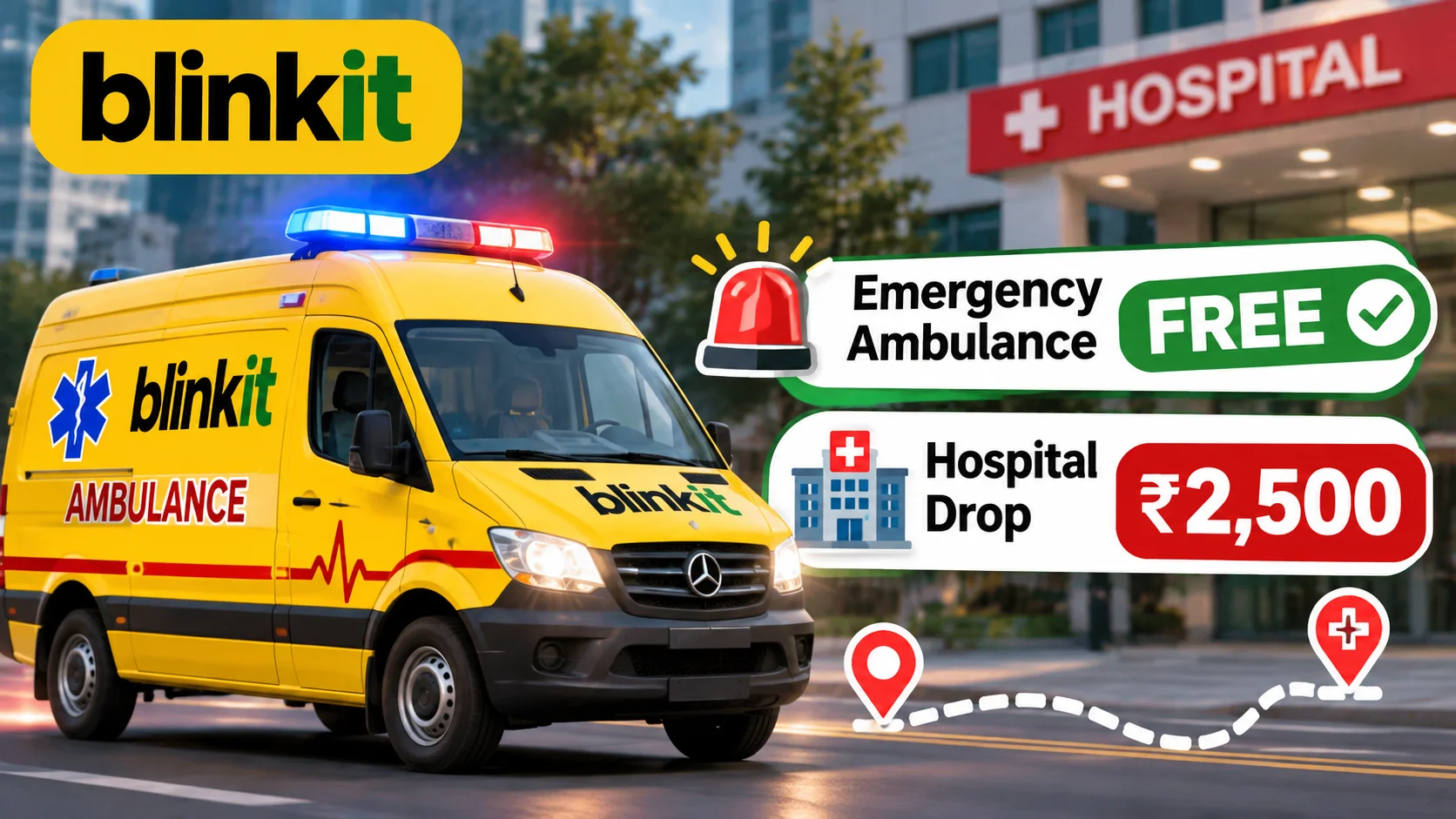
If the family group has already turned this into "Blinkit ambulance is no longer free," that sentence is half wrong, and the wrong half is the one that matters at 2 am. Business Today, updated 5 November 2026 at 2:16 PM IST in Noida, quotes Deepinder Goyal on X: emergency transfers stay free, as always. Non-emergency transfers cost ₹2,500, charged after the trip. Moneycontrol, published the same day at 14:03 IST, reports the same split. A heart attack is not the new paid product. A routine hospital visit is.
The fee is collected after the journey, not as a prepaid booking you have to clear before the van moves. Both papers say it is broadly in line with what private ambulance operators already charge. Goyal’s reason, carried by both, is that a free button was being used for trips an Uber or a private car could have done. Every one of those bookings ties up a fully equipped ambulance and paramedics who might be needed for a life-threatening call.
The numbers, without the rounding
Goyal says Blinkit Ambulance served about 20,000 emergency cases in the last two years, out of approximately 42,000 cases in total. The service had not charged a rupee for any of them. Moneycontrol’s headline shorthand is "more than 42,000 free ambulance rides." The body is the tilde: about 42,000, of which about 20,000 were emergencies. That leaves roughly 22,000 trips that were not classed as emergencies. The articles do not give a city-wise split, a monthly chart, or a percentage that Goyal himself printed. Do not let a reel turn "about 22,000 non-emergency trips over two years" into "half of today’s calls are fake."
The examples he gave are specific. Routine check-ups. Hospital visits. Hospital-to-home transfers after the kind of trip a cab could handle. Business Today’s framing is the discharge ride and the scheduled visit, not a person inventing a chest pain. Those are real medical journeys. They are just not the 10-minute emergency the fleet was built around. Goyal’s line, quoted by Business Today, is that 10-minute ambulances have saved lives and need to stay available for the emergencies that need them most.
Where the ₹2,500 goes
This is not described as a Blinkit convenience fee that lands in a delivery P&L. Goyal says the money goes to the Eternal Foundation, which runs the ambulances, and will be used to scale the service. Moneycontrol says the same: the collections fund expansion. If someone in the group says "Zomato is monetising heart attacks," they have swapped the category. The paid trip is the non-emergency one, and the stated destination of the money is the foundation that operates the fleet, not a surge price on groceries.
What the stories do not say is just as useful. They do not publish a list of cities where Blinkit Ambulance runs. They do not say every Indian pin code had a free ambulance yesterday and a paid one today. They do not print the app screen that decides "emergency" versus "non-emergency," or who makes that call if a family and a paramedic disagree. They do not say the charge is a fine, a deposit, or a cancellation fee. It is a post-trip charge for a non-emergency transfer. Anything sharper than that is someone guessing at a product flow that is not in the copy.
What I would not do with this headline
I would not tell a parent to hesitate on a real emergency because a screenshot says ₹2,500. Both reports say emergency transfers remain free. I would also not promise them the app will agree with their definition of emergency. That rule is not printed. If the situation is life-threatening, the public system is still 112 and 108. A Blinkit booking is an additional private fleet where it exists, not a replacement for the government ambulance, and these articles do not claim otherwise.
I would not book the van for a planned OPD visit or a discharge ride and then act surprised at ₹2,500. That is the behaviour Goyal says he is trying to move off the fleet. A cab, a hospital’s own transport desk, or a local private ambulance you have already agreed a price with are the alternatives he is pointing at, without naming an app. The ₹2,500 is described as broadly what private operators already charge, not as a discount and not as a premium.
And I would not pay a stranger who WhatsApps you a "Blinkit ambulance refund" link, a QR for the Eternal Foundation, or a form that asks for the patient’s OTP. Nothing in these reports asks families to pay a third party, upload medical records to a random number, or "confirm" the free emergency by sharing a UPI PIN. The charge, when it applies, is after the trip, inside the service Goyal is describing. A forward that collects money in the foundation’s name is not the announcement.
The part that is still his argument, not a measurement
Goyal’s case is that free routine rides were keeping equipped ambulances and trained paramedics off emergencies. Business Today notes that scaling the fleet is hard, and that the bottleneck he names is trained, empathic paramedics, with a training academy that the company says it is growing without dropping quality. That is a capacity argument. It is not a published audit of response times before and after the fee. Neither paper shows that a ₹2,500 charge has already shortened emergency arrivals. He hopes non-emergency use will drop sharply. Hope is not a result yet. The policy starts "from now onwards," in the post Business Today quotes. Thursday 5 November 2026 is the announcement day, not a one-month review.
So the version worth forwarding is short. Emergency transfer: still free. Routine check-up, hospital visit, hospital-to-home: ₹2,500 after the ride, broadly in line with private ambulances, paid to the Eternal Foundation to run and expand the service. About 20,000 emergency cases inside about 42,000 total rides over two years, none of them billed until this change. Cities covered, and who labels a trip an emergency, are not in the stories. If you need the van for a real emergency, these reports say you are not the customer being priced. If you need it for a planned drop, you are.

Comments (0)
Be the first to comment!