


Key Takeaways
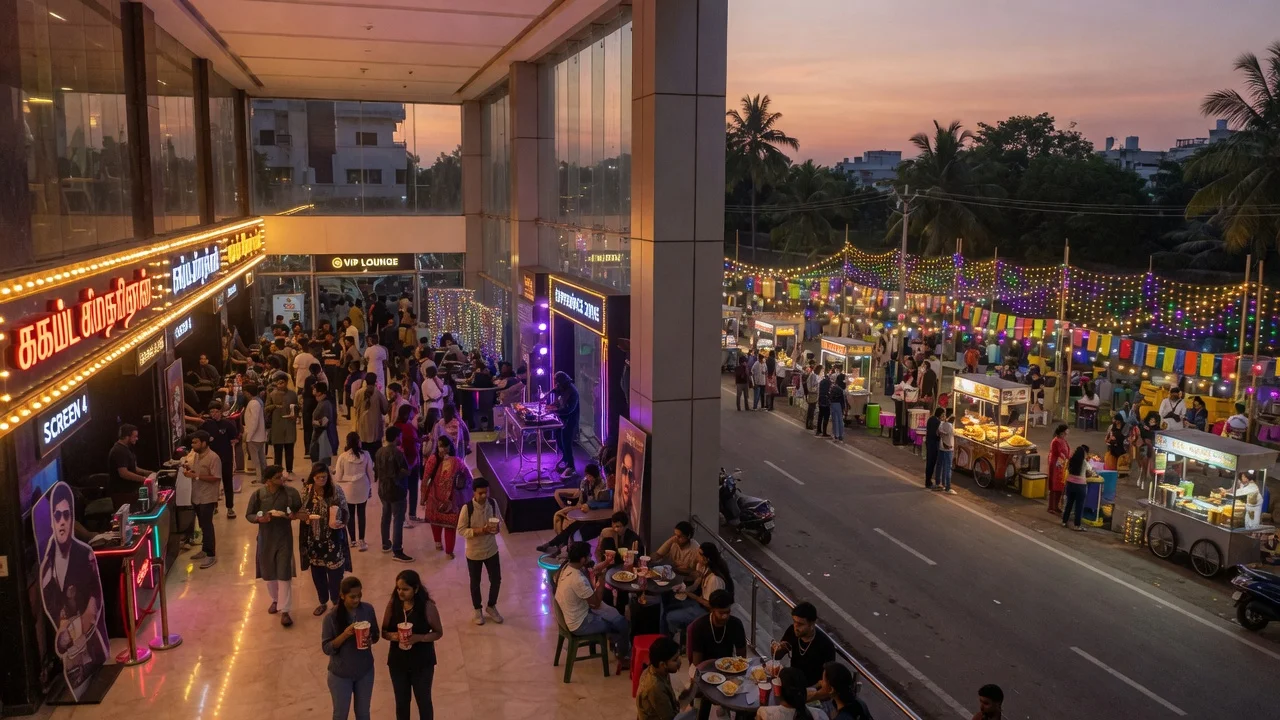
- Bookmyshow is pivoting from pure movie ticketing to a pan-entertainment live-experience platform, acknowledging that the cinema-ticket bubble has popped in top-tier metros.
- The high-profile rival District, founded by former Bookmyshow executives, has been effectively neutralized through strategic overlap and market saturation, making it a zombie competitor rather than a forward threat.
- India’s tier-2 and tier-3 growth has stalled because single-screen revival now runs through offline, pirated, and non-digital channels that online aggregators cannot easily capture.
- The real existential enemy is time fragmentation: short-form video and stacked OTT bundles are consuming leisure hours at a rate no ticketing app can outpace with discounts alone.
- Alibaba-linked sponsors and private-equity owners are shifting the playbook from growth-at-all-costs to cash-positive event aggregation.
What’s the news
Bookmyshow, the red-and-white giant that practically invented the online ticket for the Indian middle class, is reportedly rewriting its five-year road map. The pivot is not directed at District, the startup that once shook the industry when a founder walked out with investor backing to build a rival CRM and ticketing engine. District still exists on paper, but it is now shedding its standalone brand and user base through acquisitions and cash burns. Industry observers note that the two platforms now operate in such similar service territories that another price war would only kill both.
The real fight is against a behavior change that no single app can fix. A decade ago, a new blockbuster meant a quantifiable spike in fuel, apparel, and food spending. Today, that spike is diffuse. The same film lands on a streaming service within weeks, and the cultural ritual has shifted from synchronized theatre clapping to room-scale rewatches.
Details
Bookmyshow's revenue has historically depended on high-margin movie-ticketing commissions and digital ad inventory. As theaters face revenue-share disputes with studios and the entry of low-cost streaming tiers by native OTT platforms, footfall alone is no longer a reliable proxy for commercial success.
To stay relevant, Bookmyshow is reportedly deepening its integration into live sports, stand-up comedy, theatre festivals, and tertiary cultural events across Pune, Kochi, Guwahati, and Hyderabad. This is a strategic hedging play against the long tail of entertainment. Integrations with UPI for instant refunds, experiments with Ticket-on-Delivery, and partnerships with municipal corporations for sports events are part of the rumored roadmap.
But live events carry inventory risk. If a concert has fifty thousand seats and only ten thousand sell in the first forty-eight hours, the organizer bears the loss. Bookmyshow's platform risk is lower than the organizer's, but it still must push the buyer through multiple ads and payment windows to complete a transaction. The unit economics of a mid-tier concert or a district-level theatre fest are thinner than a blockbuster night at a multiplex.
Data-driven promotions used to work because there were only so many screens. Now that studios cut deals directly with theatres and release dates are less predictable, Bookmyshow loses the data advantage that made its CRM so sticky. The company is likely leaning harder on AI-powered personalization to suggest events, but the margin for error gets smaller when every ticket sold carries a price-discount memory.
India impact
For India, this is a tale of two theaters. Urban multiplexes in Mumbai, Delhi, and Bangalore still command weekly footfalls, but growth is marginal. Single-screen revival is happening, yet it now runs through offline, pirated mobile projectors and WhatsApp groups rather than Bookmyshow-branded apps. This means the cultural shift is falling through the cracks of traditional digital aggregation.
UPI remains the backbone of ticket payments, but the friction of a movie-ticket app is high when compared with watching a film at home. A domestic OTT sub and home-delivered snacks can beat a metro multiplex ticket plus a traffic trip. Bookmyshow's challenge is that it is trying to make theatre-going feel like an experience again while the default behavior is already set to a sofa.
Beyond metros, the smartphone user is increasingly on a 4G budget plan. Data is expensive, and resetting payment methods repeatedly erodes the convenience of instant checkout. Bookmyshow must offer lower-cost entry points, perhaps through a lightweight progressive web app or a telephony-based booking interface, to capture this user.
Use cases
Corporate gifting boxes given out for Diwali increasingly include Bookmyshow credits for team outings. Wedding planners in tier-1 cities are booking venues through event platforms, and Bookmyshow's live-event stack may capture overflow guests who were never in the original RSVP list.
There is also the rise of group-buy ticketing for persuadable events: flexi-passes for sports clubs, student discounts on campus theatre fests, and waitlist-driven alerts for concerts held in smaller venues.
A niche but growing angle is post-event commerce. Bookmyshow could theoretically become a marketplace for concert merchandise redistribution, artist-meetups, or cross-promotions with FSSAI-approved food courts outside metro halls. If the platform can own the entire funnel from hype to afterglow, it can monetize the time that users currently spend on Instagram or Spotify.
In addition to group-buy ticketing, Bookmyshow could monetize cancellation flows. When a user cancels a ticket, the app can offer a discount on a future event within twenty-four hours, turning a near-miss into a refund-retention loop. Another angle is cross-promotion with ticket-printing vendors and taxi aggregators, creating a closed-loop ecosystem where the booking itself is invisible inside a larger payment radio.
Honest take
Is Bookmyshow fighting the right war? Its brand dominance in film ticketing is uncontested, yet uncontested markets rarely generate compound returns. The startup that survived Taatkal frenzy and complex private-equity deals now faces a railway-station problem: the user base is saturated, and the next one hundred million buyers are in towns where storage anxiety, throttled internet, and local phone-based booking make a modern app redundant.
The bigger bet here may not be technology but distribution. Can Bookmyshow become the default backend for every second-tier event from college reunions to local kabaddi tournaments? My gut says no, not without deep losses in the live-events vertical. And those losses will only be sustainable if the parent sponsors finally accept that Bookmyshow is a cash-cow, not a unicorn.
Frequently asked questions
Q: Is District actually dead or just irrelevant? A: Industry watchers note that District no longer controls a standalone user base large enough to challenge Bookmyshow's market leadership. Its founder-turned-rival has shifted toward virtual-event infrastructure, leaving physical ticketing an uncontested monopoly.
Q: What is the biggest threat to Bookmyshow in 2026? A: The adversary is not another app. It is audience attention split across short-form video, bundled OTT, and homegrown gaming. Time, not tickets, is the scarce resource now.
Q: Will Bookmyshow survive in tier-2 cities? A: It will survive where it teams up with exhibition-owner-operators rather than fighting them. The biggest gains now lie in exhibition-management-as-a-service, not pure resale.
Q: How does UPI affect this? A: UPI has cut checkout friction to seconds, which helps high-intent buyers. But for impulse moviegoing, the payment step is no longer the important bottleneck; the TV remote is.
Q: Is Alibaba still the owner? A: Public records indicate major Chinese sponsors hold significant stakes, though the exact current boardroom composition is not widely disclosed. What matters is that private-equity returns are now the North Star.


Comments (0)
Be the first to comment!