

Key Takeaways
- C-CAMP has selected 15 bioscience startups for the ninth edition of the National Bio Entrepreneurship Competition.
- Startups from previous editions have raised more than $125 million in venture capital funding.
- The competition remains a key India-focused platform for spotting science-first bio entrepreneurs.
- India's biotech deep-tech pipeline gets fresh momentum with this latest C-CAMP cohort.
- Past winners show that patient capital can flow into Indian lab-to-market bio ideas when the right support exists.
What's the news
C-CAMP has picked 15 bioscience startups for the ninth edition of its National Bio Entrepreneurship Competition. For anyone tracking India's deep-tech and life-sciences startup scene, this is one of those announcements that does not scream for attention like a consumer app funding round, yet it quietly matters a lot.
The National Bio Entrepreneurship Competition, often shortened to NBEC, is now in its ninth run. That alone tells you the platform has stuck around long enough to build a real track record. The headline number from earlier editions is hard to brush aside: startups that came through previous cohorts have collectively raised more than $125 million in venture capital.
In a market still dominated by quick-commerce, fintech, and SaaS stories, a bio-focused competition that keeps producing fundable companies is worth noticing. C-CAMP, the Centre for Cellular and Molecular Platforms, sits at the centre of this effort. Based in Bengaluru and closely tied to India's public biotech ecosystem, it has spent years trying to turn lab science into companies that can actually raise money and ship products.
Fifteen new teams now get that spotlight. The selection itself is the news. What happens next — mentoring, investor connects, and the long grind of building bio products — will decide whether this cohort adds to that $125 million story or becomes a footnote.
Details
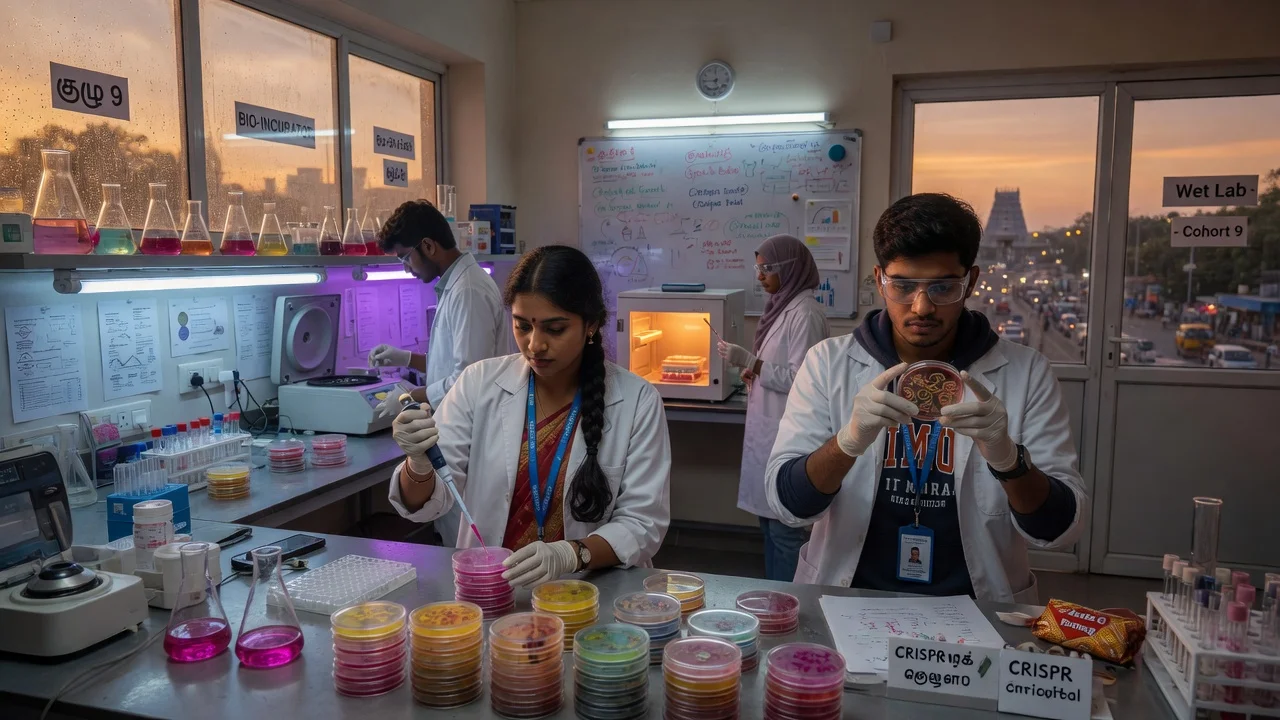
C-CAMP runs the National Bio Entrepreneurship Competition as a way to surface founders who are building around biology, not just around apps. Think diagnostics, therapeutics, agri-biotech, industrial biotech, and related deep-tech ideas that usually need wet labs, regulatory patience, and longer timelines than a typical Indian consumer startup.
The ninth edition continues that focus. Exact names of the 15 startups and the full shortlist process sit with C-CAMP and the organisers. What we do know from the public record around this announcement is the selection count and the cumulative funding figure from past participants. That $125 million-plus in VC funding across earlier editions is the clearest proof point that the competition is not just a certificate factory.
C-CAMP itself has long positioned itself as a bridge between academic research and commercial bio ventures. It offers incubation-style support, access to specialised infrastructure, and connections into the broader biotech funding and industry network in India. NBEC fits into that larger role: identify promising science-first founders early, give them visibility, and help them become investable.
Bio startups face a different reality from Flipkart-style consumer plays or UPI-led fintech. Capital cycles are longer. Proof points take more time. Regulatory pathways can be slow. A competition that repeatedly produces companies able to raise serious VC money is therefore doing something right on the selection and support side, even if the day-to-day work of building those companies remains hard.
The ninth edition arriving in 2026 also shows continuity. Many startup contests fade after two or three years. Reaching a ninth cycle with a measurable funding outcome from alumni is a stronger signal than another one-off pitch day.
India impact
India needs more of this kind of pipeline. The country has strong life-sciences research talent and a large domestic need for affordable diagnostics, better agri inputs, novel therapeutics, and industrial biotech solutions. What it has often lacked is a consistent path from lab bench to funded company.
Consumer internet and fintech soaked up most of the visible startup capital over the last decade. Deep-tech bio sat in a quieter corner. Competitions and incubators like the ones C-CAMP runs help correct that imbalance by creating a repeatable discovery mechanism for science-heavy founders who may never have chased a Shark Tank-style stage.
The $125 million raised by earlier NBEC-linked startups is meaningful in Indian context. It is not SoftBank-scale money, but for bioscience ventures that often struggle to find patient capital at home, it shows that local and global VCs will write cheques when the science and the team look credible. That matters for founders sitting in IISc, IITs, AIIMS-linked labs, or smaller research centres who wonder whether anyone will fund a biology-first idea.
There is also a strategic angle. India wants stronger domestic capability in healthtech, agri-biotech, and industrial biology. Public research institutions and platforms such as C-CAMP form part of that push. Selecting 15 more startups keeps the funnel open. Some will fail. A few may become the next fundable names that attract follow-on rounds and create jobs for scientists and engineers who prefer building products over pure academia.
For the broader ecosystem, every successful bio cohort also educates investors. More VCs seeing real exits or strong follow-on rounds from bio deep-tech makes the next fundraise slightly less lonely for the founder who walks in with a lab notebook instead of a growth dashboard.
Use cases
Bioscience startups that come through platforms like NBEC typically chase problems that sit close to India's daily realities. Affordable and accurate diagnostics for infectious disease, chronic conditions, and maternal health remain high-need areas. Point-of-care tools that work outside big-city hospitals can change outcomes in smaller towns and rural clinics.
Agri-biotech is another natural fit. Indian farmers deal with climate stress, soil health issues, and the need for better yields without simply pouring on more chemicals. Startups working on microbial solutions, better seed traits, or sustainable crop protection sit in that space. If even a handful of the 15 selected teams are building here, the potential farm-level impact is obvious.
Therapeutics and novel biologics take longer, but India already has manufacturing muscle in vaccines and generics. Early-stage companies that can invent or improve molecules, delivery systems, or manufacturing processes feed into that strength. Industrial biotech — enzymes, bio-based materials, waste-to-value processes — also maps well to manufacturing and sustainability goals.
None of this means every selected startup will succeed. Bio product cycles are unforgiving. What a competition like NBEC can do is raise the odds that the better ideas get seen by the right mentors and investors early, instead of dying quietly inside a university lab.
For founders, the practical use case of being selected is visibility plus structured support. For investors, it is a pre-filtered deal flow of science-heavy teams. For the country, it is another small step toward a thicker pipeline of companies that can eventually serve Indian patients, farmers, and industries with home-grown bio solutions.
Honest take
This is solid news for India's deep-tech bio crowd, not a flashy consumer-internet moment. Selecting 15 startups for a ninth-edition competition that already has a $125 million funding track record from past cohorts is credible. C-CAMP deserves credit for sticking with a hard category instead of chasing whatever is trendy on funding dashboards.
At the same time, let's keep the expectations honest. Bio startups still face long timelines, expensive experiments, and regulatory friction. A competition win helps with visibility and early support. It does not magically shorten a clinical pathway or replace the need for patient capital. India still needs more specialised funds, faster regulatory clarity in some segments, and better lab-to-market bridges if it wants dozens of these companies to scale, not just raise a seed round.
The $125 million figure is encouraging, yet biotech globally eats capital. Building a meaningful Indian bio deep-tech layer will take many more cohorts, more follow-on funding, and more companies that survive the messy middle years. NBEC is one useful machine in that larger system. It is not the whole system.
For founders currently grinding in wet labs or translational research groups, the message is simple: platforms like this exist, they have produced fundable companies before, and the ninth edition just added 15 more names to the list. For everyone else watching India's startup mix, it is a reminder that not every important company looks like a Jio or Flipkart clone. Some of them start with cells, assays, and a lot of patience.
C-CAMP's latest selection keeps that quieter lane moving. That is worth a nod.





Comments (0)
Be the first to comment!