


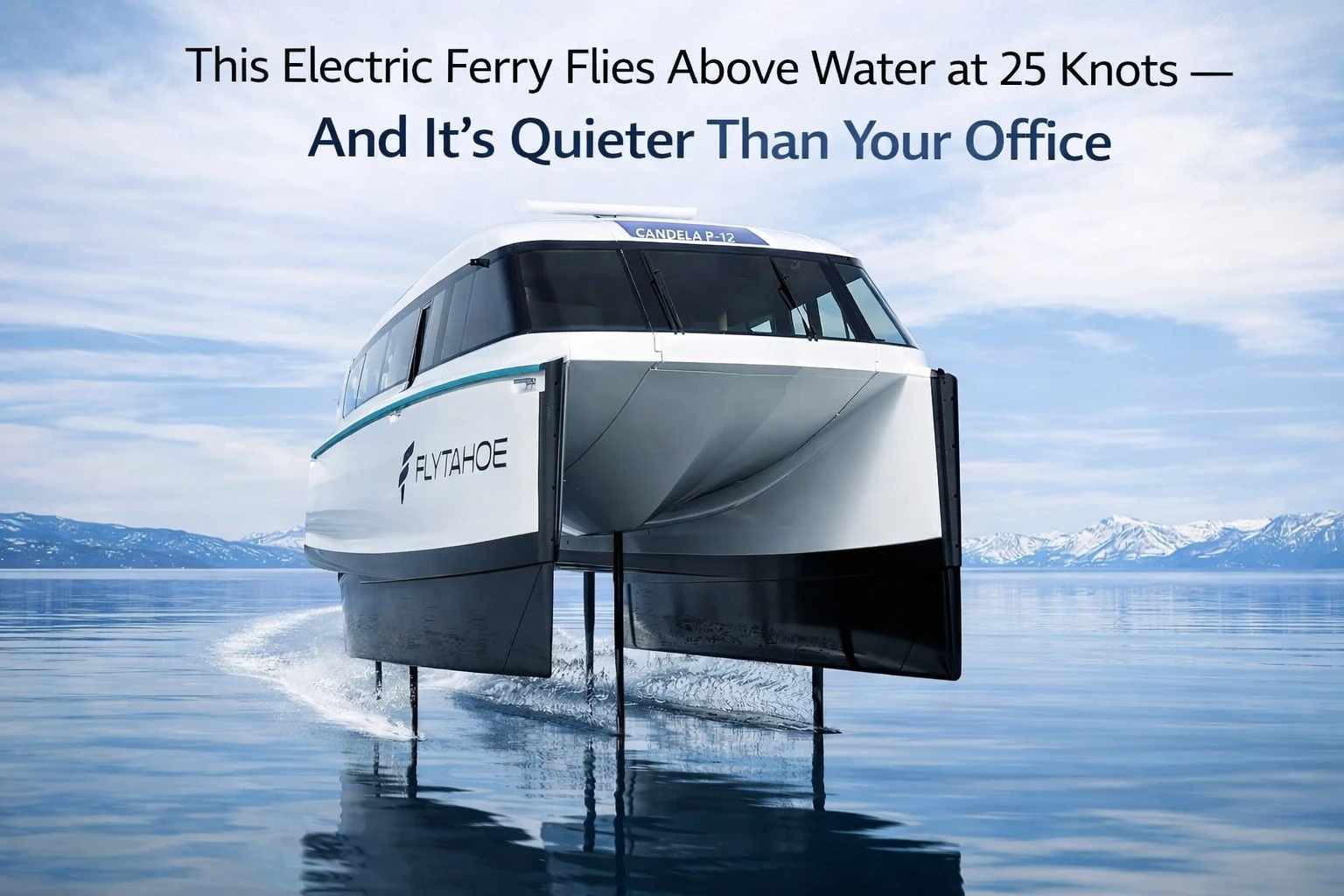
Imagine boarding a ferry and feeling nothing — no waves, no noise, no exhaust
Most ferry rides are a sensory assault. The engine roars, the hull slams into every wave, and by the time you reach the other side you're half-deaf and vaguely nauseous. It's the one part of any coastal trip that nobody enjoys.
Swedish electric boat company Candela just decided that's not good enough. Their new P-12 Business ferry doesn't push through water — it flies above it. And that single engineering choice changes everything about what a ferry ride feels like.
So how does a boat actually fly?
The P-12 Business uses a hydrofoil system — think of it like underwater wings attached to the hull. When the boat picks up speed, these wings generate lift, exactly like aircraft wings do in air. The entire hull rises out of the water, and from that point on, the boat is technically flying just above the surface rather than sailing through it.
A computer system constantly adjusts the foils in real time to keep the ride smooth regardless of wave conditions. Hit a choppy stretch of water at 25 knots on a conventional speedboat and you're getting thrown around. On the P-12 Business, passengers reportedly feel almost nothing — the foil system absorbs the chop before it reaches the hull.
This isn't a brand new concept — hydrofoils have existed for decades — but Candela has refined the technology and paired it with electric propulsion in a way that makes it genuinely commercially viable for the first time.
The numbers that matter
When foiling, the P-12 Business uses up to 80% less energy than a conventional vessel traveling at the same speed. That's not a rounding error — that's transformative. A conventional diesel ferry burning fuel at speed is expensive to operate. The P-12, because it's barely touching the water, faces a fraction of the drag and needs a fraction of the power.
Range: 40 nautical miles (about 74 km) at a cruising speed of 25 knots on a single charge. For context, that covers routes like Mumbai to Alibaug multiple times over, or the entire coastal stretch of most major Indian harbor cities. It can charge from standard DC fast chargers — the same infrastructure already being built for EVs on land.
Noise levels inside the cabin: 63-64 decibels at top speed. That's quieter than a normal conversation in the next row. For comparison, traditional speedboats run at 85-90 dB — nearly three times as loud to human ears (since decibels are logarithmic, a 10 dB difference sounds roughly twice as loud). First-class aircraft cabins are actually noisier than the P-12 Business interior. This is a genuinely remarkable stat.
The business-class interior
The "Business" version of the P-12 is specifically aimed at premium transport routes — resort transfers, executive commuter links, high-end tourism shuttles. Candela has redesigned the interior for comfort: proper seating, premium finishes, a cabin environment that feels more like a lounge than a boat.
The original P-12 is already running as a public commuter ferry in Stockholm, Sweden. The Business variant is a step up — targeting the kind of routes where passengers are paying for the experience, not just the destination.
Already confirmed orders have come in from Saudi Arabia, New Zealand, and Berlin. Lake Tahoe in the US is next. The P-12 platform has also set records — it completed a 160 nautical mile (296 km) voyage from Gothenburg to Oslo entirely on electric power, using existing DC fast charger stops along the way. Longest electric passenger vessel journey ever completed.
Why India should be watching this closely
India has an enormous coastal and riverine transport opportunity that's been massively underserved. Look at Mumbai — the gateway city with a harbor that could dramatically reduce road congestion through water transport, but ferry infrastructure has remained stubbornly old-fashioned. Diesel-powered, noisy, uncomfortable rides that most commuters avoid unless they have no choice.
Kerala's backwaters run tourist boats that are increasingly under scrutiny for their environmental impact. Goa's ferry crossings are a bottleneck. The Andaman and Nicobar Islands rely entirely on inter-island boats that are expensive to operate and polluting.
A hydrofoil electric ferry that cuts operating costs by 80%, charges at standard EV infrastructure, and offers a business-class cabin experience is exactly the kind of vessel that could change the calculus for Indian coastal transport operators. The catch, of course, is pricing — Candela's boats are not budget products, and the upfront capital for fleet operators would be significant. But with diesel prices in India running high and the government pushing hard on electric vehicle adoption, the economics could work faster than you'd expect for commercial operators.
India's Sagarmala project — the central government's initiative to modernize port infrastructure and coastal connectivity — has specifically identified electric and hybrid vessels as priority investments. Candela's P-12 platform sits squarely in that target zone.
How this compares to what else is out there
The electric boat market is growing but the P-12 is still in a category of its own for commercial passenger use. Most electric boats are small pleasure crafts — day boats, dinghies, small river ferries — that operate at low speeds over short distances. They work fine for calm inland waterways but don't handle open coastal conditions at speed.
The hydrofoil element is what separates Candela. By lifting the hull, they've solved the two biggest problems with electric commercial vessels: range anxiety (80% less energy use means smaller batteries needed) and rough water performance (flying above waves rather than slamming through them). No other company has put these pieces together at commercial scale the way Candela has.
Competitors like Boundary Layer Technologies (Ayla) and a few others are working on similar hydrofoil electric ferry concepts, but Candela is the only one with vessels already in active commercial service.
TamilTech's take
The P-12 Business is a genuinely impressive piece of engineering. The combination of hydrofoil technology with electric propulsion solves problems that have kept electric ferries as niche products for years — range, wave performance, and operating economics. For India specifically, where coastal and river transport is chronically underfunded and diesel-dependent, something like this could be transformative. The technology exists. The economics are getting there. The only question is whether Indian port operators and state transport agencies move fast enough to take advantage of it before the rest of the world does.


Comments (0)
Be the first to comment!