


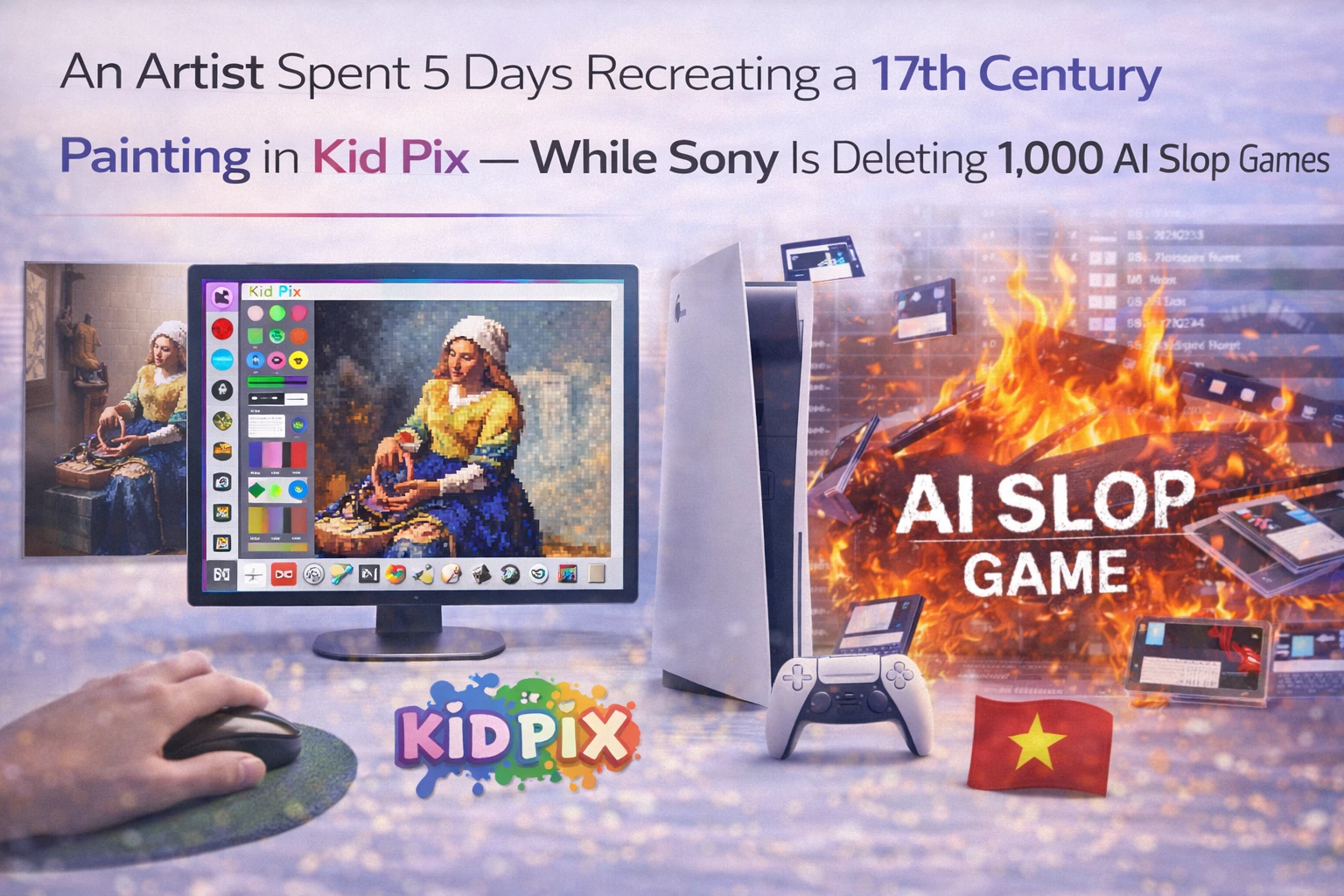
A five-day project with 112 colors in a 1998 children's paint program
Kid Pix was many Indian school kids' first encounter with digital creativity in the early 2000s. If your school had a computer lab with Windows 98 machines, you probably spent some period of class time in Kid Pix — the children's paint program famous for its ridiculous sound effects, the stamp tool that let you scatter rubber ducks across your drawing, and most memorably, the explosion eraser that nuked your entire artwork in a shower of cartoon chaos.
Most of us used it to draw wobbly houses and misshapen animals. Cat Graffam, an artist based in the US, has been using it to recreate some of the most technically demanding paintings in art history.
The latest: Artemisia Gentileschi's Jael and Sisera — a 1620 Baroque masterpiece by one of the few major female painters of the 17th century. Using Kid Pix Studio Deluxe from 1998, with only 112 available colors and the software's extremely limited brush and blending tools, Graffam spent five full days producing a digital recreation that genuinely holds up as a piece of art in its own right.
The original painting is a technically sophisticated work of dramatic contrast — characteristic of Baroque style — depicting a Biblical scene of violence rendered with psychological depth. Gentileschi, who survived sexual assault at the hands of a colleague and fought a lengthy trial for justice, is believed to have poured personal catharsis into the painting. The violence in the work is not gratuitous — it's a reckoning. Graffam was drawn to this particular painting for that reason: the connection between personal experience, artistic expression, and the specific meaning that context gives an image.
"She used this piece as a powerful catharsis from the violence she was a victim of, reclaiming what power she could through art," Graffam explained in the video documenting the project. "It gives me chills."
Why Kid Pix — and why this matters beyond nostalgia
Graffam's series isn't a stunt. Each project in the series picks a specific historical artwork and a specific obsolete or unexpected digital tool that has its own cultural meaning. Goya's Saturn was recreated in Mario Paint. Vermeer's Milkmaid was done on Nintendo DSi homebrew software. Edward Hopper's Nighthawks was drawn using THX's uDraw peripheral — a drawing tablet Nintendo Wii accessory that was such a commercial failure it contributed to THX shutting down its gaming division.
The point isn't to prove that these tools can be used for fine art. The point is about what it means when a specific piece of technology is the medium through which a generation first discovered creativity. Kid Pix Studio Deluxe from 1998 is "extremely formative for growing my love of technology," Graffam says. The software isn't just a quirky constraint — it's the specific context through which an entire generation of kids (especially in the late 1990s and early 2000s, when computer lab time was precious and carefully scheduled) first understood that a computer could make things.
For Indian audiences, this resonates differently. Many Indian school computer labs of the same era ran MS Paint rather than Kid Pix — MS Paint was bundled with Windows and didn't need a separate license. The experience of creating in MS Paint on a school computer, with its flat color fills and pixel-level frustrations, carries the same emotional weight. A generation of Indian students who grew up on MS Paint, Logo programming, and early educational software has a visceral relationship with the constraint of limited digital tools that younger generations who grew up with Procreate and Adobe don't quite understand.
What Graffam is doing is essentially saying: the limitation was the point. The 112 colors aren't a handicap. They're the whole conversation.
The Sony PlayStation Store story — and why these two things belong in the same article
At almost exactly the same moment Graffam was releasing their Kid Pix recreation, Sony was continuing a months-long purge of its PlayStation Store — delisting titles from publishers identified as shovelware operators. The latest batch included games from GoGame Console Publisher, VRCForge Studios, and Welding Byte, covering titles like Jesus Simulator, Water Blast Shooter, Racing Car Chaos: Extreme Stunt Showdown, and Card Shop Game Store.
These are AI-generated and low-effort asset-flip games — products made not with creative intent but with production pipelines designed to flood digital storefronts with content that looks like something valuable from a thumbnail but delivers nothing on purchase. January 2026 saw over a thousand games delisted from a single developer in one sweep. The March 2026 purge removed 700 or more titles in another cleanup. April is continuing the trend.
The games being removed share characteristics: they often have titles deliberately similar to successful indie games, they use generative AI tools for their assets, and they chase easy Trophy unlock patterns that attract a specific subset of players looking for cheap completion achievements rather than actual gameplay.
Sony hasn't issued public statements explaining the exact criteria for removal. Publishers affected have announced they'll continue releasing on Switch, Xbox, and Steam. The PlayStation Store cleanup is ongoing without a clear end point.
The actual tension — human creative effort vs. automated content production
Putting these two stories together reveals something important about where digital creativity is right now. On one side: an artist spending five days with 112 colors in obsolete 1990s software to create something that makes people feel something. On the other: publishers using AI generation pipelines to produce hundreds of titles per month with zero creative intent, purely to occupy space on a digital storefront.
Both are using technology. Both are producing digital content. The difference is entirely in what the creator was trying to do and how much of themselves they put into it.
For Indian gamers and creators, this tension is immediately relevant. India's game development community has been growing — studios in Pune, Bangalore, Chennai, and Hyderabad are building games that are increasingly competitive at international levels. The shovelware problem that Sony is cleaning up represents the opposite trajectory: using easy access to digital distribution to bypass creative effort entirely.
The broader lesson for Indian developers who want to build careers in games: the tools don't matter nearly as much as what you're trying to do with them. Graffam made something meaningful in Kid Pix. Thousands of publishers made nothing meaningful in Unity with professional asset stores and AI generation tools. Tool access is not the constraint. Intent is.
TamilTech's take
The Kid Pix story is delightful on its face — a children's paint program from 1998 producing a convincing recreation of 17th century Baroque art is genuinely surprising and worth five minutes of your time to look at. But the reason it's worth writing about in 2026 is because it sits in direct contrast to everything the PlayStation Store shovelware story represents. One person, one idea, five days, 112 colors, and something worth sharing. Versus automated pipelines generating hundreds of titles that add nothing to anyone's life. The tools of digital creation have never been more accessible. That makes the question of what you do with them more important, not less. For anyone in India thinking about building something creative with technology — games, art, music, writing — the Kid Pix story is a useful reminder of what it actually looks like when the work is worth doing.





Comments (0)
Be the first to comment!