


Key Takeaways
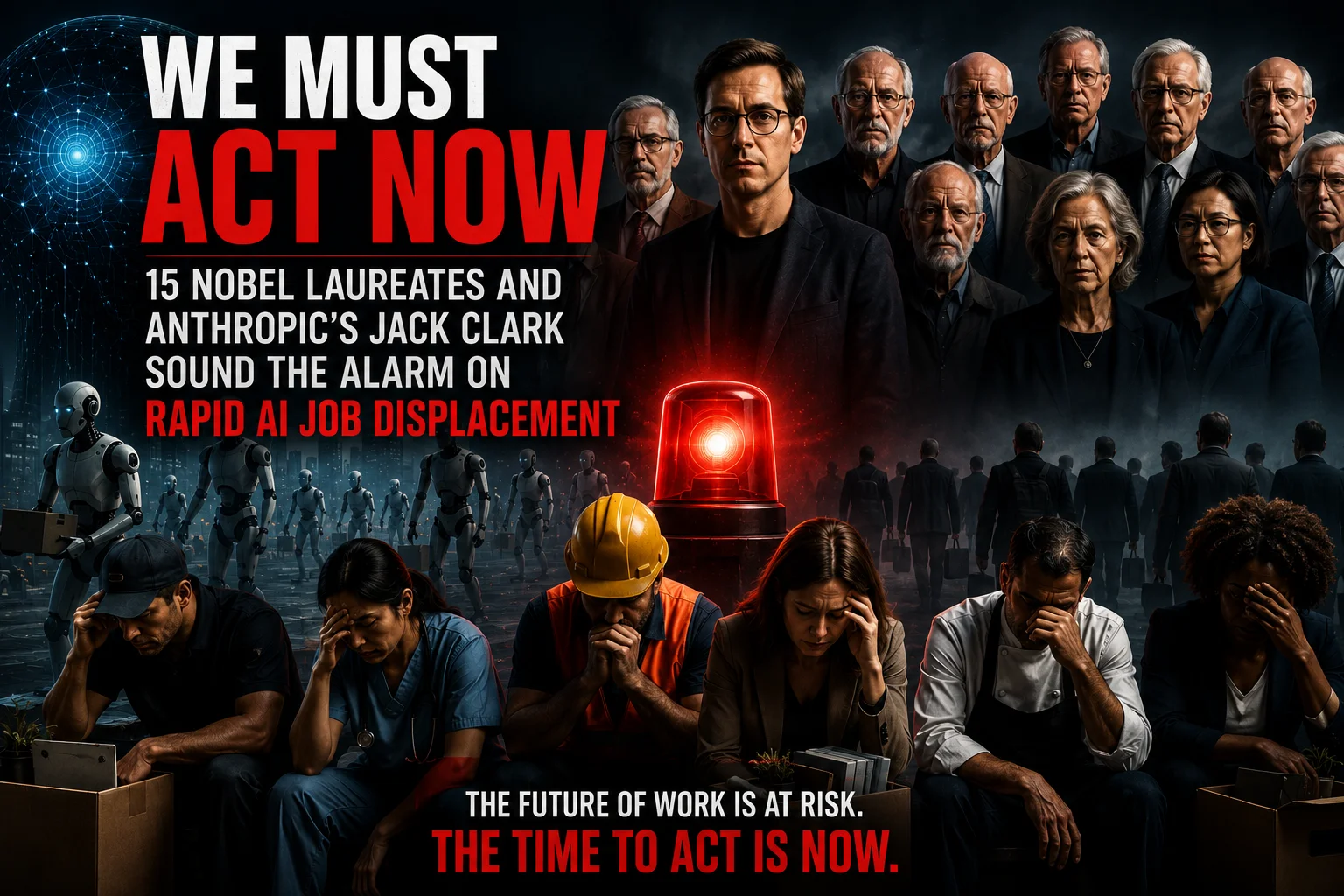
- A group of 200 experts, including 15 Nobel Prize-winning economists and Anthropic co-founder Jack Clark, signed the 'We Must Act Now' open letter.
- The letter warns that AI progress in 2026 has reached a tipping point where job displacement is happening faster than new jobs are being created.
- Experts are calling for immediate government intervention, including AI taxes and expanded social safety nets like Universal Basic Income (UBI).
- In India, the IT and BPO sectors face the highest risk, with entry-level coding and support roles being rapidly automated by AI agents.
- The bottom line: It is no longer about 'AI helping humans' but about 'AI replacing roles,' requiring a total rethink of our career paths.
The 2026 AI Reality Check
It’s mid-2026, and the conversation around AI has shifted from "Will it happen?" to "It’s happening right now." If you’ve been following TamilTech, you know we’ve been tracking how AI agents have evolved from simple chatbots to autonomous workers that can handle entire projects. But today, the warning isn't coming from tech enthusiasts; it's coming from the people who understand the world's money and labor markets better than anyone else. Nearly 200 economists, including 15 Nobel laureates, have just put their names on a document titled 'We Must Act Now.' This isn't just another online petition; it's a massive red alert for the global economy.
The letter highlights a scary reality: the speed at which AI is improving in 2026 is far outstripping the speed at which humans can reskill or at which the economy can create new types of work. We used to say, "AI won't replace you, a person using AI will." But these experts, including Jack Clark from Anthropic, are now saying that might have been too optimistic. In many sectors, the AI agent is becoming the end-to-end solution, leaving no room for a human in the loop. This is a fundamental shift in how we perceive work, and it's happening faster than any industrial revolution in history.
Why 15 Nobel Laureates Are Worried Right Now
When someone wins a Nobel Prize in Economics, they usually look at long-term trends. For 15 of them to sign a letter together in 2026 means the data is undeniable. The core of their argument is that the 'productivity gain' from AI is mostly going to big tech companies and shareholders, while the 'labor share'—the money paid to workers—is shrinking. In 2026, we are seeing AI models that don't just write emails but manage supply chains, write complex software architectures, and even handle legal discovery. These were once 'safe' white-collar jobs.
Jack Clark’s involvement is particularly significant. As a co-founder of Anthropic, he sees the raw power of the models being developed behind closed doors. By signing this, he’s essentially admitting that the technology his industry is building is so powerful that it could break the current social contract. The letter argues that we can't wait for the 'invisible hand' of the market to fix this. If we don't have policies in place by the end of this year, we could see a permanent class of unemployed workers whose skills have been rendered obsolete overnight.
The India Impact: What Happens to Our IT Workforce?
Let's talk about the situation closer to home. India has always been the 'back office' of the world. Our massive IT sector, which employs millions in cities like Bengaluru, Chennai, and Hyderabad, is built on providing skilled labor at scale. But in 2026, the global companies that used to outsource to India are now 'insourcing' to AI agents. Why hire a team of 10 junior developers in Pune when a customized version of a 2026-era LLM can do the same work for the price of a monthly subscription? This is the reality we are facing.
We are already seeing a slowdown in campus placements across major Indian engineering colleges. The roles that used to go to freshers—testing, basic coding, data entry, and level-1 support—are the exact roles that AI now handles with 99% accuracy. The 'We Must Act Now' letter specifically mentions that developing nations with large youth populations are at the highest risk of social unrest if this transition isn't managed. For India, this means we need to stop training students for 2020-style jobs and start focusing on high-level AI orchestration and 'human-centric' services that AI still struggles with.
The Proposed Solutions: AI Tax and UBI
The letter doesn't just complain; it offers radical solutions that were considered 'fringe' just two years ago. One of the main proposals is an 'AI Displacement Tax.' The idea is simple: if a company replaces 100 workers with an AI system, they should pay a specific tax that goes into a fund for retraining those workers. It sounds fair on paper, but implementing it globally in 2026 is a massive challenge. If India implements an AI tax and the US doesn't, companies might just move their digital operations elsewhere.
Then there’s the big one: Universal Basic Income (UBI). The economists argue that as AI takes over more of the 'productive' work, the link between 'having a job' and 'having money to survive' might need to be broken. They suggest that the massive wealth generated by AI should be redistributed so that everyone has a baseline level of financial security. In an Indian context, this could look like an expansion of existing welfare schemes but on a much larger, digital scale. It’s a controversial idea, but when 15 Nobel winners suggest it, we have to take it seriously.
TamilTech’s Analysis: Is it Time to Panic?
At TamilTech, we’ve always been pro-technology, but we also believe in being realistic. Our take is that you shouldn't panic, but you absolutely must pivot. The 'We Must Act Now' letter is a wake-up call for everyone—from students to mid-level managers. If your job involves following a set of instructions or processing data, you are in the danger zone. In 2026, the 'safe' jobs are those that require deep human empathy, physical presence in complex environments (like specialized healthcare or high-end construction), and high-level strategy that involves 'unpredictable' human elements.
What we expect next is a series of heated debates in the Indian Parliament and global summits. We might see the first versions of 'AI Regulation Bills' that actually address labor, not just deepfakes or privacy. For you, the reader, the move is clear: stop being just a 'user' of technology and start being an 'architect.' Learn how these AI systems work under the hood. Understand how to prompt, fine-tune, and chain AI agents together. The people who can manage the AI will be the ones who stay employed in this new era.
How to Future-Proof Your Career in 2026
If you're wondering what to do next, here’s our recommendation. First, audit your own skills. Ask yourself: "Can an AI do this 80% as well as me for 1% of the cost?" If the answer is yes, you need to upskill immediately. Focus on 'soft skills' like negotiation, complex problem solving, and emotional intelligence—areas where AI in 2026 still feels 'robotic.' Second, stay updated with platforms like ours. The tech world is moving so fast that what you learned three months ago might already be outdated.
The 'We Must Act Now' letter is a historic moment. It marks the point where the world's smartest minds admitted that the AI revolution is different from anything we've seen before. It's not just another tool; it's a new form of labor. Whether this leads to a golden age of leisure or a crisis of unemployment depends entirely on how governments and individuals react in the next 12 months. We’ll be here to guide you through every update, every new model, and every policy change. Stay tuned to TamilTech.




Comments (0)
Be the first to comment!