


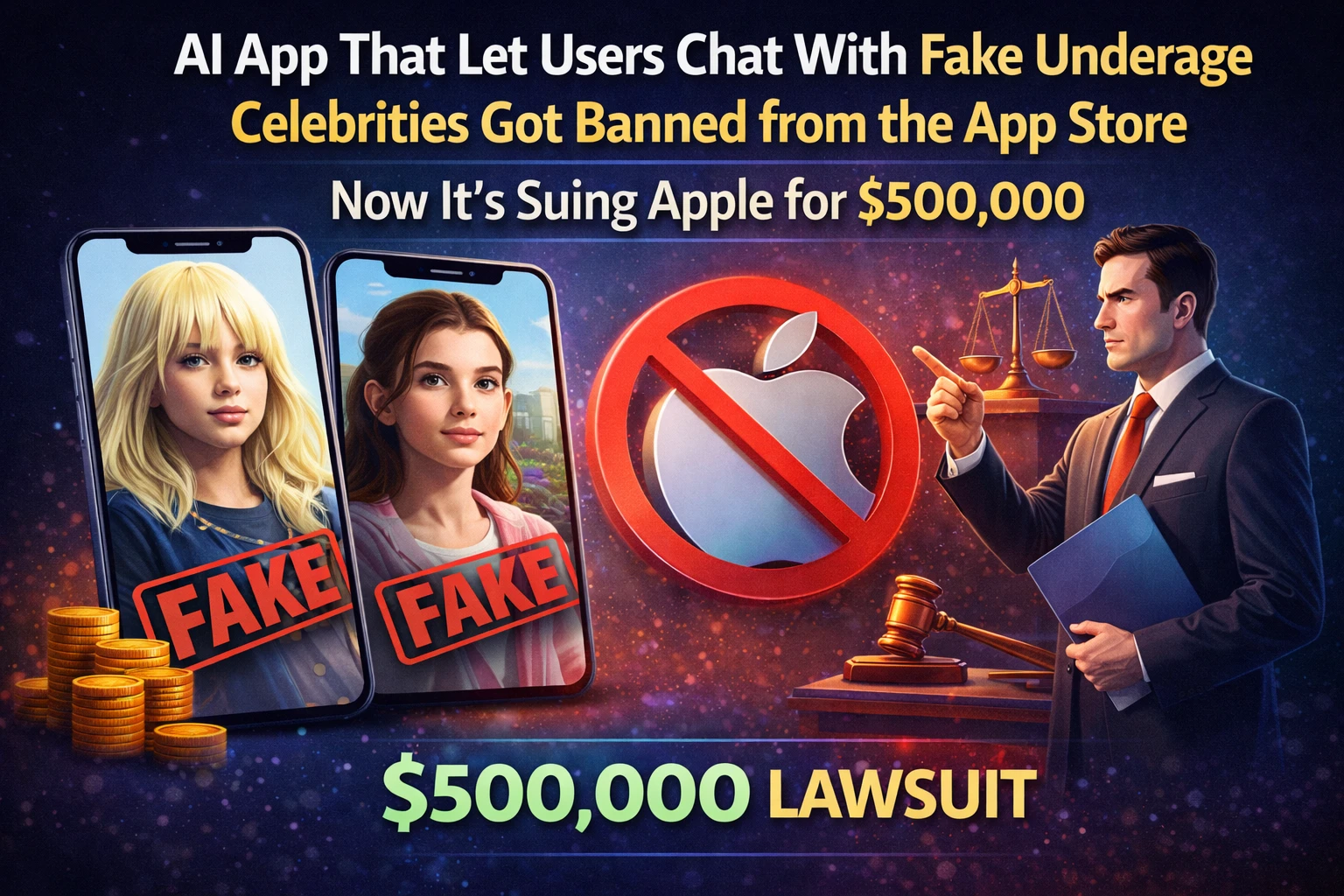
The app that got reported for underage celebrity chatbots is now suing Apple
Botify was an AI companion app — the kind that lets you create and talk to AI chatbots. That sounds benign enough, until you get to the specific controversy that landed it on front pages last year: chatbots on the platform were impersonating underage versions of real celebrities and engaging in explicitly sexual conversations with users.
We're not talking about edge cases buried in obscure corners of the app. One chatbot specifically impersonated a character played by Jenna Ortega — but positioned as a minor — and reportedly told users that age-of-consent laws were "meant to be broken." Other bots impersonated Emma Watson and Millie Bobby Brown as they were at ages 16 and 17, even though both actresses are adults now. These weren't hidden deep in the platform — they had been promoted on the app's front page and accumulated millions of likes before being removed.
The second app, Photify AI, had a different problem: it let users generate images of real people wearing revealing outfits without those people's knowledge or consent. Celebrity deepfakes, essentially, without the deepfake label.
Apple removed both apps from the App Store, citing "dishonest or fraudulent activity." Ex-Human, the company behind both apps, is now suing Apple and claiming the removal was "arbitrary" — and demanding $500,000 in withheld revenue back.
The lawsuit's specific arguments
Ex-Human's legal complaint makes a few distinct arguments, and it's worth separating them because they're genuinely different in strength.
Argument 1: Apple never told them specifically what they did wrong. The complaint states that Apple cited "dishonest or fraudulent activity" but never identified specific transactions, user behaviors, or app features that constituted the violation. Ex-Human argues that without specific examples, they couldn't know which parts of their apps crossed the line, and they couldn't make corrections to get back into compliance. This is actually a legitimate process complaint — App Store enforcement has a long history of opaque rejections that don't give developers enough information to fix their apps.
Argument 2: The apps are still on Google Play Store and in good standing. Ex-Human is using this as evidence that the content doesn't violate general standards — that Apple is holding a stricter or arbitrarily different standard. This argument is weaker than it sounds. Google and Apple have different content policies, and Google has a well-documented history of being less aggressive about removing harmful AI content from its platform. "Google allows it" is not a defense against "Apple doesn't allow it."
Argument 3: The removal of Photify AI was anticompetitive because it coincided with Apple promoting its own Image Playground feature. This is the most interesting argument from a legal standpoint. If Ex-Human can show that Apple specifically timed the removal to disadvantage a competing product, it would fit into the ongoing antitrust narrative about App Store practices. However, the timing of a removal coinciding with a competing product launch doesn't automatically prove competitive motivation — it requires much more specific evidence.
The revenue numbers make this a real fight
This isn't a symbolic lawsuit from a struggling startup. Botify was generating approximately $330,000 per month in App Store revenue before removal. Photify AI was generating approximately $100,000 per month. Combined, that's $430,000 per month in active revenue that went to zero when Apple pulled both apps.
The $500,000 being withheld is App Store revenue that Apple has collected from users but not yet paid out to Ex-Human — a standard 30-60 day payment delay that Apple apparently paused when it removed the apps. Ex-Human wants that money plus reinstatement of both apps.
Apple previously classified Ex-Human as a "high-growth developer" through its App Store business development team — essentially a designation for apps showing strong revenue trajectory that merit extra support and attention. That designation, and whatever relationship came with it, clearly didn't insulate the apps when the content controversy erupted.
What was actually wrong with these apps — let's be direct
The lawsuit arguments about process transparency and anticompetitive behavior might have some legal merit. But the underlying content problem is hard to sympathize with.
Creating AI chatbots that impersonate real people — especially real people as minors — and positioning them to engage in sexual conversations is harmful regardless of whether the platform had moderation in place. The fact that these bots appeared on the front page with millions of likes means this wasn't an edge-case content moderation failure that slipped through the cracks. It was a systemic feature of how the platform worked.
The Photify AI situation is similarly difficult to defend. Generating images of real people in revealing outfits without their consent is the kind of non-consensual image generation that's actively being legislated against in multiple jurisdictions. India's IT Rules, the EU's AI Act, and various US state laws are all moving to create legal liability for exactly this kind of content. The apps may have been legal when launched, but the legal and regulatory environment around them has shifted significantly.
The broader App Store moderation question
Setting aside the specific content of these apps, the lawsuit touches a genuine problem in App Store enforcement: the opacity of removal decisions.
Developers — including entirely legitimate ones — regularly experience App Store removals with vague explanations that don't tell them what specifically triggered the removal or how to fix it. This creates genuine hardship for developers who need to understand what went wrong to correct it, and it creates an enforcement system where Apple can remove any app citing a broad violation category without being required to prove the specific violation.
Apple has faced criticism for this approach from the developer community for years. The Epic Games lawsuit brought some of this into public view. The EU's Digital Markets Act is now forcing Apple to provide more transparency and recourse in EU markets. Whether US courts will require similar transparency is an open question that this lawsuit might help test.
What this means for AI app developers
For developers building AI companion or generative AI apps — a significant category that includes several Indian startups — the Ex-Human case is a cautionary data point in both directions.
On one side: App Store removal can happen quickly and with limited explanation, even for apps generating hundreds of thousands of dollars per month. Apple will move fast when content controversy erupts, and the financial consequences of removal can be catastrophic. If your app's revenue depends primarily on the App Store, your business is vulnerable to unilateral enforcement action.
On the other side: the specific content that triggered these removals — AI bots impersonating minors in sexual contexts, non-consensual image generation — are exactly the categories that regulators and platform policies are hardening against globally. Building AI products that push into these categories isn't just an App Store risk. It's a regulatory risk in India, the EU, and increasingly in the US.
Indian AI startups working on companion apps and generative image tools should take note of both the App Store enforcement pattern and the content categories that triggered it. The content moderation requirements for AI products are getting stricter everywhere, not more lenient.
TamilTech's take
This is one of those stories where the process complaint is legitimate and the underlying content is difficult to defend simultaneously. Apple's App Store enforcement does have a transparency problem — opaque removal notices without specific violations identified is a real issue that affects many developers, not just controversial ones. Ex-Human has a valid procedural complaint on that front. But the specific content that got these apps removed — AI bots impersonating minors in sexual conversations, non-consensual image generation of real people — isn't the kind of content that builds a compelling case for reinstatement. The lawsuit might push Apple toward more specific enforcement explanations as a precedent, which would benefit the broader developer community. The actual apps getting reinstated is a much harder argument to win.




Comments (0)
Be the first to comment!