


Key Takeaways
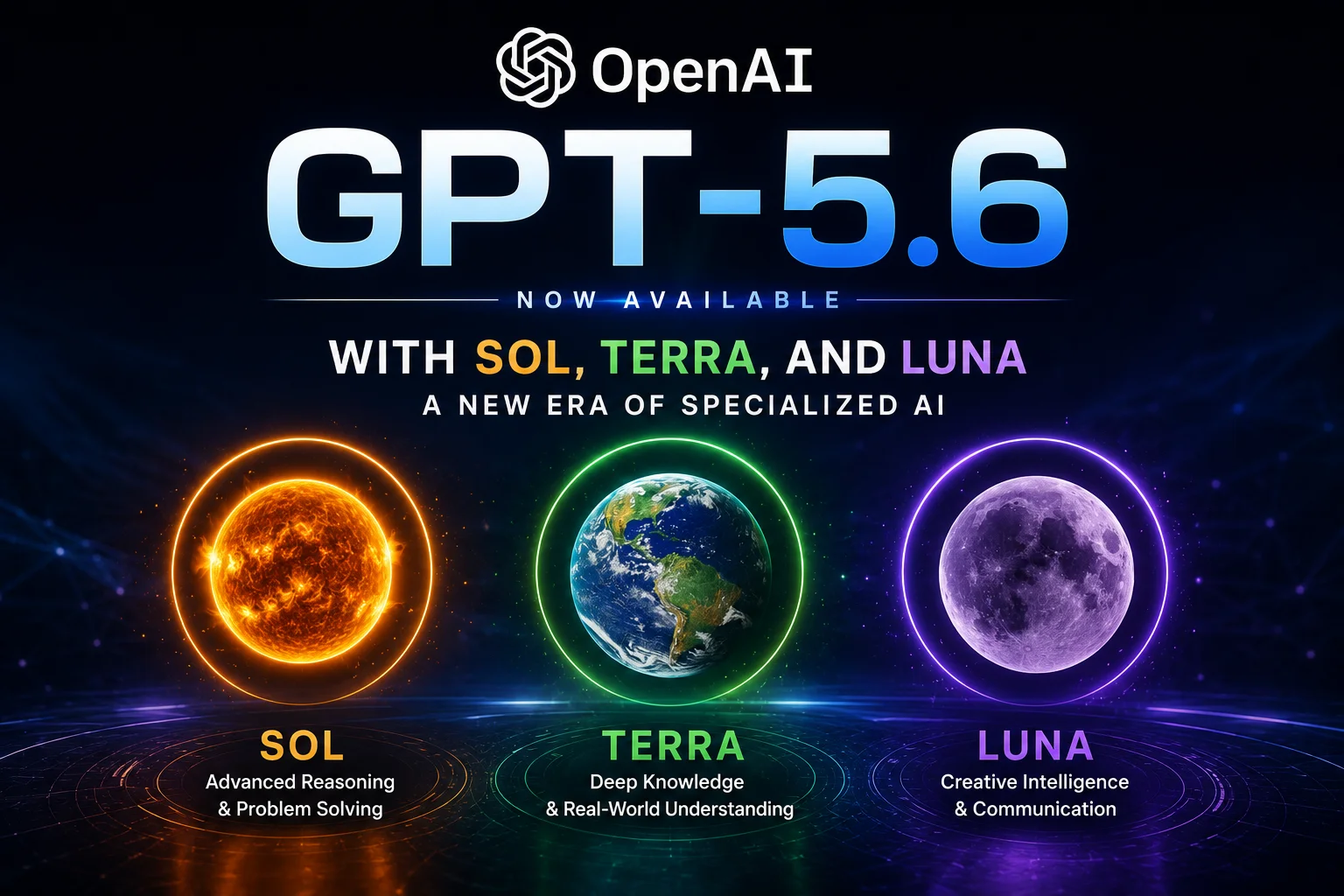
- GPT-5.6 is not a single model but a trinity of three specialized models: Sol (Fast/Local), Terra (Balanced), and Luna (High-reasoning).
- The 'Sol' model is designed to run locally on flagship smartphones (Snapdragon 8 Gen 5 and Apple A19 Pro) without needing an active internet connection for basic tasks.
- OpenAI has introduced localized Indian pricing for the 'Terra' tier starting at ₹199 per month, with full support for 22 Indian languages including native Tamil reasoning.
- Luna, the most powerful model, features a 10-million token context window, allowing it to analyze entire libraries or hours of 8K video in seconds.
The AI Game Just Changed Again
So, OpenAI just dropped a massive update that we’ve all been waiting for. If you thought GPT-5 was the peak, think again. Today, OpenAI officially announced GPT-5.6, and it’s not just a small speed boost or a bug fix. They are moving away from the 'one size fits all' approach. Instead of one massive model that tries to do everything, we now have three distinct models: Sol, Terra, and Luna. This is a strategic move to dominate everything from your smartwatch to massive supercomputers. We’ve been testing the beta version for a few hours, and honestly, the way it handles Indian languages and local context is something we haven’t seen before. This isn't just about chatting; it’s about an AI that actually understands the nuances of how we live and work in 2026.
Why the jump to 5.6? Well, OpenAI realized that users are frustrated with latency and high subscription costs. By splitting the architecture, they can give you exactly what you need without wasting computing power. Whether you are a student trying to solve a math problem, a developer coding a complex app, or a researcher looking for a cure for a disease, there is now a specific version of GPT tailored for you. Let’s break down what these three models actually do and why you should care about the names Sol, Terra, and Luna.
Meet the Trinity: Sol, Terra, and Luna
First up is Sol. Think of this as the 'Lightweight Champion'. Sol is designed for speed and efficiency. The biggest news here is that Sol can run locally on your hardware. If you have a flagship phone from 2025 or 2026, you don't even need the cloud for this. It’s perfect for real-time translation, quick email drafts, and voice commands. Because it runs on-device, your data stays with you, which is a massive win for privacy. It’s incredibly snappy, and in our initial tests, the latency is almost zero. It feels like talking to a real person without that awkward 2-second pause we used to have with older AI models.
Then we have Terra. This is the 'Workhorse' and the direct successor to the GPT-5 we’ve been using. It’s the balanced model that most of us will use daily. Terra is optimized for creative writing, complex coding, and general problem-solving. OpenAI has focused heavily on 'grounding' with Terra, meaning it’s much less likely to hallucinate or give you fake information. It has access to real-time web data with a much better filtering system. If you’re a Plus subscriber, this is the default model you’ll be interacting with. It’s roughly 4x faster than GPT-5 but significantly smarter in logical reasoning.
Finally, there is Luna. This is the 'Beast'. Luna is not for your everyday 'write a poem' tasks. It’s a high-reasoning model designed for scientific research, advanced mathematics, and massive data analysis. It features a staggering 10-million token context window. To put that in perspective, you could upload 20 thick textbooks or 5 hours of 4K video footage, and Luna would be able to answer specific questions about a single frame or a single sentence buried in the middle. It’s multimodal to the core, meaning it doesn't just 'see' images; it understands the physics and logic behind them. This is the model that’s going to change how engineering and medicine work.
The India Impact: Pricing and Language Support
Now, let’s talk about what this means for us in India. For a long time, we’ve been paying in Dollars, which honestly felt a bit steep for many students and small businesses. With the launch of GPT-5.6, OpenAI is finally getting serious about the Indian market. They’ve introduced a new 'Terra Lite' subscription for India, priced at just ₹199 per month. This gives you full access to the Terra model and limited daily runs on Luna. This is a game-changer because it makes high-end AI accessible to almost everyone with a smartphone and a UPI ID. Yes, they now support UPI payments directly through the app, so no more struggling with international credit cards.
The language support has also received a massive boost. Earlier, Tamil or Hindi responses often felt like a direct translation from English—sometimes the grammar was just 'off'. But with GPT-5.6, they’ve used a new training dataset specifically for Indian regional languages. The Tamil reasoning is now native. If you ask it a question about Tamil literature or ask it to write a script in a specific Madurai slang, it actually gets it right. This is going to be huge for local content creators and students who prefer learning in their mother tongue. We also hear rumors that OpenAI is partnering with major Indian telcos to offer 'AI Data Packs', where using the Sol and Terra models won't even count against your daily data limit.
How to Get Started (Step-by-Step)
If you want to try out the new GPT-5.6 models, here is how you do it. First, make sure your app is updated to the latest version from the Play Store or App Store. Look for version 6.0 or higher. Once you open the app, you’ll see a new 'Model Switcher' at the top. By default, it will be set to 'Auto', which uses the 'Orchestrator' to decide whether your prompt needs Sol, Terra, or Luna. This is actually the best way to use it because it saves your high-end limits for when you actually need them.
If you want to force a specific model, just tap the switcher. Choose Sol if you are on a weak connection or want an instant reply for a simple task. Choose Terra for your daily work, writing, or coding. If you have a massive file to analyze, select Luna. Note that Luna might take a few extra seconds to 'think' because of the sheer amount of processing it does. Also, check your settings for the new 'Local Mode' toggle. If your phone supports it, enabling this will download the Sol model weights (about 4GB) so you can use AI even when you’re on a flight or in a basement with no signal.
TamilTech’s Honest Take: Is it Worth the Hype?
Look, we see AI updates every other week, but GPT-5.6 feels different. It feels like the technology has finally matured. The split into Sol, Terra, and Luna is a smart move because it acknowledges that we don't always need a supercomputer to fix a typo, but we definitely need one to analyze a complex legal contract. The on-device capability of Sol is the real winner here for us. In a country like India, where internet connectivity can be patchy in many areas, having a powerful AI that works offline is a massive advantage.
However, it’s not all perfect. The Luna model is quite expensive if you go beyond the free tier, and you’ll need a very high-end phone to run Sol locally. If you’re using a budget phone from 2-3 years ago, you might not see the performance gains everyone is talking about. But overall, the ₹199 pricing and the native Tamil support make this a 'must-have' tool. Our advice? Start with the free tier of Sol and Terra. If you find yourself needing more 'brain power' for your professional work, the Terra subscription is now finally affordable for the average Indian user. The AI race is heating up, and with Google’s Gemini 3.0 expected next month, we are in for an exciting year.





Comments (0)
Be the first to comment!