


Key Takeaways
- Humanizer apps like StealthWriter and Undetectable AI now use 'burstiness' algorithms to make AI text pass as 100% human-written.
- Autotyper tools simulate physical keystrokes and pauses in Google Docs to fake a document's 'Version History' for teachers.
- Subscription costs for these bypass tools range from ₹800 to ₹2,500 per month, becoming a massive industry in India.
- AI detectors like Turnitin are struggling to keep up as humanizers constantly update their language models to mimic student errors.
The Cat and Mouse Game of 2026
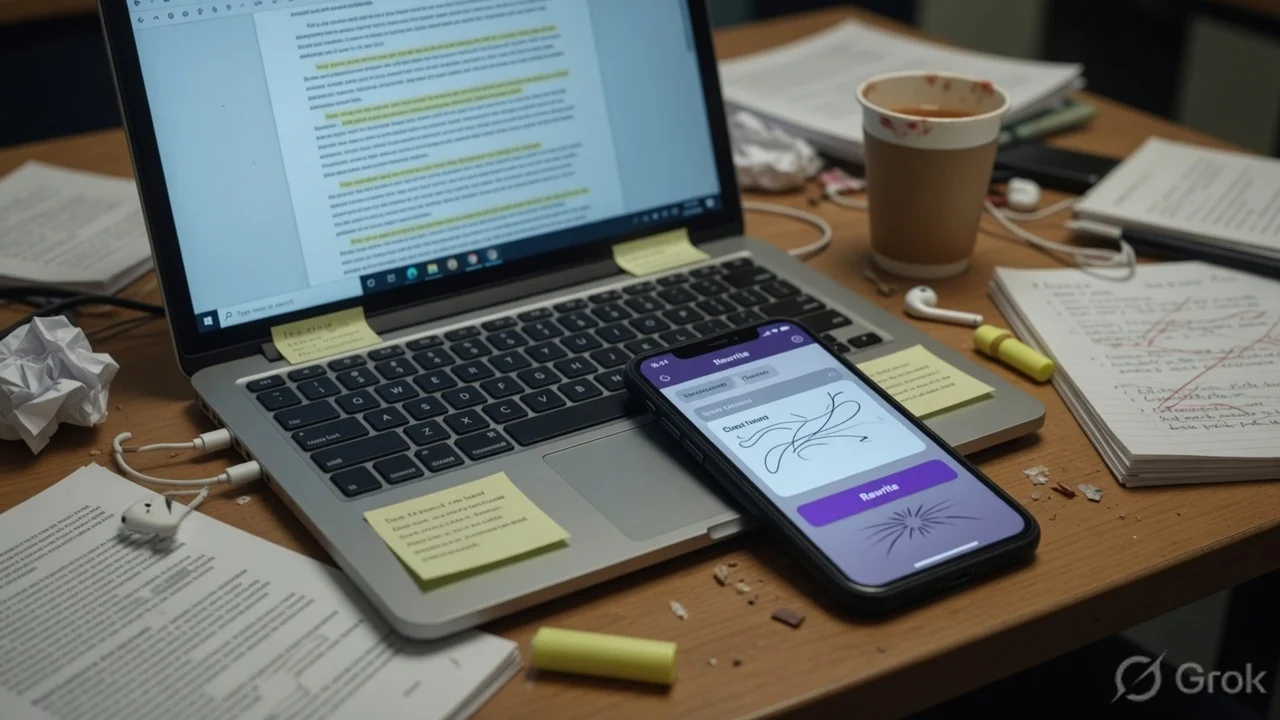
It is June 2026, and the battle between students and professors has moved to a whole new level. Remember when ChatGPT first came out and everyone thought writing assignments was dead? Well, schools fought back with AI detectors. But today, the students have a new set of weapons in their digital arsenal: Humanizers and Autotypers. This isn't just about simple paraphrasing anymore; we are talking about sophisticated software designed to mimic the exact rhythm, mistakes, and pacing of a real human being. At TamilTech, we’ve been watching this trend explode across Indian colleges, and honestly, the tech behind it is both fascinating and a bit scary.
The problem is simple. A student uses an AI like Gemini or ChatGPT to write a 2,000-word essay on Indian Economics. If they copy-paste that directly, tools like Turnitin or GPTZero will flag it immediately. Why? Because AI writes with a very predictable 'pattern'—it's too perfect, too consistent. To beat this, students are now flocking to 'Humanizer' apps. These apps take that robotic AI text and inject what experts call 'Perplexity' and 'Burstiness.' They intentionally vary sentence lengths, add slight grammatical quirks, and use synonyms that a college student would actually use. The result? A document that passes through every major AI detector with a 0% AI-generated score.
How Humanizers Actually Work
Let's talk about the 'Humanizer' tech for a second. If you look at apps like Hix.ai or BypassGPT, they don't just swap words. They use 'Secondary LLMs' specifically trained on human-written essays. These models are taught to avoid the 'average' word choice that AI usually goes for. For example, instead of saying "The economic impact was significant," a humanizer might rewrite it as "The shift in the economy really hit people where it hurts." It sounds more natural, more grounded, and less like a textbook. This makes it incredibly hard for detection algorithms, which rely on statistical probability, to catch the source.
In 2026, these tools have become incredibly refined. They now offer 'Academic Modes' where you can choose the level of the writer—High School, Undergraduate, or PhD. Each level uses a different vocabulary set. This means a first-year B.Com student won't accidentally turn in an essay that sounds like it was written by an Oxford professor. They are literally 'dumbing down' the AI to make it look authentic. It’s a multi-million dollar industry now, with millions of students worldwide paying monthly fees to keep their grades up without the grind.
The Rise of the 'Autotyper'
But wait, teachers got smarter. They started saying, "I don't just want the final PDF; show me your Google Docs Version History." They wanted to see the student typing, deleting, and editing over several hours. This was supposed to be the ultimate proof of original work. Enter the 'Autotyper.' This is perhaps the most clever—and deceptive—tool we've seen this year. An Autotyper is a browser extension or a script that takes a finished AI essay and 'types' it into a blank document in real-time. It doesn't just paste the text; it simulates a human typing at 40-60 words per minute.
These tools are advanced enough to simulate mistakes. Every few sentences, the Autotyper will 'accidentally' type a wrong letter, pause for three seconds as if the student is thinking, backspace the error, and then type the correct word. If a teacher looks at the document history, they see 4 hours of 'hard work' recorded in the metadata. In reality, the student just pressed 'Start' and went to grab a coffee while the script did the work. It’s a perfect digital forgery of the writing process itself.
The Impact in India: Pricing and Availability
In India, the use of these tools has skyrocketed. Many of these services now accept UPI payments and offer 'Student Packs' specifically for the Indian market. We've seen subscriptions starting from around ₹800 per month for basic humanization, going up to ₹3,000 for 'untraceable' premium tiers. For many students in competitive engineering or medical colleges, where the pressure is immense, this is seen as a 'necessary expense.' It’s no longer just about being lazy; it’s about surviving a system that hasn't yet figured out how to test students in the age of AI.
We are seeing a shift where universities are starting to move back to pen-and-paper exams or 'In-Class' essays where no devices are allowed. This is the direct result of these bypass tools. If a professor can't trust a digital document, they have no choice but to go back to the old ways. However, for remote learning and online courses, which are huge in India now, this remains a massive loophole that no one has a perfect solution for yet.
TamilTech’s Honest Take
So, what do we think about this? Look, the tech is impressive, but it's a dangerous path. If you're using a Humanizer and an Autotyper to get through college, you're not just 'hacking the system'—you're missing out on the actual skill of thinking and articulating your thoughts. In the job market of 2026, companies aren't just looking for someone who can produce a report; they want someone who can explain it, defend it, and iterate on it in person. If an app did the work, you'll get caught the moment you're asked a follow-up question in a meeting.
Our advice? Use AI as a brainstorming partner, not a ghostwriter. Use it to outline your ideas or explain complex topics, but do the actual writing yourself. These bypass tools might help you pass a semester, but they won't help you build a career. The 'Cat and Mouse' game will continue, and eventually, detectors will find a way to catch even the best Autotypers. Don't be the one caught when that happens. Technology should empower you, not replace your brain.




Comments (0)
Be the first to comment!