


Key Takeaways
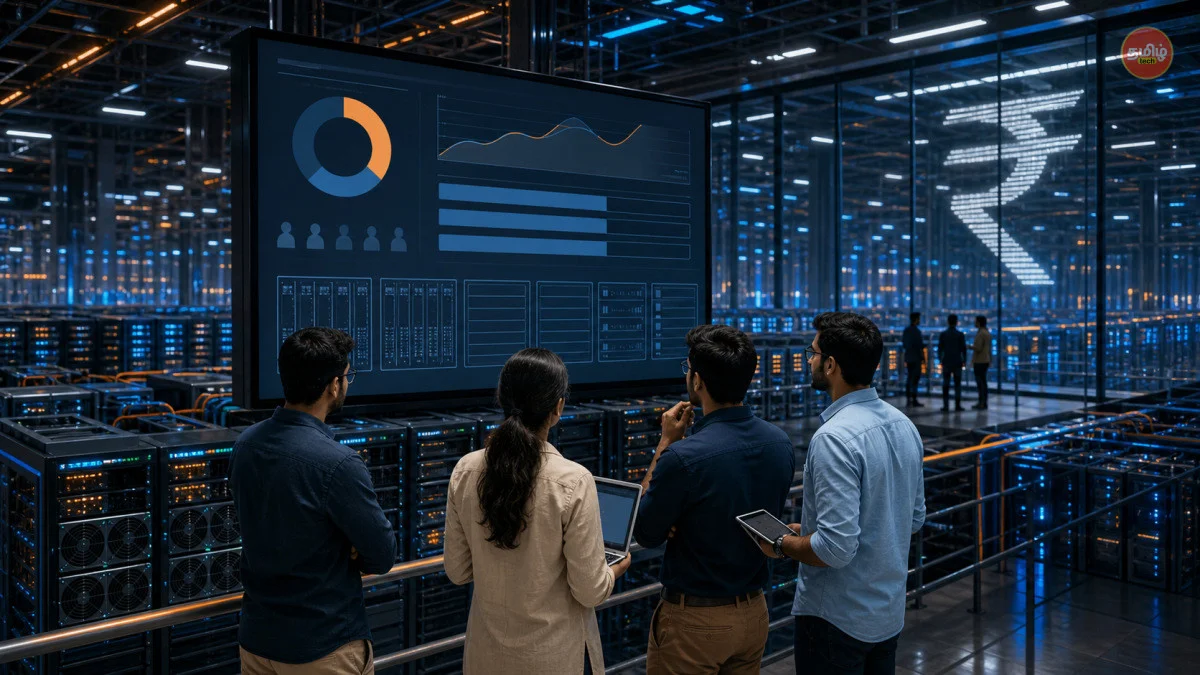
- The IndiaAI Mission has a total budgetary outlay of ₹10,372 crore to build sovereign AI compute capacity.
- As of 2026, nearly 38,000 GPUs have been planned or deployed across 12 empanelled private firms to provide 'Compute-as-a-Service'.
- Despite the massive hardware scale-up, actual utilization by Indian startups and researchers remains below 30% due to high costs and integration hurdles.
- The Indian government is now pivoting to offer 'AI Vouchers' to subsidize compute costs for early-stage startups and academic institutions.
Imagine building a massive 10-lane highway but finding out that only a handful of cars are actually driving on it. That is exactly what is happening with India’s ambitious AI infrastructure right now. In 2026, India is at a crossroads where we have the muscle—the hardware—but we are desperately looking for the 'drivers'—the startups and researchers—to actually use this power. The government’s ₹10,372 crore IndiaAI Mission was supposed to be the backbone of our digital sovereignty, but the ground reality is a bit more complicated than just buying expensive Nvidia chips.
How We Got Here: The ₹10,372 Crore Bet
Two years ago, the Indian government realized that if we didn't have our own AI compute power, we would forever be dependent on American giants like Microsoft, Google, and Amazon. This led to the approval of the IndiaAI Mission. The goal was simple: build a massive cluster of at least 10,000 GPUs (Graphics Processing Units) to help Indian companies train their own Large Language Models (LLMs). Fast forward to today in 2026, and that number has expanded. Through partnerships with 12 major firms—including the likes of Yotta Data Services, Tata Communications, and Netmagic—the total pool of available GPUs for the mission has touched nearly 38,000 units.
This wasn't just about buying chips; it was about creating an ecosystem. The government empanelled these 12 firms to act as 'Compute Providers.' The idea was that the government would subsidize the cost, and these firms would provide the raw power to anyone building AI in India. On paper, it looked like a masterstroke. We have the data, we have the talent, and now we have the GPUs. But as we’ve seen over the last few months, having the hardware is only 40% of the battle.
The Numbers: 38,000 GPUs and the 'Empty Rack' Syndrome
Let’s talk specs. We are not talking about basic gaming GPUs here. We are talking about high-end enterprise-grade hardware like the Nvidia H100s, H200s, and even the newer Blackwell B200 units that have started arriving in Indian data centers this year. These chips are the gold standard for training AI models like ChatGPT or Claude. However, industry data suggests that a significant portion of this capacity is sitting idle. Why? Because training a model isn't just about renting a GPU for an hour. It requires massive datasets, specialized software stacks, and, most importantly, a lot of money.
The 12 empanelled firms have built world-class facilities in cities like Navi Mumbai, Chennai, and Noida. They have the cooling systems, the high-speed interconnects, and the security protocols ready. But for a small startup in Bengaluru or Chennai, the cost of renting these high-end GPUs—even with government subsidies—is often higher than what they would pay on a global cloud provider like AWS or Azure if they have 'startup credits.' This has created a paradoxical situation where India has one of the world's largest sovereign AI compute pools, yet our developers are still logging into US-based servers to run their code.
The India Impact: Why Startups are Hesitant
In the Indian context, cost is everything. While the IndiaAI Mission offers subsidies, the process of applying for these 'AI Vouchers' has been described by many founders as 'bureaucratic.' If a startup needs to test a feature today, they can't wait three weeks for a government approval process. They need to click a button and start training. Global providers offer 'spot instances'—unused capacity at 70-80% discounts—which the Indian empanelled firms are currently struggling to match because of their high initial capital expenditure on the hardware.
Furthermore, there is the 'Data Residency' factor. While the government wants data to stay in India, many AI tools and libraries are optimized for global cloud platforms. If your data is on an Indian server but your favorite AI development tools are better integrated with Google Cloud, you’re going to face latency issues. We’ve spoken to several AI founders who say that while they want to support the local mission, the 'friction' of moving their entire workflow to a new provider is currently too high. This is the 'last-mile' connectivity problem of the AI world.
How to Access the Power: A Step-by-Step for Researchers
If you are a researcher or a startup founder looking to tap into this ₹10,000 crore treasure trove, here is how the process currently works. First, you need to register on the IndiaAI portal. You have to submit a proposal detailing what you are building—whether it's a healthcare AI, a local language model (like a Tamil LLM), or an agritech solution. Once your proposal is vetted, you are granted 'AI Vouchers.' These vouchers act like digital currency that you can 'spend' at any of the 12 empanelled data centers.
The 12 firms include names you should know: Yotta, Tata Communications, E2E Networks, and others. Each has a different pricing model and specialized support. For example, if you are doing heavy LLM training, you might choose a provider with better liquid cooling and H100 clusters. If you are doing 'Inference' (running an already trained model), you might go for cheaper, older GPUs. The key is to compare the 'Price per GPU-hour' across these 12 firms before committing your vouchers. It is a competitive marketplace, but it requires the user to be tech-savvy enough to manage their own infrastructure.
Comparison: IndiaAI Mission vs. Global Cloud Giants
Let's look at the pros and cons. On the side of the IndiaAI Mission, you have data sovereignty—your data never leaves Indian soil, which is crucial for government contracts or sensitive healthcare data. You also get local support and, potentially, the lowest prices if you qualify for the highest tier of subsidies. On the other hand, global giants like AWS, Google Cloud, and Azure offer a 'one-stop-shop.' They don't just give you a GPU; they give you the database, the security, the monitoring, and the AI deployment tools all in one dashboard. For many startups, the 'convenience' of the global giants outweighs the 'cost-saving' of the local mission.
TamilTech’s Honest Take: What’s Next?
At TamilTech, we think the government has done the hard part—getting the budget and the hardware. But now comes the harder part: building the software layer. You can't just give someone a Ferrari and expect them to win a race if they don't have the fuel or a paved track. India needs to focus on 'AI Middleware.' We need an Indian software layer that makes it as easy to use a Yotta GPU as it is to use a Google Cloud one. We also need to simplify the voucher system—make it instant, like a UPI transaction for compute power.
Looking ahead to the rest of 2026, we expect the government to announce a second phase of the mission. This phase won't be about buying more GPUs; it will be about 'Demand Generation.' Expect to see more 'AI Grand Challenges' with massive prize pools and guaranteed compute access. The goal is to move from 'Hardware Sovereignty' to 'Application Sovereignty.' If we don't find a way to get our startups onto these 38,000 GPUs soon, we risk having the world's most expensive collection of paperweights. The talent is there, the hardware is there—now we just need to bridge the gap.





Comments (0)
Be the first to comment!