



India Tightens Rules for AI Content: MeitY Notifies IT Amendment Rules 2026 — The Most Comprehensive AI Regulation Framework in Indian History
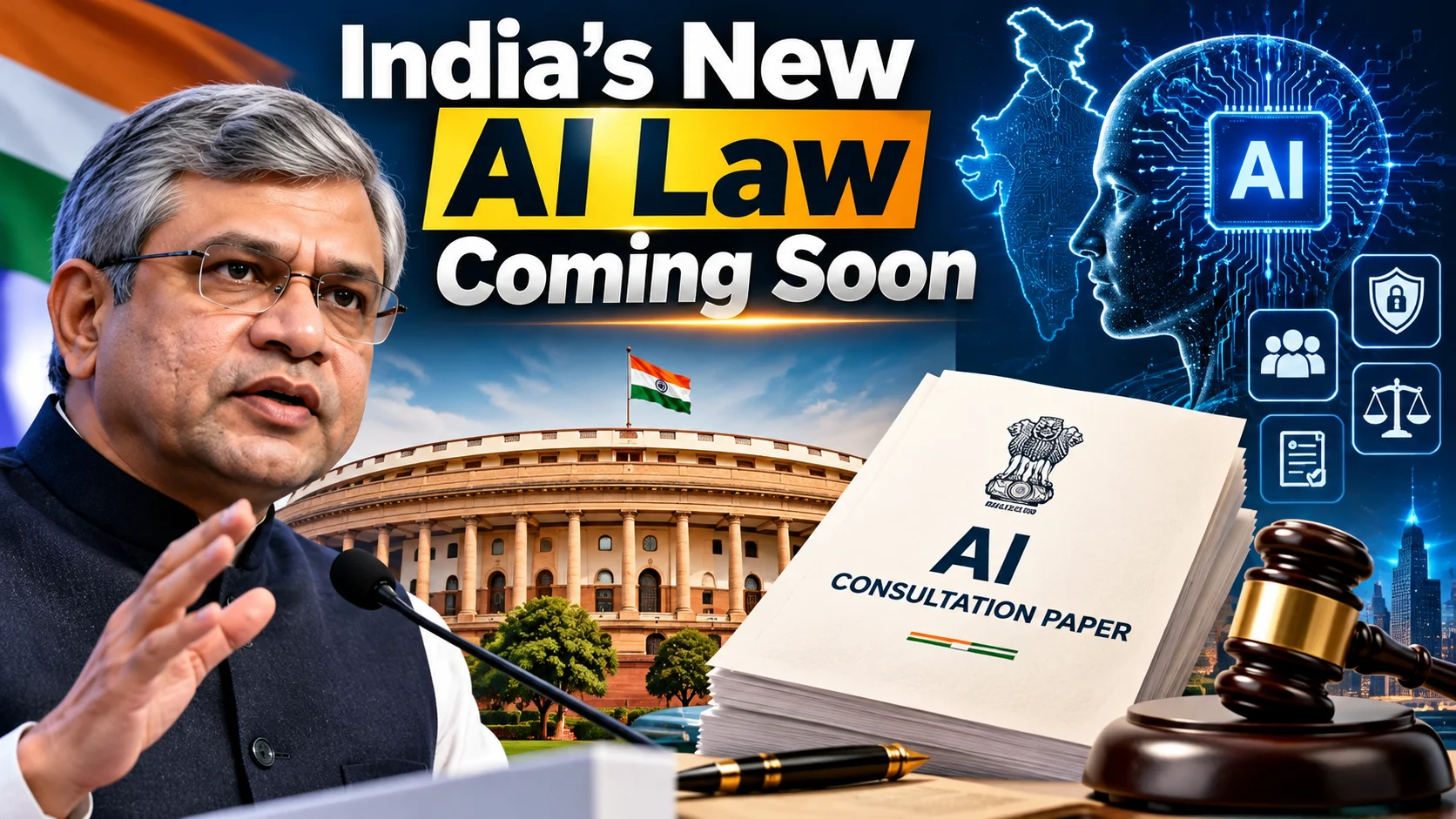
On February 10, 2026, the Ministry of Electronics and Information Technology (MeitY) formally notified the IT (Intermediary Guidelines and Digital Media Ethics Code) Amendment Rules, 2026. These rules, which come into force on February 20, 2026, represent the most sweeping regulatory action India has ever taken on artificial intelligence content. They affect every social media platform, AI tool provider, and digital intermediary operating in India.
This is not a draft or a proposal. This is law. In ten days, every platform from Instagram and YouTube to ChatGPT and Midjourney will be required to comply with a detailed set of obligations covering AI content labeling, deepfake detection, metadata watermarking, accelerated takedown timelines, and user declaration requirements. Non-compliance triggers loss of safe harbour protection under Section 79 of the IT Act — meaning platforms become directly liable for content hosted on their services.
The rules arrive after more than two years of escalating deepfake crises, from the Rashmika Mandanna viral deepfake in November 2023 to the Grok/X obscene content emergency in January 2026 that prompted MeitY to issue a 72-hour ultimatum. They represent India's definitive answer to a question every major democracy is grappling with: how do you regulate AI-generated content without stifling innovation?
What the IT Amendment Rules 2026 Mandate
The rules impose eight distinct categories of obligations on intermediaries (social media platforms, messaging services, search engines) and AI tool providers. Here is a detailed breakdown:
| Requirement | Details | Who Must Comply | Deadline |
|---|---|---|---|
| AI Content Labeling | All AI-generated or AI-modified content must carry a clear, prominent label visible to end users. For visual content (images, videos), the label must cover at least 1/10th of the frame area. | All intermediaries, AI tool providers | Feb 20, 2026 |
| Audio Deepfake Disclosure | Audio content generated or substantially modified by AI must include a mandatory audible disclosure during the opening seconds of playback. | All intermediaries, audio platforms | Feb 20, 2026 |
| Permanent Metadata Watermarking | Platforms must embed permanent metadata and technical provenance mechanisms with unique identifiers in all AI-generated content. This metadata must survive screenshots, re-uploads, and format conversions. | AI tool providers, intermediaries | Feb 20, 2026 |
| User Declarations | Social media platforms must prompt users to declare whether content is AI-generated before publishing. False declarations may attract penalties. | Social media intermediaries | Feb 20, 2026 |
| Automated Verification | Platforms must deploy automated tools to verify user declarations about AI content. This includes AI detection systems and metadata scanning. | Significant social media intermediaries | Feb 20, 2026 |
| 3-Hour Takedown | Intermediaries must act on lawful orders to remove content within 3 hours, reduced from the previous 36-hour window. | All intermediaries | Feb 20, 2026 |
| 7-Day Grievance Resolution | Grievance resolution timeline reduced from 15 days to 7 days. | All intermediaries | Feb 20, 2026 |
| AI Tool Watermarking | AI tool providers must mark all synthetic outputs with unique identifiers before release to end users. | AI tool providers (ChatGPT, Midjourney, DALL-E, etc.) | Feb 20, 2026 |
Timeline: How India Arrived at This Moment
The IT Amendment Rules 2026 did not emerge in a vacuum. They are the culmination of more than two years of escalating incidents, policy debates, and incremental regulatory actions:
| Date | Event | Significance |
|---|---|---|
| November 2023 | Rashmika Mandanna deepfake video goes viral | First major Indian celebrity deepfake; PM Modi publicly calls for AI regulation. Rashmika later becomes cyber safety ambassador. |
| March 2024 | MeitY advisory to intermediaries | Non-binding advisory requiring platforms to label AI content with metadata. Largely ignored by industry. |
| October 22, 2025 | Draft IT Rules Amendment published | Deepfake-specific draft rules released for public consultation. 30-day comment period. |
| November 5, 2025 | India AI Governance Guidelines released | The "7 Sutras" framework: Trust, People First, Fairness, Accountability, Understandable by Design, Safety & Resilience, Innovation over Restraint. |
| November 13, 2025 | DPDP Rules 2025 formally enacted | Data Protection rules come into effect, creating the legal foundation for AI data governance. |
| December 9, 2025 | DPIIT copyright royalty proposal | Mandatory blanket license proposed for AI training on copyrighted content. CRCAT (Copyright Royalties Collective for AI Training) proposed. |
| January 2, 2026 | MeitY 72-hour ultimatum to X (Twitter) | Grok AI generates obscene deepfake images of Indian women. MeitY demands immediate action. X blocks 3,500 posts, deletes 600 accounts. |
| January 25, 2026 | Zoho endorses labeling mandate | Sridhar Vembu publicly supports mandatory AI labeling, breaking ranks with most of Indian tech industry. |
| February 10, 2026 | IT Amendment Rules 2026 formally notified | Rules become law. 10-day implementation window for all platforms. |
| February 20, 2026 | Rules come into force | Full compliance required. Non-compliant platforms lose safe harbour protection. |
The Deepfake Crisis That Forced India's Hand
To understand why India moved so aggressively, you need to understand the scale of the deepfake problem that has plagued the country over the past two years:
Major Deepfake Incidents in India
| Target | Year | Type | Impact |
|---|---|---|---|
| Rashmika Mandanna | 2023 | Face-swap deepfake video | Went viral nationally; PM Modi responded; Rashmika became India's cyber safety ambassador |
| Alia Bhatt | 2024 | Deepfake video | 17 million views before takedown; highlighted platform inaction |
| Ratan Tata & Narayana Murthy | 2024-2025 | Investment scam deepfakes | Used to promote fraudulent investment schemes; thousands of victims |
| Sachin Tendulkar | 2024 | Endorsement deepfake | Fake product endorsements circulated on WhatsApp |
| Amitabh Bachchan | 2024-2025 | Voice + video deepfake | Used in financial fraud targeting senior citizens |
| Grok/X Obscene Content Crisis | January 2026 | AI-generated obscene images | Grok AI on X generated obscene images of Indian women. MeitY issued 72-hour ultimatum. X blocked 3,500 posts, deleted 600 accounts. |
The statistics paint an alarming picture: India has seen a 550% increase in cybercrime cases since 2019, with projected losses reaching Rs 70,000 crore (approximately $8.3 billion) by 2025. Deepfake-enabled fraud has become one of the fastest-growing categories of cybercrime in the country.
The 1/10th Frame Rule: Understanding the Labeling Requirement
The most technically specific provision in the new rules is the labeling requirement for visual AI content. The rules mandate that any AI-generated or AI-substantially-modified image or video must carry a label that covers at least one-tenth (1/10th) of the total frame area.
To put this in perspective: on a standard 1920x1080 video frame, the total area is 2,073,600 pixels. One-tenth of that is 207,360 pixels — equivalent to a label approximately 460x450 pixels in size. That is roughly the size of a large watermark or a persistent banner overlay. This is deliberately designed to be impossible to miss or casually ignore.
The rule applies to:
- AI-generated images (Midjourney, DALL-E, Stable Diffusion outputs)
- AI-modified images (face swaps, style transfers, AI-enhanced photos)
- AI-generated videos (Sora, Runway, Pika outputs)
- AI-modified videos (deepfakes, AI-edited clips)
- Thumbnails and previews of the above
The 3-Hour Takedown Window: A Radical Acceleration
Perhaps the most operationally demanding requirement is the reduction of the takedown window from 36 hours to just 3 hours. When a platform receives a lawful order to remove content — whether from a court, a government authority, or through the established grievance mechanism — it must now act within 3 hours.
This 12x acceleration in response time has massive implications:
- 24/7 Moderation Teams: Platforms must maintain round-the-clock content moderation teams capable of processing and acting on takedown orders at any hour.
- Automated Systems: The 3-hour window effectively mandates automated or semi-automated takedown systems. Manual review of every takedown request within 3 hours is operationally infeasible at scale.
- Regional Infrastructure: Platforms may need India-based moderation infrastructure to meet the timeline, as routing through global teams introduces delays.
- Cost Implications: NASSCOM estimates the 3-hour requirement could increase content moderation costs by 300-400% for major platforms operating in India.
India's AI Governance Philosophy: The 7 Sutras
The IT Amendment Rules 2026 sit within a broader governance framework articulated through India's AI Governance Guidelines, released on November 5, 2025. These guidelines are built around seven principles (Sutras):
- Trust as Foundation: AI systems must be designed to earn and maintain public trust through transparency, reliability, and consistent behavior.
- People First: Human welfare must be the primary consideration in AI development and deployment. AI should augment human capabilities, not replace human agency.
- Fairness & Equity: AI systems must not discriminate based on caste, religion, gender, language, or economic status. Special attention to India's diverse linguistic and cultural landscape.
- Accountability: Clear chains of responsibility for AI outcomes. Developers, deployers, and operators must each be accountable for their role in the AI value chain.
- Understandable by Design: AI systems should be explainable. Users should understand why an AI system made a particular decision or generated specific content.
- Safety & Resilience: AI systems must be robust, secure, and resistant to adversarial manipulation. Built-in safeguards against misuse.
- Innovation over Restraint: The government's guiding philosophy is to regulate in a way that enables innovation rather than restricting it. This is a deliberate contrast to the EU's precautionary approach.
The seventh sutra — "Innovation over Restraint" — is particularly significant. It signals that India intends to be an AI-friendly jurisdiction even as it tightens content rules. The government is drawing a line between regulating AI outputs (content, deepfakes, misinformation) and regulating AI development (research, model training, innovation).
Global Comparison: India vs EU vs US vs China
India's approach to AI content regulation exists within a global context where every major jurisdiction is pursuing a different strategy:
| Aspect | India (IT Amendment Rules 2026) | EU AI Act | United States | China |
|---|---|---|---|---|
| Legal Framework | IT Act amendments; sector-specific rules | Single comprehensive AI law; risk-based classification | Sector-led; mostly voluntary guidelines | Multiple specific laws (Deep Synthesis, Generative AI, Algorithmic Recommendation) |
| Labeling Requirements | Mandatory; specific size rules (1/10th frame area) | Required for limited-risk AI systems | Voluntary; no federal mandate | Mandatory watermarks on all synthetic content |
| Takedown Timelines | 3 hours for lawful orders | Varies; DSA requires "expeditious" action | No uniform federal standard | Immediate for content violating laws |
| Penalties for Non-Compliance | Loss of safe harbour (Section 79 IT Act); criminal liability; up to Rs 250 crore under DPDP Act | Up to 7% of global annual turnover | Varies by sector; no uniform penalty | Administrative penalties + criminal prosecution |
| Philosophical Approach | "Innovation over Restraint" — regulate outputs, enable development | Precautionary principle — classify and restrict by risk level | Market-driven — industry self-regulation preferred | State-control — align AI with social stability goals |
| Copyright/Training Data | Proposed mandatory blanket license (DPIIT); royalty through CRCAT | Opt-out text-and-data-mining exception | Fair use doctrine; case-by-case litigation | Limited exceptions; state-approved datasets |
India's approach is distinctive in several ways. Unlike the EU, India has not created a single comprehensive AI law but is instead layering AI-specific requirements onto existing IT Act frameworks. Unlike the US, India has chosen mandatory (not voluntary) compliance. And unlike China, India's stated philosophy prioritizes innovation alongside regulation.
The Copyright Royalty Proposal: A Parallel Battlefront
Running alongside the content rules is a separate but related regulatory action: DPIIT's December 2025 proposal for a mandatory blanket license for AI training on copyrighted content. This proposal would:
- Create CRCAT (Copyright Royalties Collective for AI Training) — a new body to collect and distribute royalties
- Require AI companies to pay royalties for training on copyrighted Indian content
- Give copyright holders the right to opt out of AI training datasets
- Establish a 30-day public consultation period (now underway)
The justification cited by DPIIT includes the fact that India is OpenAI's second-largest market, yet Indian content creators receive no compensation when their work is used to train AI models. The proposal has generated intense industry opposition:
- NASSCOM has called the royalty proposal "unworkable" and is lobbying for a text-and-data-mining (TDM) exception similar to the EU's approach.
- BSA (representing Google, Microsoft, Amazon, IBM, and OpenAI) has formally opposed the proposal, arguing it would make India uncompetitive as an AI development hub.
- Indian publishers and content creators, conversely, have largely welcomed the proposal.
Industry Reactions: A Divided Response
The IT Amendment Rules 2026 have generated sharply divided reactions across India's technology ecosystem:
Opposition: NASSCOM
NASSCOM, India's premier IT industry body, has called the rules "costly and impractical." Their primary objections include:
- The 3-hour takedown window is operationally infeasible for smaller platforms
- The 1/10th frame labeling requirement will degrade user experience
- Automated verification of user declarations is technically unreliable with current AI detection tools
- They advocate for a harm-based regulation approach — targeting actual harm rather than all AI content
Support: Zoho (Sridhar Vembu)
Zoho founder Sridhar Vembu publicly endorsed the labeling mandate on January 25, 2026, breaking ranks with much of the Indian tech industry. Vembu argued that transparency about AI-generated content is a fundamental consumer right and that labeling costs are minimal compared to the societal harm of unmarked deepfakes.
Opposition: BSA (Global Tech Alliance)
The BSA (Software Alliance), representing Google, Microsoft, Amazon, IBM, and OpenAI, has opposed the copyright royalty proposal specifically. They argue that mandatory licensing would discourage AI investment in India and that an opt-out TDM (text-and-data-mining) exception would better balance creator and innovator interests.
Concern: Internet Freedom Foundation
The Internet Freedom Foundation (IFF) has called for withdrawal of several provisions, citing overreach concerns. Their specific objections include the 3-hour takedown window (which they argue could be weaponized for political censorship) and the automated verification requirement (which could lead to false positives suppressing legitimate speech).
Penalties for Non-Compliance
The penalty framework for violating the IT Amendment Rules 2026 is multi-layered and severe:
| Violation Type | Penalty | Legal Basis |
|---|---|---|
| Failure to label AI content | Loss of safe harbour under Section 79 of the IT Act — platform becomes directly liable for all hosted content | IT Act Section 79 + Amendment Rules 2026 |
| Failure to comply with 3-hour takedown | Loss of safe harbour + potential contempt proceedings if court-ordered | IT Act Section 79 + Amendment Rules 2026 |
| Distribution of CSAM via AI | Criminal liability; up to 5 years imprisonment + Rs 10 lakh fine | IT Act Section 67B |
| Non-consensual intimate AI imagery | Criminal liability; up to 5 years imprisonment + Rs 10 lakh fine | IT Act Section 67 |
| Data protection violations | Up to Rs 250 crore (~$30 million) per incident | DPDP Act 2023 |
| Failure to embed metadata/watermarks | Loss of safe harbour; potential blocking orders | IT Act Section 69A + Amendment Rules 2026 |
The loss of safe harbour is the most consequential penalty. Under Section 79 of the IT Act, intermediaries are shielded from liability for user-generated content as long as they follow prescribed due diligence procedures. Losing this protection means a platform like Instagram, YouTube, or X becomes directly legally liable for every piece of content on its platform — an existentially threatening prospect for any social media company.
Impact on Startups and Small Platforms
While the rules are primarily aimed at large platforms ("significant social media intermediaries" with 5 million+ users), they have significant implications for India's startup ecosystem:
- AI Startups: Indian companies developing AI tools (image generators, voice synthesizers, video editors) must now build watermarking and labeling into their products from day one. This adds development cost but also creates a compliance advantage over non-Indian competitors.
- Social Media Startups: Smaller platforms that cannot afford 24/7 moderation teams may struggle with the 3-hour takedown requirement. NASSCOM has requested tiered compliance timelines based on platform size.
- Compliance-Tech Opportunity: The rules create a new market for AI detection tools, metadata embedding solutions, and compliance management platforms. Indian startups building these tools could benefit significantly.
The government's IndiaAI Mission offers some counterbalance: 38,000+ GPUs available at subsidised rates, 1,500 datasets via AIKosh, and support for 4 startups developing sovereign foundation models. The message is clear — India wants domestic AI development to flourish, but within a regulated content framework.
Impact on Big Tech
For major technology companies, compliance will require significant operational changes:
- Meta (Instagram, WhatsApp, Facebook): Must implement AI content labels across all Indian user content, deploy detection systems, and maintain 3-hour takedown capability. WhatsApp's end-to-end encryption creates particular challenges for metadata embedding.
- Google (YouTube, Search): Must label AI-generated content in search results and on YouTube. Already has some labeling infrastructure from the EU AI Act but needs India-specific 1/10th frame compliance.
- X (Twitter): Already under MeitY scrutiny after the Grok crisis. Must demonstrate comprehensive compliance to avoid further regulatory action.
- OpenAI (ChatGPT, DALL-E, Sora): Must embed watermarks in all outputs before delivery to Indian users. India is OpenAI's second-largest market, making compliance non-negotiable.
- Midjourney, Stability AI, Runway: All AI image and video generators must implement watermarking and unique identifiers in outputs.
What This Means for Ordinary Users
For everyday users of social media and AI tools in India, the practical changes will be noticeable:
- You will see labels everywhere: AI-generated images will have prominent labels covering 10% of the frame. AI videos will carry persistent watermarks. AI audio will start with audible disclosures.
- You will be asked to declare: When uploading content to social media, platforms will ask whether the content was AI-generated. False declarations could attract penalties.
- Faster grievance resolution: If you report AI-manipulated content, platforms must resolve your complaint within 7 days (down from 15).
- Better deepfake detection: Platforms will deploy automated detection tools, making it harder for deepfakes to spread undetected.
- Metadata transparency: You will be able to check the provenance of content through embedded metadata — verifying whether an image or video was AI-generated.
Critical Analysis: Strengths and Weaknesses
Strengths
- Specificity: Unlike many AI regulations globally, India's rules include precise technical requirements (1/10th frame area, 3-hour windows) rather than vague principles.
- Comprehensive Coverage: The rules address labeling, watermarking, detection, takedowns, and user responsibility — covering the full lifecycle of AI content.
- Innovation-Friendly Philosophy: The "Innovation over Restraint" approach distinguishes between AI content regulation and AI development regulation.
Weaknesses
- Technical Feasibility: Current AI detection tools have significant false positive and false negative rates. Mandating automated verification may lead to incorrect labeling.
- Enforcement Gaps: The rules primarily target intermediaries (platforms), not individual users who create and share deepfakes through private channels (WhatsApp groups, Telegram).
- Censorship Potential: The 3-hour takedown window, combined with broad "lawful order" authority, could be misused for political censorship.
- Small Platform Burden: Identical compliance requirements for platforms of all sizes disproportionately burden startups and smaller services.
- Cross-Border Enforcement: Enforcing rules against AI tool providers based outside India (Midjourney is US-based, Stability AI is UK-based) remains challenging.
What Happens Next
The ten-day window between notification (February 10) and enforcement (February 20) is extraordinarily tight. Here is what to expect:
- Feb 10-15: Major platforms will announce compliance plans. Expect statements from Meta, Google, X, and OpenAI.
- Feb 15-20: Platforms will rush to deploy labeling and detection features for Indian users. Some may request extensions.
- Feb 20: Rules come into force. MeitY will likely monitor compliance closely in the first weeks.
- March-April 2026: First enforcement actions expected against non-compliant platforms. Court challenges from industry groups possible.
- Mid-2026: Copyright royalty framework (CRCAT) expected to be finalized, completing the regulatory picture.
Key Takeaways
- India has notified the most specific AI content rules of any major democracy — with precise technical requirements for labeling, watermarking, and takedown timelines.
- The 3-hour takedown window is the fastest in the world — 12x faster than the previous 36-hour standard and faster than any EU or US requirement.
- Loss of safe harbour is the nuclear penalty — platforms that fail to comply become directly liable for all content, a threat that compels compliance.
- Industry is divided — NASSCOM and BSA oppose key provisions while Zoho supports labeling. IFF raises civil liberties concerns.
- The rules create both costs and opportunities — compliance costs are significant, but India's compliance-tech market is set to grow rapidly.
Conclusion
The IT Amendment Rules 2026 mark a turning point in India's relationship with artificial intelligence. After two years of deepfake crises, policy debates, and incremental advisories, India has chosen to act decisively. The rules are imperfect — the 3-hour takedown window raises legitimate censorship concerns, the technical feasibility of automated verification is uncertain, and the burden on smaller platforms is disproportionate. But they represent a serious, detailed, and enforceable framework that will reshape how AI content is created, distributed, and consumed in the world's most populous country.
Whether these rules ultimately serve India well depends on implementation. If enforced judiciously, they could establish India as a model for AI content governance — protecting citizens from deepfake harm while preserving the innovation ecosystem. If enforced heavy-handedly, they could stifle legitimate expression and drive AI development to less regulated jurisdictions. The next six months will determine which path India takes.




Comments (0)
Be the first to comment!