


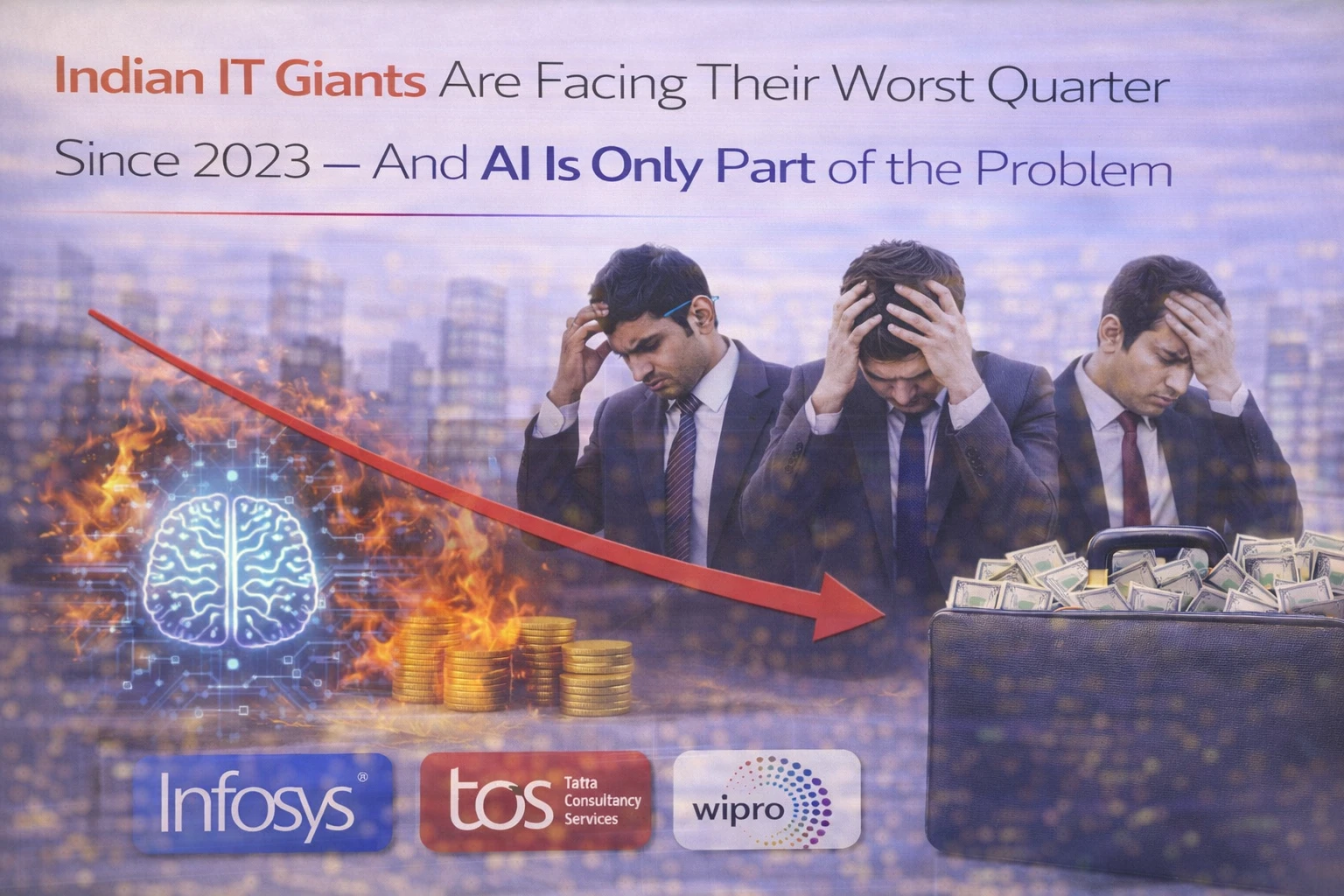
Q4 results land April 9 — and 5.9 million IT workers are watching
Tata Consultancy Services reports its Q4 FY26 earnings on April 9, after market hours. Infosys, HCLTech, Wipro, and Tech Mahindra follow within the same week. The numbers matter beyond the usual analyst note cycle. India's IT and software services sector employs 5.9 million people, generates over $315 billion in annual revenue, and has been the single largest white-collar job engine in the country for two decades.
This quarter could be the worst one the sector has delivered since March 2023. Not because of a lack of demand — though global tech spending has slowed to just 5-6% growth. Not just because of the war-related uncertainties making Western enterprise clients nervous. But because the fundamental economic model of Indian IT services is being disrupted from two directions at once: AI-driven cost optimization on one side, and a structural shift in what global clients actually need on the other.
The stock market already knows something is wrong. Indian IT shares are down 20% year-to-date — significantly worse than the broader Nifty 50 decline of 13%. Investors are pricing in a structural reset, not a cyclical dip.
The hiring numbers tell the real story
India's tech sector had 256,000 active job openings in April 2022. At that point, tech accounted for 83% of all hiring in the country — the post-pandemic IT services boom was in full swing. In April 2026, there are approximately 110,000 active tech job openings, down 8% from 119,000 in March. Tech's share of total Indian hiring has slumped from 83% to 49%.
Recruitment has been sluggish for four consecutive quarters now. But this isn't a blanket slowdown — it's highly selective. IT services companies have reduced hiring to only essential roles and newer skill sets, focusing heavily on AI-led efficiency. Global capability centres — the in-house tech centres of Western companies in India — continue to hire, but much more selectively, slowing down on low-value and support roles while investing in high-skill, strategic, and digital capabilities.
Global clients from the US and Europe are deferring hiring decisions rather than cancelling them outright. But the effect is the same: fewer entry-level positions, slower onboarding, and a clear signal to fresh engineering graduates that the India IT hiring machine has changed gears permanently.
Companies are actively cutting headcount — not just pausing
This isn't about a hiring freeze. Major IT companies are actively reducing employee numbers. TCS has cut 20,000 positions in Q2 FY26 and another 11,150 in Q3 — a total of 31,150 over two quarters. Oracle cut nearly 12,000 roles in India alone. TCS's total employee base now stands at 582,163, about 2% lower than its recent peak.
The justification, from company earnings calls and internal communications, is familiar: AI is delivering 10-40% productivity gains in tasks like coding, customer support, and routine maintenance. Teams that previously needed 100 people for application maintenance now need 60 to 70. AI code generation tools allow smaller dev teams to produce the same output. Companies are not pulling back on technology adoption — they're pulling back on headcount because the technology is doing the work.
Oracle explicitly signalled the approach in an earnings release: "build more with fewer people." It's not a temporary efficiency play. It's a permanent structural change to how IT services work are done.
What's actually happening to the work
The Indian IT services model was built on labour arbitrage: hire large numbers of engineers at lower costs than Western markets, train them, and deploy them at client sites or remote centres. The margin came from the spread between what the company paid engineers and what global clients paid for the services. Over 60% of Indian IT workers now report job-related anxiety, knowing that the routine work their companies have been selling for decades is exactly the work AI tools can automate.
But two skill categories are seeing 18-27% hiring growth: data science and AI engineering roles, and cybersecurity roles. The companies aren't stopping hiring entirely — they're stopping hiring for the roles that are declining, and hiring aggressively for different kinds of people. An electrical engineer with basic coding skills who got a TCS offer in 2015 would not necessarily get an offer in 2026. The same person with AI/ML specialisation or cloud security certification would likely get one with a salary premium.
The weak rupee is masking the damage
Here's a detail that's relevant if you're trying to understand the earnings numbers when they drop next week: Indian IT companies earn most of their revenue in dollars and pay most of their costs in rupees. A weaker rupee makes their financials look better on paper without any actual improvement in business fundamentals. The 10.9% year-on-year revenue growth expected for Q4 FY26 is largely driven by a weaker rupee rather than organic demand. On a constant currency basis, revenue growth for the top four IT firms is projected at just 1.8%.
This is important because it means the headline revenue number next week will look decent at first glance, but the underlying story — constant currency growth of under 2%, declining headcount, slower deal cycles — tells a very different picture. Infosys and HCLTech have already guided for FY27 revenue growth of 2-4% and 4-6% respectively. These are not the growth rates of a sector in expansion.
What this means for specific groups
If you're a new engineering graduate in Tamil Nadu trying to break into IT: the mass-recruitment drives that used to absorb thousands of graduates from engineering colleges are shrinking. Companies still hire freshers, but in much smaller numbers and with much higher skill expectations. Focus on cloud, data science, or cybersecurity — not generic software testing or basic development.
If you're a mid-career professional with 5-10 years in traditional IT services roles in Chennai, Bengaluru, or Hyderabad: the roles centered on routine maintenance, manual testing, and basic application support are the ones most vulnerable. Reskilling isn't optional anymore. The 10-12% salary increase trend exists, but it's concentrated in AI-adjacent and cloud-native roles — not traditional services.
If you're a senior leader or architect in Indian IT: demand for strategic, high-value roles continues. The gap between what companies need at the top and what they need at the bottom is widening. Senior attrition at companies like TCS is running at 16% — that's people leaving voluntarily for better opportunities, which is very different from the headcount reductions happening at junior levels.
TamilTech's take
The Indian IT sector isn't dying — it's becoming something fundamentally different. For twenty years, the model was scale-based: add more people, serve more clients, grow revenue linearly. That model doesn't work when AI lets the same number of people do significantly more work, and when clients are willing to pay for capability and outcomes rather than headcount. The companies that survive are the ones that figure out how to build a capability-led business rather than a people-counting business. If you work in IT in India — and especially if you're early in your career — the lesson is clear: the jobs that can be described as "write basic code, test, maintain" are the ones being replaced. The jobs that cannot be replaced are the ones that involve solving problems nobody has coded for before. Know the difference. Plan accordingly.





Comments (0)
Be the first to comment!