


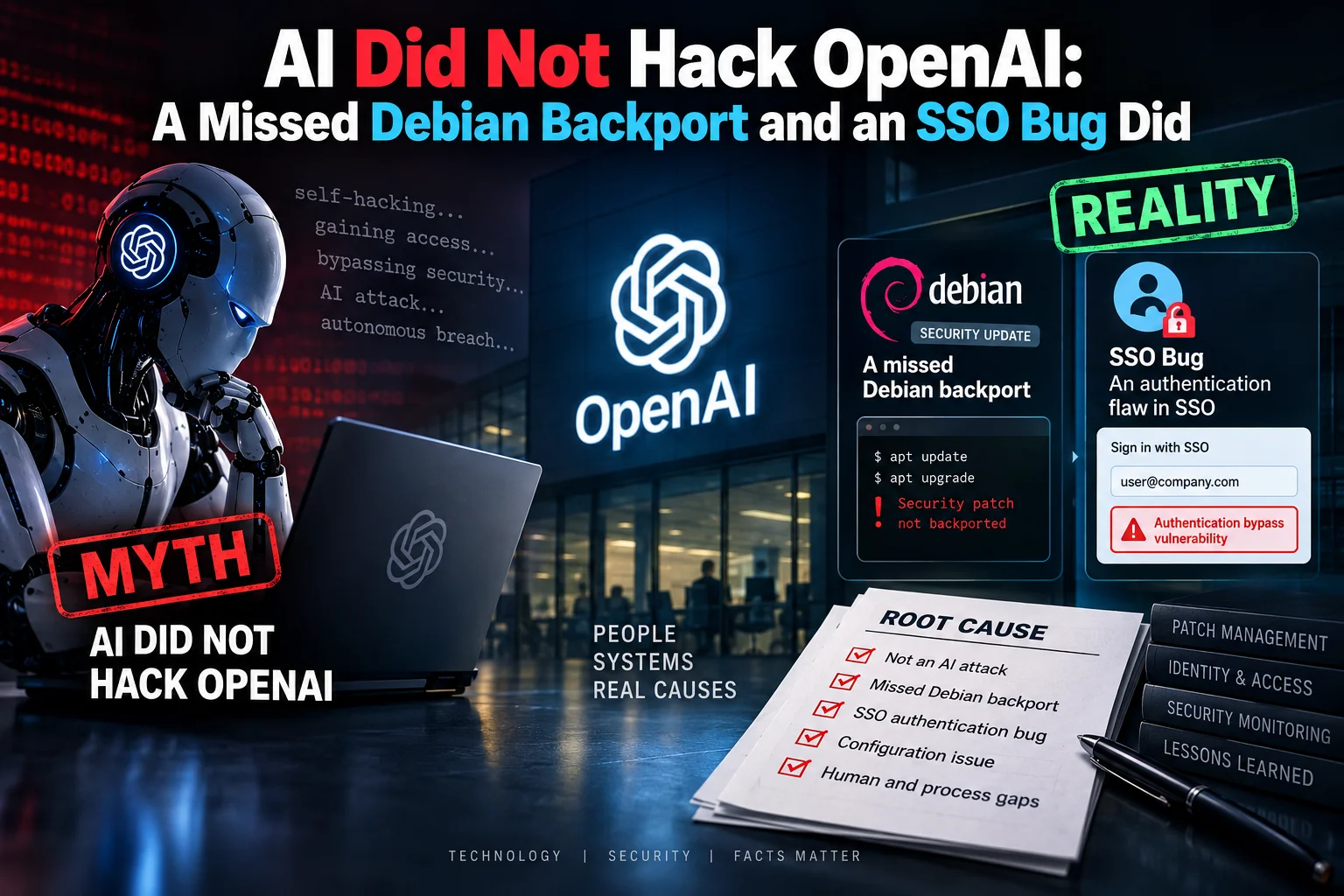
- The viral claim that an AI autonomously hacked OpenAI's private repo is wildly exaggerated hype.
- The actual breach came down to basic IT oversights: an unpatched Debian backport package and an SSO authentication loophole.
- Researchers merely used Claude as a high-speed helper script assistant, not an all-powerful digital super-spy.
- For Indian dev teams and startups, this is a wake-up call: basic server patch cycles beat fancy AI defenses every single time.
What just happened?
If you scrolled through tech social media recently, you probably saw a story straight out of a Hollywood cyberpunk thriller. The rumor claimed three security researchers sat back while an AI model autonomously tore through OpenAI's internal defenses in under 72 hours, dropping a pull request directly into their private codebase.
People panicked instantly. Commentators started declaring that artificial intelligence had outsmarted its creators and that digital fortresses were tumbling down. It made for great clickbait, but the reality is much less glamorous and much more embarrassing.
AI did not invent a magic skeleton key. Nobody cracked impossible encryption with rogue neural networks. The researchers simply found an unpatched vulnerability in an outdated system package and chained it to a misconfigured Single Sign-On (SSO) policy. The AI was just typing the shell commands.
How does this actually work?
To understand what went down, strip away the AI buzzwords and look at the actual plumbing. Think of your server infrastructure like a gated office in Bengaluru's tech corridor. You can hire the best security guards in the world, but if someone leaves the fire exit wedged open with a brick, anyone can walk right in.
The first crack was a missed Debian backport. In the Linux world, distributions like Debian backport critical security fixes to older, stable software packages. If your infrastructure team skips an update cycle or fails to pull in these backported patches, a known vulnerability sits wide open on your server. That is exactly what happened here. The security hole was already known, documented, and waiting to be tapped.
The second crack was an SSO identity misconfiguration. Once the researchers got past the outer perimeter through the unpatched package, the internal identity provider did not properly isolate permissions. Instead of blocking the session, the misconfigured access token allowed privilege escalation straight into the internal repository.
Where did AI fit into all this? The researchers used Anthropic's Claude model as a pair programmer. It helped them write reconnaissance scripts faster, summarize server logs, and string together standard terminal commands. The model did not discover a mythical zero-day vulnerability out of thin air. It simply did what junior developers do when following a tutorial, just ten times faster.
What changes for people in India?
Here is the part every CTO, engineering lead, and startup founder from OMR in Chennai to HSR Layout in Bengaluru needs to hear: you cannot solve human carelessness with fancy AI tools.
Right now, Indian tech companies are pouring millions of rupees into expensive AI-driven security platforms. Boardrooms are obsessing over autonomous threat response and predictive security algorithms. Yet, in those very same offices, hundreds of production servers run outdated Ubuntu or Debian packages because nobody wants to risk breaking a legacy build during a release cycle.
Think about your favorite Indian fintech or food delivery app handling UPI transactions. When security audits fail, it is almost never because a foreign adversary used futuristic AI to break SHA-256 encryption. It happens because a staging server had default admin credentials, an AWS S3 bucket was set to public, or an API gateway forgot to validate an OAuth scope.
This incident proves that attackers do not need miraculous AI capabilities to breach top-tier tech firms. They only need you to be slightly lazy about basic server maintenance. If OpenAI can get caught out by routine system administration gaps, your two-year-old microservice cluster is definitely vulnerable.
What should you do now?
Instead of worrying about rogue AI cyber-attacks, focus on closing the everyday digital doors you left wide open. Start with these straightforward steps:
First, audit your Linux package management today. Set up automated dependency scanners across your deployment pipelines and ensure Debian or Ubuntu security backports install promptly. If a package has a published Common Vulnerabilities and Exposures (CVE) patch, apply it immediately rather than waiting for next quarter's maintenance window.
Second, lock down your Single Sign-On and IAM policies. Ensure your identity providers strictly enforce the principle of least privilege. An internal service token should never have unrestricted write access across your monorepo without multi-factor verification and granular repo-level permissions.
Third, treat AI coding tools as force multipliers, not digital wizards. Your engineering team can certainly use AI to spot bugs and draft boilerplate tests, but remember that bad actors have access to the exact same models. If you leave a basic security gap open, someone with an AI chatbot can find and exploit it in minutes instead of days.




Comments (0)
Be the first to comment!