


Key Takeaways
- ShareChat (Mohalla Tech) achieved a massive ₹1,000 crore revenue turnaround in fiscal 2026 by pivoting from aggressive user acquisition to high-margin monetization.
- The leadership team slashed cloud infrastructure costs by 35% through localized data centers and optimized AI algorithms.
- Virtual gifting and live-streaming on Moj now account for nearly 45% of the company's total revenue, proving the micro-transaction model works in India.
- The company successfully reduced its monthly burn rate from $20 million in 2023 to near-profitability by mid-2026.
So here is the thing — back in 2023 and 2024, everyone in the Indian tech circle was ready to write ShareChat’s obituary. The 'funding winter' was hitting hard, layoffs were happening every other month, and the valuation was getting slashed faster than a discount at a clearance sale. But fast forward to today, July 25, 2026, and the story is completely different. ShareChat hasn't just survived; they’ve executed a ₹1,000 crore turnaround that is honestly one of the most impressive comeback stories in the Indian startup ecosystem. I’ve been tracking their numbers for a while, and what they’ve pulled off is nothing short of a masterclass in 'survival of the fittest.'
The Dark Days: How We Got Here
To understand how big this turnaround is, we have to look back at where they were. Just a couple of years ago, ShareChat was burning cash like there was no tomorrow. They were trying to fight Instagram Reels and YouTube Shorts at their own game, spending millions on marketing and creator payouts. Their cloud bills from AWS and Google Cloud were astronomical because hosting billions of hours of video content isn't cheap. The leadership, led by Ankush Sachdeva, faced a tough choice: keep burning cash and hope for a miracle, or fundamentally change how the business works. They chose the latter, and it wasn't easy. They had to make the hard call of laying off talented people and shutting down non-core projects to keep the lights on.
The biggest problem was that while they had millions of users in Tier 2 and Tier 3 India, they didn't know how to make money from them. Advertisers weren't paying the same premium for a user in a small village as they were for someone in South Delhi or South Mumbai. This 'monetization gap' was the giant hole in their ship. The leadership team realized that they couldn't just rely on ads like Meta does; they needed something uniquely Indian. They needed to tap into the 'digital pocket money' of the Indian heartland, and that’s exactly what they set out to do starting in late 2024 and throughout 2025.
The Pivot to 'Project Profitability'
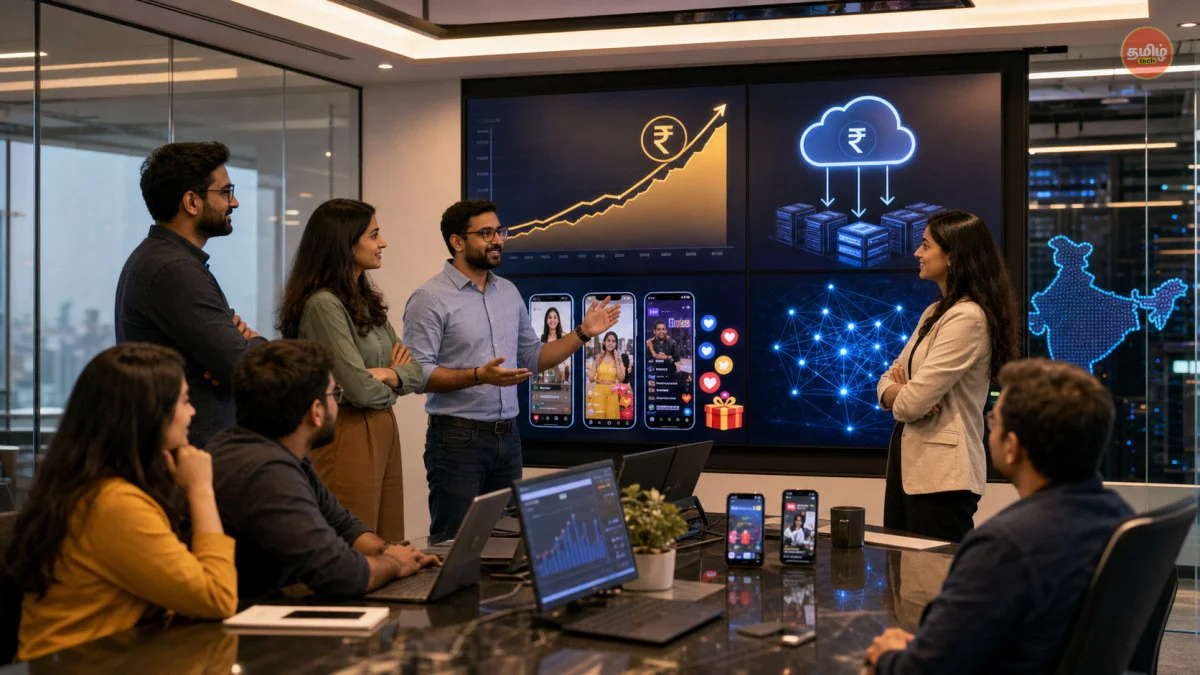
The turnaround started with a shift in mindset. The leadership stopped talking about 'Daily Active Users' (DAU) as the only metric that mattered and started obsessing over 'Average Revenue Per User' (ARPU). They launched 'Project Profitability,' a company-wide mandate to find revenue in every corner of the app. The first big move was doubling down on virtual gifting. If you’ve used Moj or ShareChat recently, you’ll see live streamers performing, singing, or just chatting. Fans can buy digital 'roses' or 'diamonds' for as little as ₹5 to ₹500 to support them. While it sounds small, when you multiply that by millions of users, it becomes a massive revenue stream. This micro-transaction model is exactly what worked for TikTok in China (Douyin), and ShareChat’s leadership was smart enough to adapt it for the Indian context.
But it wasn't just about making more money; it was about spending less. One of the most technical parts of this turnaround happened under the hood. Their engineering leadership spent the last 18 months rewriting their content delivery network (CDN) and AI recommendation engines. By making their AI more efficient, they reduced the 'compute power' needed to show you the next video. They also moved a significant portion of their data processing to more cost-effective localized solutions. This move alone saved them hundreds of crores annually. It’s the kind of boring, behind-the-scenes work that doesn’t get headlines but actually saves companies from going bankrupt.
The Moj Factor and the Ad-Tech Surge
Moj, their short-video platform, was the biggest bet. In 2026, Moj has finally matured into a self-sustaining ecosystem. The leadership realized they couldn't beat Instagram on 'glamour,' so they leaned into 'relatability.' They focused on regional influencers who speak Tamil, Telugu, Bhojpuri, and Punjabi. By building a specialized ad-tech stack that allows local brands (like a regional soap brand or a local coaching center) to target users specifically in their language, they unlocked a whole new segment of advertisers that Google and Meta often overlook. This hyper-local advertising strategy is what pushed their revenue past the ₹1,000 crore mark.
What’s even more interesting is how they integrated commerce. Instead of just showing an ad, they allowed creators to sell products directly through live streams. Think of it as a digital version of those local market auctions. The leadership team saw the potential of 'Social Commerce' early on and integrated it into the core experience. Now, a user in rural Tamil Nadu can watch a live stream about a new smartphone or a saree and buy it without ever leaving the app. ShareChat takes a small cut of every transaction, adding another layer to their ₹1,000 crore pie.
TamilTech’s Honest Take: What’s Next?
Look, I’ll be honest with you — ShareChat still has a long way to go to become a global giant, but what they’ve done in the last two years is incredible. They proved that an Indian social media app can actually make money from Indian users without just copying the Silicon Valley playbook. The leadership showed that being 'frugal' is just as important as being 'innovative.' By focusing on virtual gifting and regional ads, they’ve built a moat that is very hard for foreign companies to cross. They understand the 'Bharat' audience better than anyone else right now.
What should you expect next? I think we’re going to see ShareChat move towards an IPO (Initial Public Offering) by the end of 2026 or early 2027. Now that they’ve shown they can hit ₹1,000 crore in revenue and keep their costs under control, investors are going to be lining up again. For the average user, this means the app will stay free, but expect more 'interactive' features where you can spend small amounts of money to support your favorite creators. It’s a win-win for the ecosystem. ShareChat’s turnaround isn’t just a win for the company; it’s a win for the entire 'Make in India' tech movement.




Comments (0)
Be the first to comment!