


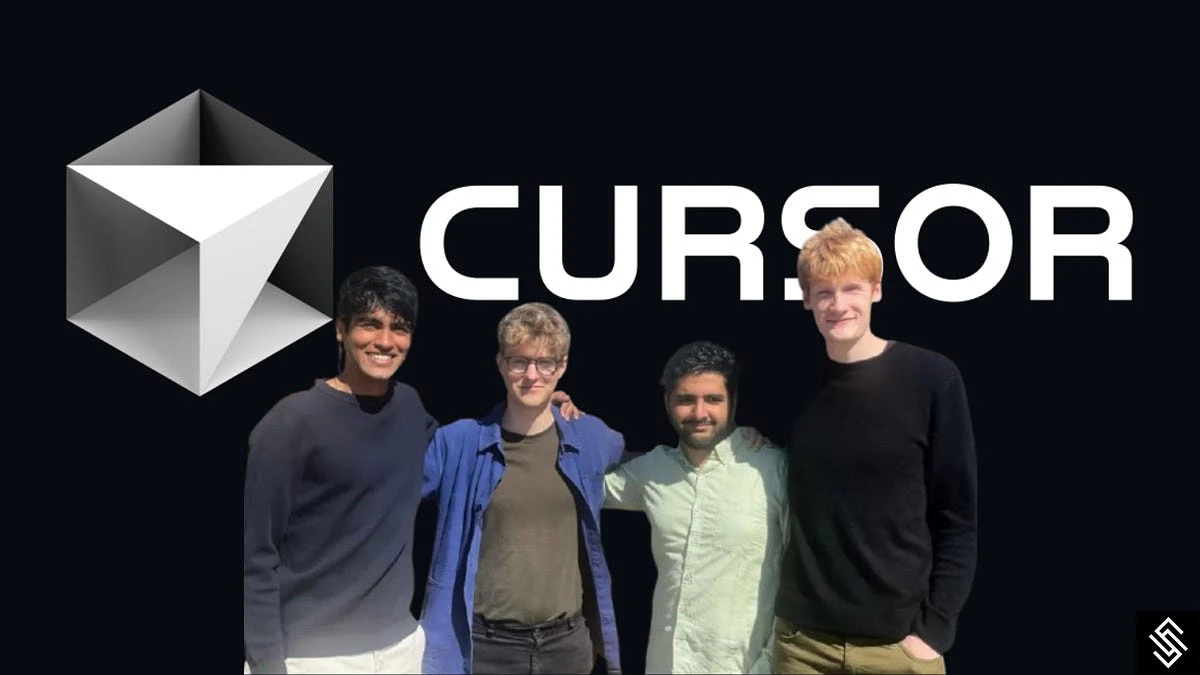
In 2022, four MIT students launched a startup to build AI autocomplete for mechanical engineering software. It failed. They pivoted. And within two years, they built the fastest-growing SaaS company in history — Cursor, an AI-powered code editor that reached $1 billion in annual recurring revenue (ARR) and a $29.3 billion valuation by the end of 2025. The CEO, Michael Truell, was just 25 years old.
The Four MIT Founders
Anysphere — the company behind Cursor — was founded by four MIT classmates who met while studying computer science and mathematics:
- Michael Truell (CEO) — A USA Computing Olympiad finalist who built a programming game at age 14. He had interned at Google, Two Sigma, and Octant.
- Sualeh Asif — Co-founder with deep expertise in machine learning systems
- Arvid Lunnemark — Engineer focused on infrastructure and scaling
- Aman Sanger — Specialist in AI model development and integration
They collaborated on research and projects at MIT and participated in Neo Scholars, a mentorship network for technical undergraduates.
The Failed Start: "Wandering in the Desert"
The founders didn't start with Cursor. Their original idea was to build AI autocomplete tools for CAD (Computer-Aided Design) software used by mechanical engineers. It seemed like a promising niche — design software was stagnant, and AI could potentially revolutionize it.
But reality hit hard:
- The CAD market was uncompetitive and slow-moving
- Training data was scarce — unlike code, there wasn't abundant open-source CAD data
- The market was outside their direct expertise as software engineers
Truell later described this period as "wandering in the desert" — a phase of uncertainty where nothing seemed to work. But this failure taught them a crucial lesson: build for a market you deeply understand.
The Pivot: Building for Developers
The founders realized that code was the perfect domain for AI. Unlike CAD, there were billions of lines of open-source code available for training. And unlike many other fields, the founders were themselves software engineers — they were building for their own community.
Cursor was born as a fork of Visual Studio Code (the world's most popular code editor) with AI capabilities deeply integrated into the editing experience. It used models from Anthropic, OpenAI, and others, plus Anysphere's own proprietary models designed specifically for coding tasks.
The Most Explosive Growth in SaaS History
Cursor's growth has broken every record in SaaS history:
- October 2023: $8 million seed round (led by OpenAI's Startup Fund)
- Late 2024: $100 million raise at $2.5 billion valuation
- January 2025: Crossed $100 million ARR — in just 14 months, making it the fastest company ever to reach this milestone
- June 2025 (Series C): $900 million raise at $9.9 billion (past $500M ARR)
- November 2025 (Series D): $2.3 billion raise at $29.3 billion valuation
- December 2025: Surpassed $1 billion ARR
The total funding has reached $3.5 billion, backed by Thrive Capital, Accel, Coatue, and strategic partners Google and Nvidia.
The Numbers Behind the Phenomenon
Cursor's growth metrics are unlike anything the software industry has seen:
- 9,900% year-over-year ARR growth
- ARR doubling approximately every two months
- 1 million+ daily active users
- 50,000+ businesses using Cursor
- From $100M to $1B ARR in less than 12 months
The 25-Year-Old Billionaire CEO
At 25 years old, Michael Truell became one of the youngest CEOs to ever command a company worth more than $25 billion. Each of the four founders holds approximately a 4.5% stake in the company, worth at least $1.3 billion each after the $29.3 billion valuation round.
When asked about an IPO, Truell told CNBC:
"Our immediate focus is on building out the company and growing the team, and we have a lot more to do there before thinking about anything like going public."
Surviving Big Tech Competition
Cursor faces competition from giants like OpenAI, Anthropic, and Microsoft (GitHub Copilot). OpenAI even approached Anysphere about acquiring Cursor in 2025, but the deal failed to gain traction.
Truell believes Cursor can survive because of its proprietary models built specifically for coding — unlike general-purpose AI providers, Cursor's models are tailored to the exact experience of writing and debugging code.
What's Next: From Code Editor to Software Development Platform
Truell has outlined two major areas of focus:
- Complex agentic tasks — Having Cursor handle end-to-end tasks like complete bug fixes autonomously
- Beyond writing code — Expanding into code review, testing, deployment, and other parts of the software development lifecycle
Lessons from the Cursor Story
- Failure is a feature — The failed CAD project taught them to build for a market they understood
- Build for yourself — As software engineers building a code editor, they were their own best users
- Speed kills the competition — Moving fast, iterating constantly, and shipping weekly gave them an edge no big company could match
- Young doesn't mean inexperienced — A 25-year-old CEO built a more valuable company than most Fortune 500 firms




Comments (0)
Be the first to comment!