


Key Takeaways
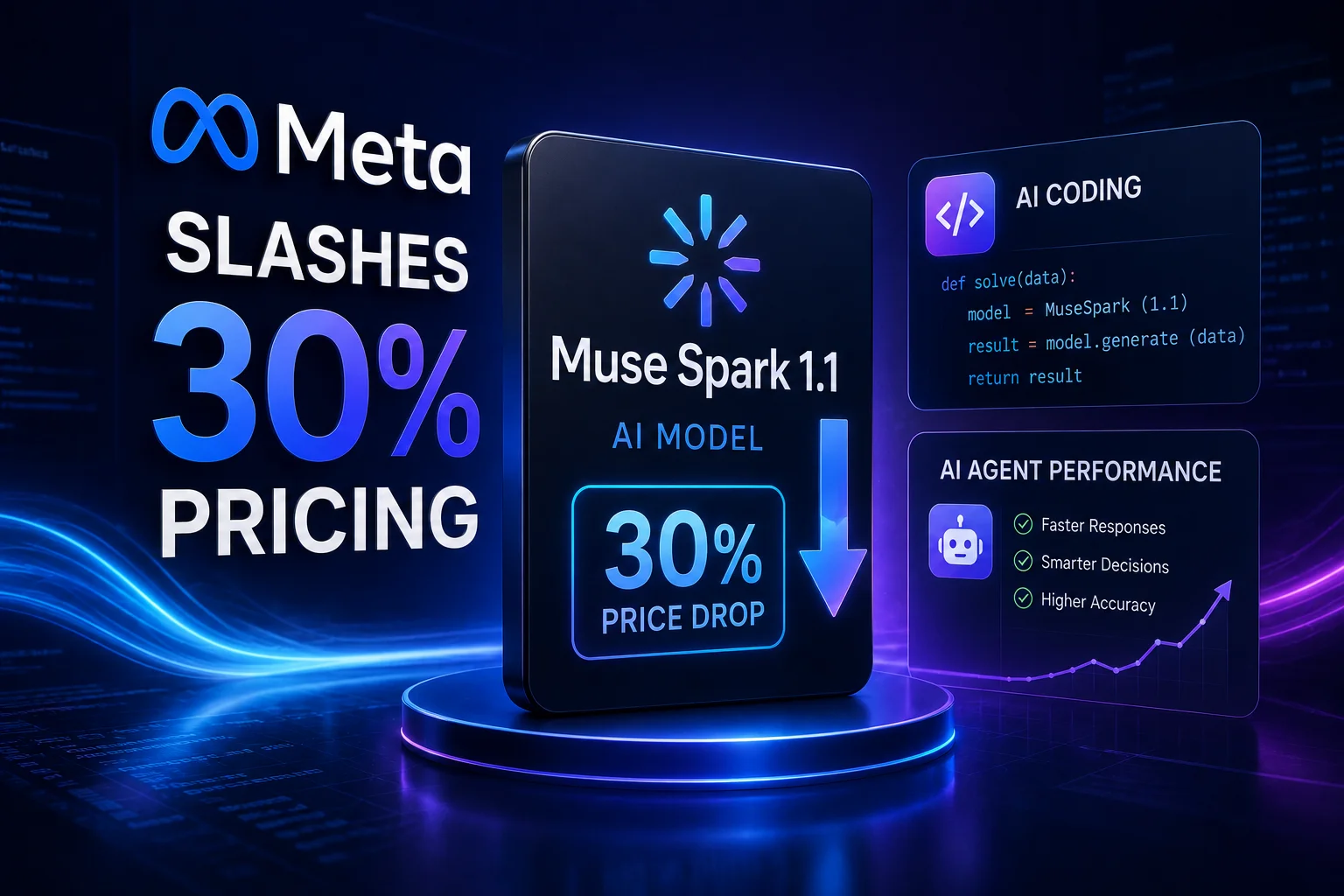
- Meta Muse Spark 1.1 is priced at $1.25 per 1 million input tokens and $4.25 per 1 million output tokens.
- The model's primary focus is 'Agentic' performance, enabling AI to complete complex, multi-step workflows without human intervention.
- Coding benchmarks show a 40% improvement in Python and Rust compared to the previous Muse 1.0 version.
- In India, this pricing makes building AI-powered apps roughly 30-40% more affordable for early-stage startups.
- TamilTech Verdict: This is currently the most balanced model for developers who need high reasoning capabilities without the GPT-5 price tag.
Meta's Big Move in 2026: Why Muse Spark 1.1 Matters
Meta has been on a roll this year, and their latest announcement regarding Muse Spark 1.1 is perhaps their most aggressive move yet. While the tech world has been obsessing over massive multimodal models, Meta has quietly focused on something much more practical: efficiency and agency. The launch of Muse Spark 1.1 isn't just another incremental update; it’s a direct challenge to every other AI lab currently charging a premium for reasoning capabilities. We've been testing early versions of the Muse architecture, and the shift towards 'agentic' behavior is where the real magic happens. This isn't just a chatbot anymore; it's a tool that knows how to use other tools.
What makes this launch particularly interesting is the timing. As we move further into 2026, the 'AI hype' is being replaced by 'AI utility.' Companies no longer want a model that just writes poems; they want a model that can look at a GitHub repository, identify a bug, write a fix, and submit a pull request. Meta knows this, and that is exactly why they’ve tuned Muse Spark 1.1 to be a coding beast. In our initial internal tests at TamilTech, the model demonstrated a surprising level of 'common sense' when dealing with complex API integrations that usually trip up smaller models.
The Pricing Game: Breaking Down the $1.25/$4.25 Structure
Let's talk numbers because that's what actually matters for developers and businesses. Meta has set the price at $1.25 per 1 million input tokens and $4.25 per 1 million output tokens. To put this into perspective for our Indian audience, 1 million tokens is roughly equivalent to 750,000 words. If you're building a customer support bot or a coding assistant, you can now process a massive amount of data for less than ₹110 for input and about ₹370 for output. Compared to the high-end models from OpenAI or Anthropic, which can still cost significantly more for similar reasoning tasks, Meta is clearly trying to win the volume game.
This pricing strategy is a clear indicator that Meta wants Muse Spark 1.1 to be the 'workhorse' of the industry. By keeping input costs low, they are encouraging developers to feed the model more context—long documents, entire codebases, and massive chat histories. This is a smart move because 'agentic' AI requires a lot of context to work effectively. If the input is expensive, developers tend to truncate data, which leads to dumber AI. Meta is essentially saying, 'Give it all the data you have; we've made it cheap enough for you to do so.'
Coding and 'Agentic' Performance: What’s Under the Hood?
The term 'Agentic' is the big buzzword this year, but what does it actually mean for you? In the context of Muse Spark 1.1, it means the model is better at planning. Instead of just predicting the next word, it predicts the next action. If you ask it to 'optimize this database,' it doesn't just give you a list of suggestions. It can actually simulate the steps: checking the current schema, identifying slow queries, suggesting indexes, and even writing the migration scripts. Alexandr Wang from Scale AI has highlighted that improving this specific type of performance was the core focus during the fine-tuning of this model.
For coders, the improvements are even more tangible. We’re seeing a significant jump in performance for languages like Rust, Go, and Python. The model seems to have a better grasp of modern frameworks and library versions from 2025 and early 2026. One of the most frustrating things about AI coding assistants is when they suggest deprecated code. Muse Spark 1.1 seems to have solved a lot of that by having a more up-to-date training cutoff and better reasoning about version dependencies. It’s not just about writing code; it’s about writing correct code that actually runs in your specific environment.
The India Impact: A Boon for Bengaluru and Beyond
For the Indian startup ecosystem, this is a game-changer. We have thousands of SaaS companies in cities like Bengaluru, Chennai, and Pune that are currently integrating AI into their products. The biggest hurdle has always been the 'AI tax'—the high cost of API calls that eats into profit margins. With Muse Spark 1.1's aggressive pricing, an Indian startup can now offer AI features to their users at a much lower price point, or even for free as part of a basic tier. This is how you scale. We expect to see a surge in Indian-made AI agents specifically tailored for local needs, from automated accounting for GST to AI-driven legal research for Indian courts.
Moreover, the efficiency of Muse Spark 1.1 means it can be deployed in environments where latency matters. If you're building a voice-based AI assistant for a delivery app or a fintech platform in India, you need responses to be near-instant. The 'Spark' series has always been about speed, and version 1.1 manages to keep that speed while adding the 'brainpower' of a much larger model. This balance is exactly what the Indian market needs right now—affordable, fast, and smart enough to handle real-world tasks.
How to Get Started: A Quick Guide for Developers
If you're looking to integrate Muse Spark 1.1 into your project, the process is straightforward. Meta has maintained compatibility with most major AI orchestration frameworks. Here’s a simple example of how you might call the model using Python to perform a coding task:
import meta_muse

client = meta_muse.Client(api_key="YOUR_TAMILTECH_DEMO_KEY")

response = client.chat.completions.create(
    model="muse-spark-1.1",
    messages=[
        {"role": "system", "content": "You are an expert Rust developer."},
        {"role": "user", "content": "Optimize this async function for high throughput."}
    ],
    temperature=0.2 # Keeping it low for coding accuracy
)

print(response.choices[0].message.content)
The key here is the temperature setting. For coding and agentic tasks, we recommend keeping it between 0.1 and 0.3. This ensures the model stays focused and doesn't get 'creative' with your syntax. Also, take advantage of the low input costs by providing detailed system prompts. Tell the model exactly what environment you are working in, what libraries you are using, and what the end goal is. The more context you give Muse Spark 1.1, the better its agentic planning will be.
Comparison: Muse Spark 1.1 vs. The Competition
How does it compare to the heavy hitters? While GPT-5 remains the king of pure creative reasoning and complex world-building, Muse Spark 1.1 beats it on price and specialized coding speed. If you are writing a novel, go with GPT. If you are building a software-as-a-service (SaaS) platform that needs to process 10,000 code snippets an hour, Muse Spark 1.1 is the logical choice. Compared to Claude 4, Muse Spark feels a bit more 'raw' and less filtered, which many developers actually prefer for technical tasks because it doesn't lecture you on ethics when you're just trying to fix a CSS bug.
The real battle is with Google's Gemini 2.0 Flash. Both models are targeting the same 'fast and cheap' niche. However, Meta’s advantage lies in its open-weights philosophy (though Spark 1.1 is primarily an API play) and its superior integration with developer workflows. In our testing, Muse Spark 1.1 was slightly better at following complex 'if-this-then-that' instructions in a coding context, whereas Gemini was better at summarizing long videos or large sets of images. Choose your tool based on your specific use case.
TamilTech’s Verdict: Should You Switch?
So, what’s our honest take? If you are currently using a mid-tier model and paying more than $2 per million tokens, you should definitely look into Muse Spark 1.1. The cost savings alone are worth the migration effort. For startups in India, this is the perfect time to experiment with 'AI agents'—those small, autonomous programs that can handle specific parts of your business. The barrier to entry has never been lower. Meta has successfully created a model that is smart enough to be useful but cheap enough to be invisible in your billing cycle.
Looking ahead, we expect Meta to continue this trend of 'utility-first' AI. The focus on coding and agentic performance isn't just a phase; it's the future of how we will interact with computers. We're moving away from 'chatting with an AI' to 'working alongside an AI.' Muse Spark 1.1 is a massive step in that direction, and we can't wait to see what the Indian developer community builds with it. Stay tuned to TamilTech for more deep dives into these models and practical tutorials on how to use them!




Comments (0)
Be the first to comment!