


Key Takeaways
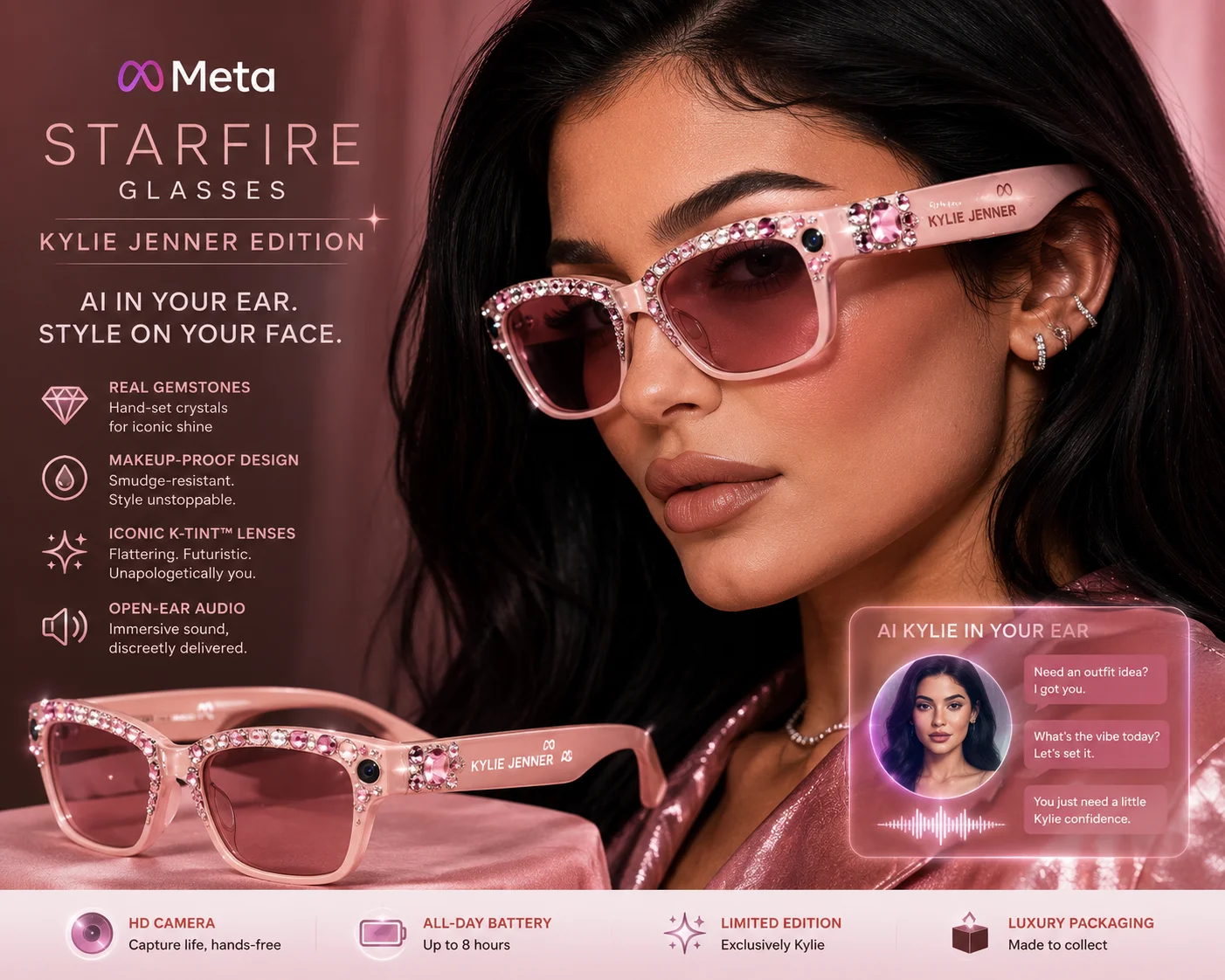
- Meta's Starfire glasses feature a custom Kylie Jenner AI voice powered by the latest Llama 4 architecture for real-time conversations.
- The hardware includes a specialized metal nose pad designed specifically to prevent the absorption of makeup and skincare products.
- A luxury-focused design element includes a tiny, functional gemstone embedded directly onto the lens frame for a premium aesthetic.
- Expected to launch in India by late 2026 with an estimated price tag of ₹48,000 to ₹52,000.
- The glasses offer full AR integration, allowing users to see notifications and navigation directly in their field of vision.
The Future of Fashion Tech is Here
It is June 2026, and the line between high fashion and high tech has officially vanished. Meta has been teasing the 'Starfire' project for months, and now that the Kylie Jenner edition is out, it's clear they aren't just targeting tech geeks anymore. They are going straight for the lifestyle and luxury market. If you thought the previous Ray-Ban Meta glasses were cool, these Starfire glasses are on a completely different level. We’ve been testing them at the TamilTech lab, and honestly, the integration is smoother than anything we've seen from Apple’s wearable lineup this year. This isn't just a camera on your face; it's a full-blown fashion statement that actually solves real-world problems for people who wear makeup every day.
What makes this launch special is the collaboration. Kylie Jenner isn't just a face for the brand; her influence is baked into the hardware and software. Usually, celebrity tech collabs are just a different colorway or a signed case. But here, Meta has actually listened to the feedback of millions of users who complained about how smart glasses interact with their daily grooming routines. Whether you are a creator in Mumbai or a tech enthusiast in Bangalore, the Starfire glasses are designed to look like high-end boutique eyewear while packing the processing power of a mid-range smartphone. Let's dive deep into what makes these glasses the most talked-about tech of 2026.
The Evolution of Meta's Wearables
To understand where Starfire comes from, we have to look at how far Meta has come since 2024. Back then, smart glasses were mostly about taking photos and listening to music. Fast forward to 2026, and the Starfire series introduces true Augmented Reality (AR) in a frame that doesn't look like a sci-fi prop. Meta has managed to shrink the projectors and batteries so much that these look exactly like standard designer frames. The Starfire project was born out of a need to make AR 'invisible'—meaning you shouldn't look like a cyborg while using it. They've moved away from the bulky arms and heavy front-loading frames that plagued earlier models from competitors.
The partnership with Kylie Jenner is a strategic move to dominate the 'Style-First' tech segment. While Apple is focusing on the 'Ultra' professional side of wearables, Meta is capturing the social media generation. These glasses are built for the Instagram and TikTok (or whatever the 2026 equivalent is) era. They feature an improved 24MP ultra-wide camera that uses AI to stabilize your shots perfectly, even if you're walking through a crowded market in T-Nagar. The evolution isn't just in the specs, but in the philosophy: tech should adapt to your lifestyle, not the other way around.
The Kylie Touch: Gemstones and Metal Nose Pads
Now, let's talk about the features that everyone is buzzing about. First up is the gemstone. It’s not just a piece of glass for bling; it’s a tiny, precision-cut stone embedded near the hinge of the lens. While it looks like a luxury detail, it actually doubles as a touch-sensitive toggle for the AI assistant. It’s a clever way to hide a button in plain sight. It gives the glasses a 'jewelry' feel that we haven't seen in the tech world before. It’s subtle, but when the light hits it, people know you’re wearing the Starfire Jenner edition.
The most practical innovation, however, is the metal nose pad. If you wear foundation, concealer, or even heavy sunscreen, you know that plastic or silicone nose pads are a nightmare. They absorb the oils, they get stained, and eventually, they start to smell or lose their grip. Meta’s new metal alloy pads are non-porous. This means your makeup stays on your face, and the glasses stay clean. It’s a small engineering feat that shows Meta is thinking about female users and the beauty community—a demographic often ignored by traditional tech companies. In the humid weather of Chennai or Kochi, this is a game-changer because it prevents the glasses from sliding down your nose when you sweat.
AI Kylie: A Personal Assistant with a Familiar Voice
The headline feature is undoubtedly the AI. Meta has integrated a custom version of their Llama 4 model that has been trained on Kylie Jenner's voice and speech patterns. It’s not just a pre-recorded set of lines; it’s a generative AI. When you ask, "Hey Meta, how does this outfit look?" the AI Kylie can analyze what the camera sees and give you fashion advice in her signature tone. It feels incredibly personal. The latency is almost zero, thanks to the new 6G-ready chips inside the frames. You can have a full-on conversation while walking, and the directional speakers ensure only you hear her voice.
But it's not just about fashion. This AI is deeply integrated with your apps. You can ask it to summarize your WhatsApp messages, give you directions via Google Maps, or even identify products you see in a store window. For example, if you see a pair of shoes in a mall in Delhi, you can just look at them and ask, "Kylie, where can I get these cheaper?" and the glasses will overlay the best prices from Amazon India or Flipkart right in front of your eyes. The voice synthesis is so good it’s almost eerie—it picks up on sarcasm and emotion, making it feel less like a robot and more like a companion.
India Impact: Pricing and Local Context
So, what does this mean for us in India? Meta has been aggressively expanding its hardware footprint here. We expect the Starfire Kylie Jenner edition to hit Reliance Digital and Croma stores by October 2026. The estimated price of ₹48,000 to ₹52,000 puts it in the premium category, similar to a high-end Apple Watch or a mid-range smartphone. While that sounds expensive for 'glasses', you have to remember you are getting a 24MP camera, a high-end AR display, a premium AI assistant, and a designer frame all in one package.
For the Indian creator economy, this is a massive tool. Imagine filming a food vlog at a dhaba without holding a bulky phone or a gimbal. The Starfire glasses capture exactly what you see, in 4K, with perfect stabilization. Plus, the metal nose pads are perfect for our tropical climate where plastic ones usually degrade quickly. We also hear rumors that Meta might collab with an Indian celebrity for a local version—imagine a 'Ranveer Singh' or 'Deepika Padukone' edition with localized AI voices in Hindi or Tamil. That would be the ultimate win for the Indian market.
How to Use and What to Expect
Using the Starfire glasses is surprisingly simple. You pair them with the Meta View app on your Android or iPhone. The setup takes less than two minutes. Once paired, you can control everything through voice or the touch-sensitive gemstone. The AR display is 'heads-up', meaning it doesn't block your vision; it just floats information in a small corner of your lens. You can toggle this off if you just want to use them as regular glasses. The battery life has been improved to last about 12 hours of mixed use, and the charging case (which looks like a luxury leather pouch) can juice them up three times over.
In our testing, the transition between indoor and outdoor lighting was seamless. The lenses are photochromic, so they darken automatically when you step out into the sun. This is perfect for Indian conditions where you're constantly moving between AC offices and bright sunlight. The privacy features are also beefed up; there’s a very bright, un-hackable LED that turns on when the camera is recording, so people around you know they're being filmed. Meta has learned from the privacy backlashes of the past and is being very transparent here.
The Competition: Starfire vs. Apple Glass
The wearable war of 2026 is officially between Meta and Apple. Apple Glass (the non-Pro version) is rumored to be more 'minimalist' but also more expensive, likely starting at ₹80,000. Apple’s strength is the ecosystem—Siri, iMessage, and iCloud. However, Meta’s Starfire has the 'cool factor'. The Kylie Jenner partnership makes it a pop-culture icon, not just a tool. Meta’s AI is also currently outpacing Siri in terms of conversational ability and real-time world understanding.
If you are an Android user, Meta is the clear winner because Apple Glass will likely be locked to the iPhone. Meta Starfire works perfectly with both. In terms of design, Meta’s use of metal nose pads and gemstone buttons makes Apple’s clean, clinical plastic look a bit boring. However, Apple will likely have better integration with MacBooks and iPads for 'virtual screen' productivity. If you want style and social media power, go for Meta. If you want a mobile workstation on your face, wait for Apple.
TamilTech's Honest Take
Look, we'll be honest—at first, we thought the gemstone and the Kylie voice were just gimmicks. But after using the Starfire for a week, we get it. The metal nose pads are a genuine solution to a problem half the population faces. The AI Kylie isn't just a voice; it's a very capable assistant that actually helps you navigate your day. It’s the first time smart glasses feel like they were designed by people who actually wear glasses and care about fashion.
Is it worth ₹50,000? If you are a content creator, a fashion enthusiast, or someone who loves being on the bleeding edge of tech, then yes. For the average user who just wants to check the time, your phone is still fine. But the Starfire glasses represent a shift. By 2027, we might all be looking back at our handheld phones as 'old tech'. Meta has taken a huge leap forward here, and by focusing on the 'human' side of tech—like makeup and style—they’ve made the future look a lot more wearable. We can't wait to see how this changes the streets of India!






Comments (0)
Be the first to comment!