


The company worth trillions is suddenly looking uncertain
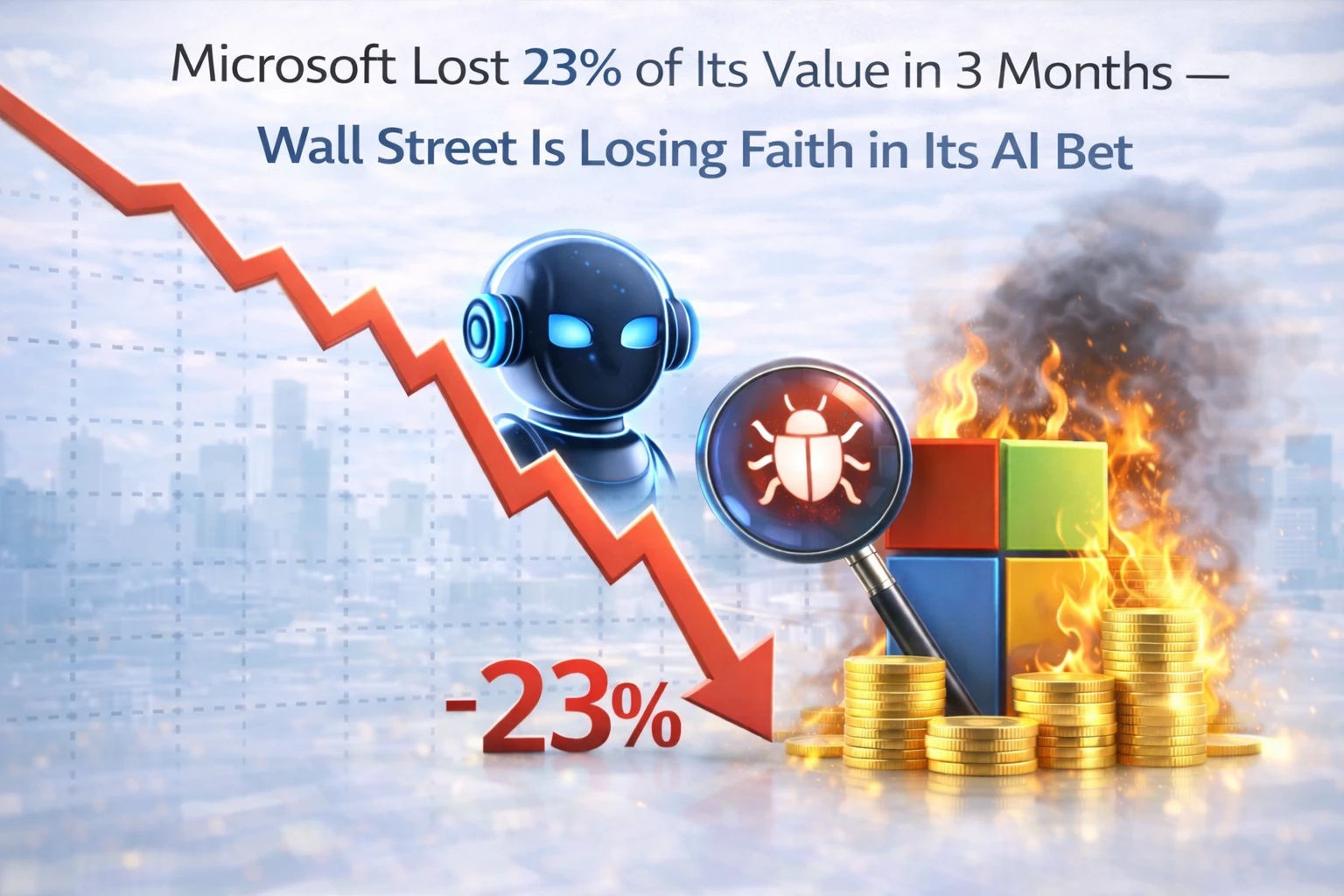
A 23% stock drop in a single quarter. That's what Microsoft just logged — its steepest quarterly fall since the 2008 global financial crisis. For comparison, the Nasdaq index as a whole fell about 7% in the same period. Microsoft fell more than three times the market average. That's not a market correction. That's investors specifically deciding they don't trust Microsoft's direction.
The company is still dominant. Windows runs on most of the world's computers. Microsoft 365 is what most offices use. Azure is the second-largest cloud platform on earth. LinkedIn has hundreds of millions of users. None of that changed. What changed is investor confidence that Microsoft can actually win the AI race it has bet its future on.
The Copilot problem nobody wants to talk about
Microsoft's AI strategy is called Copilot. It's built into Windows, Microsoft 365, Teams, GitHub, Azure — essentially everywhere. The idea was that AI would be so woven into everything Microsoft makes that users would have no choice but to use it and pay more for the privilege.
The reality? Copilot hasn't taken off the way Microsoft hoped. Users are still using ChatGPT, Gemini, and Claude for serious AI work. Microsoft's own enterprise customers, who pay for Microsoft 365 subscriptions, aren't upgrading to the more expensive Copilot tiers at the rate analysts expected.
One analyst's note captured the situation perfectly: "Redmond is in a pickle." (Redmond is the city in Washington state where Microsoft is headquartered.) The pickle is this: Microsoft needs to use its valuable Azure cloud computing capacity to improve Copilot, but every bit of Azure capacity used internally is capacity that isn't being sold to paying customers. It's an expensive fix for a product that isn't generating the revenue to justify the fix.
Meanwhile, Google's Gemini is deeply integrated into Workspace tools that compete directly with Microsoft 365. OpenAI — in which Microsoft has invested tens of billions — is building its own standalone enterprise products that compete with Microsoft's own Copilot. Anthropic's Claude is winning enterprise AI contracts. Microsoft built the AI wave and may be getting swept up by it.
The broader SaaS meltdown
Microsoft isn't suffering alone. A wave of traditional software companies are getting hit by what analysts are calling the "SaaSpocalypse" — a term for what happens when AI threatens to replace the subscription software that whole industries are built on.
SaaS (Software as a Service) is the model where companies pay monthly subscriptions for tools like Adobe Creative Cloud, project management apps like Atlassian Jira, and workflow automation platforms like ServiceNow. These companies saw their stocks fall 30% or more this year. The theory is simple: if AI can perform many of the same tasks these tools do, why pay full price for the tools?
Microsoft's earnings multiple — essentially how much investors are willing to pay for each dollar of Microsoft's earnings — hasn't been this low since the fourth quarter of 2022. That's the same quarter OpenAI launched ChatGPT and started the whole AI boom. The irony: the company that helped fund ChatGPT and triggered the AI revolution is now being punished by the same revolution it helped create.
The cost problem: data centers and an oil price surge
Building AI requires enormous amounts of computing power, which requires enormous amounts of data centers, which requires enormous amounts of energy. Microsoft has committed to spending hundreds of billions on AI infrastructure over the next few years — data centers, custom AI chips, power infrastructure.
On top of that, a new complicating factor: oil prices are rising sharply due to the ongoing conflict in Iran. Data centers run on electricity, and electricity prices are linked to energy costs. Higher oil prices mean higher data center operating costs. Every percentage point increase in energy costs across Microsoft's global data center footprint represents hundreds of millions in additional annual expenses.
Investors are looking at this math and asking: Microsoft is spending massively to build infrastructure, Copilot isn't monetizing well, competitors are winning AI market share, and now costs are going up. When does this all pay off?
What this means for India specifically
Microsoft's products are deeply embedded in Indian enterprise. Most large Indian companies — IT services firms like TCS, Infosys, Wipro, HCL, as well as banking, healthcare, and government sectors — run on Microsoft 365, Azure, and Windows. When Microsoft's AI strategy struggles, it affects product roadmaps, pricing decisions, and enterprise support for Indian customers.
For Indian IT professionals, this is particularly relevant. Microsoft's GitHub Copilot is widely used by developers at Indian IT firms for code assistance. If Microsoft deprioritizes Copilot investment to focus on core Azure revenue, the product's development pace might slow. Alternatively, if Microsoft doubles down on Copilot improvements to justify the enterprise pricing, Indian enterprises might see more pressure to upgrade to paid Copilot tiers.
For Indian students and professionals learning tech, this is also a signal. Microsoft Azure certification and Microsoft 365 skills remain highly valuable — the enterprise installed base is enormous. But the pure AI product story is complicated. Gemini is competing hard for Google Workspace enterprise customers. ChatGPT Enterprise is competing with Microsoft Copilot. The AI assistant market in enterprise is genuinely unsettled, and Indian tech workers should be learning multiple platforms, not betting everything on Microsoft's ecosystem.
Is Microsoft actually in trouble?
Here's some perspective. A 23% stock drop is significant, but Microsoft's fundamentals haven't collapsed. The company is still generating massive revenue from Azure, Office subscriptions, and enterprise licensing. Windows and Office still have no realistic replacement in most corporate environments. The market is pricing in uncertainty about AI ROI, not a business collapse.
Microsoft bounced back 3.3% on the last trading day of the quarter — its biggest single-day gain since July. That suggests investors see the stock as oversold at these levels. The question isn't whether Microsoft survives — it obviously will. The question is whether it can make Copilot work well enough and fast enough to justify the AI investment it has already committed to.
The Q2 2026 earnings report, expected in late April, will be the first real test. If Copilot adoption numbers improve, expect the stock to recover. If they don't, the pressure on Satya Nadella and his AI strategy will intensify significantly.
TamilTech's take
Microsoft's problem is a story about the gap between AI hype and AI utility. Companies have spent billions assuming users would immediately embrace AI tools. The reality is messier — AI is useful for specific tasks but hasn't yet replaced whole workflows the way the hype suggested. Copilot is a good product that people use when they try it, but adoption has been slower than hoped. The stock market is harsh about unmet expectations. Microsoft will be fine — it's too embedded in enterprise infrastructure to fail. But the AI gold rush assumption that "build it and they will pay" is getting reality-checked in real time. That's actually a healthy correction, even if it's painful for Microsoft investors. The companies that figure out genuine, measurable AI value delivery will win. The ones that just add AI to existing products and hope users notice are struggling. Microsoft is right on that line right now.



Comments (0)
Be the first to comment!