


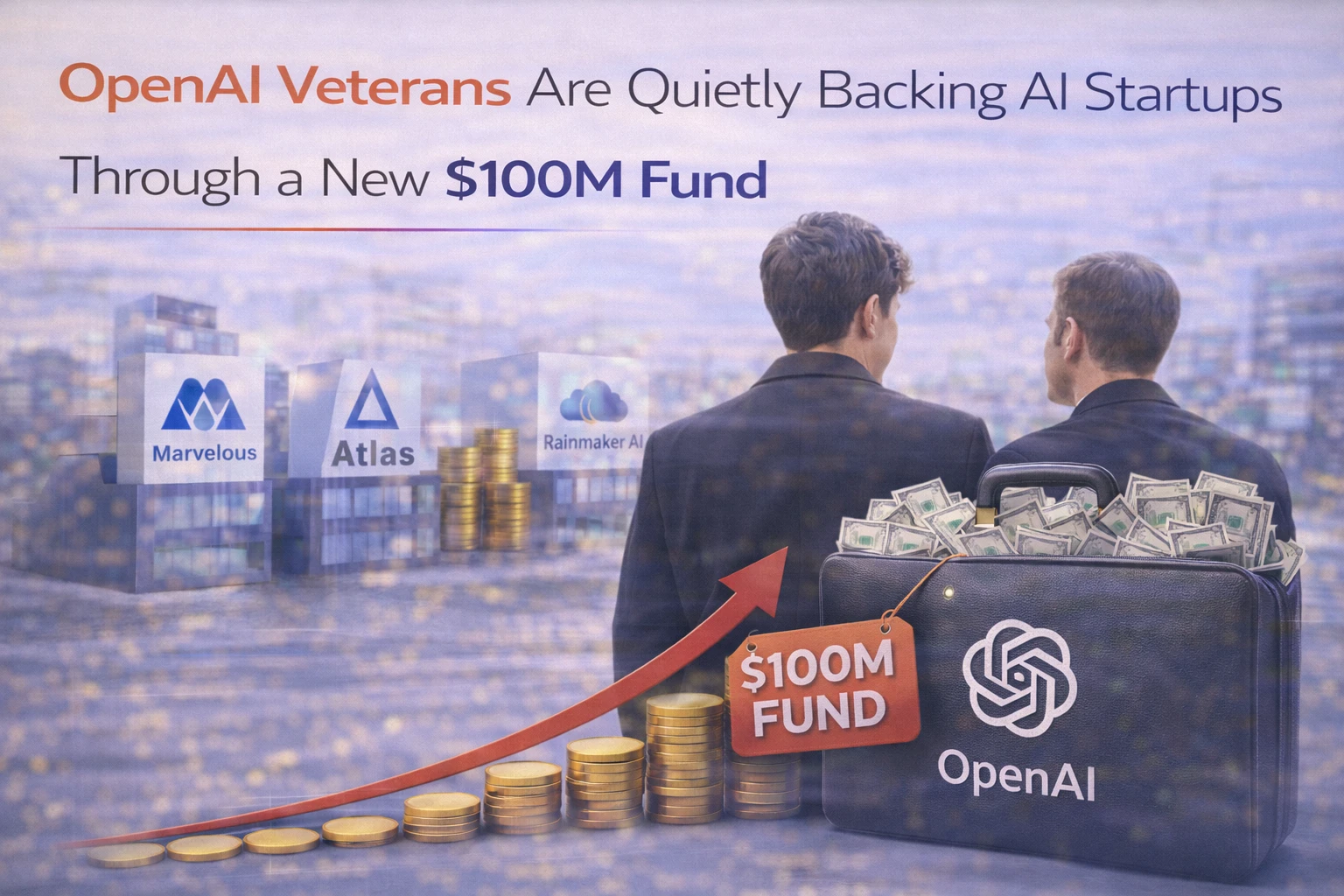
So Here is What is Actually Happening in AI Funding Right Now
While everyone is busy arguing about which AI chatbot is smarter, a quiet shift is happening behind the scenes. A group of engineers and operators who helped build ChatGPT, DALL-E, and Codex have stepped away from the lab and started writing checks. They just closed the first tranche of a new $100 million venture fund, and they are already deploying capital into early-stage AI startups. No press tours, no hype, just straight-to-the-point investing. The fund is called Zero Shot, and it is exactly what the name sounds like — a technical, founder-friendly vehicle run by people who actually know how AI works under the hood.
Breaking Down the Zero Shot Fund & The Team
Let us talk about who is actually sitting at the table. Five founding partners are running this show. Three of them came straight from OpenAI. First up is Evan Morikawa. He led applied engineering during the critical rollout phases of DALL-E, ChatGPT, and Codex. He is currently working at Generalist, a robotics startup trying to make machines actually useful outside demo days. Then there is Andrew Mayne, widely recognized as OpenAI's original prompt engineer and the host of The OpenAI podcast. He also runs Interdimensional, an AI deployment consultancy. Shawn Jain, a former OpenAI researcher and engineer, pivoted into venture capital and is now building Synthefy, a generative AI startup himself.
They are joined by Kelly Kovacs, who brings traditional VC experience as a former founding partner at 01A, a growth-stage firm backed by tech veterans Dick Costello and Adam Bain. Rounding out the group is Brett Rounsaville, ex-Twitter and Disney, who is currently serving as CEO at Mayne's Interdimensional. This is not a random mix of tech influencers. This is a tightly knit group that worked together before ChatGPT went mainstream, survived the explosive growth phase, and watched firsthand how AI transitions from research papers to real products.
Why the Name Zero Shot Actually Makes Sense
If you work in machine learning, zero-shot learning is a familiar concept. It means asking an AI model to perform a task or classify something it has never been explicitly trained on, and it still figures it out. In venture capital, the analogy is pretty clever. Instead of waiting for startups to prove everything with massive traction, this fund is looking for early technical signals, strong engineering teams, and novel approaches to unsolved problems. They want to back founders who can execute with limited hand-holding — zero-shot style. They have already cut a few checks, and the remaining capital is being allocated as deals close over the next few quarters.
How Did They Go From Engineers to Investors?
It was not some grand master plan. After leaving OpenAI, the founders noticed a pattern. VCs kept calling them asking what was real and what was vaporware. Startup founders kept sliding into their inboxes asking for architecture advice, model fine-tuning tips, and go-to-market sanity checks. Andrew Mayne started a consultancy to handle the demand. Eventually, they realized something obvious: the best people to fund the next wave of AI are the ones who actually understand the infrastructure, the limitations, and the real cost of running these models at scale. Consulting turned into deal flow, deal flow turned into a fund, and the rest is history.
What This Means for Indian AI Founders
Here is the reality check. The global AI funding winter is thawing, but the bar is higher. Investors are no longer impressed by wrapper apps that just slap a UI on top of an existing LLM API. They want proprietary data pipelines, efficient inference architectures, vertical-specific fine-tuning, and clear paths to revenue. This is where Indian startups have a real shot. We have deep engineering talent, rapidly improving compute infrastructure, and a massive domestic market that generates unique datasets in healthcare, agriculture, logistics, and regional languages.
If you are building in Bangalore, Hyderabad, or Chennai right now, here is the playbook. Tech-first funds like Zero Shot care about three things: technical differentiation, unit economics, and scalability. Do not pitch them on AI hype. Show them your training pipeline. Explain how you reduced inference latency. Prove that your fine-tuning strategy actually beats base models for your specific use case. Indian founders who document their architecture, open-source useful components, and build transparent benchmarking reports stand out immediately. Also, remember that global funds expect dollar-denominated revenue models or clear expansion plans into US/EU/SEA markets from day one.
My Honest Take: Is This a Good Thing?
I think this is genuinely positive for the ecosystem. Too many AI startups in the last two years were funded by generalist investors who treated generative AI like a software subscription play. They did not understand that token costs, context window limits, hallucination rates, and compliance requirements completely change the business model. When engineers write checks, they ask the right questions early. They know that a 500 million parameter model run on optimized hardware is often more profitable than brute-forcing a 70 billion parameter model. That technical filter will save founders from burning runway on dead-end architectures.
But there is a catch. Engineering brilliance does not automatically translate to venture capital success. Building great tech is one thing. Managing cap tables, negotiating term sheets, timing market exits, and handling board dynamics is another. The fact that they brought in Kelly Kovacs from a traditional VC background shows they know this. They are balancing deep technical judgment with actual fund mechanics. Indian founders should not expect easy money. These investors will tear apart your tech stack, stress-test your assumptions, and push for ruthless prioritization. If you can survive that scrutiny, you will get more than just capital — you will get architectural guidance that actually scales.
What to Expect Next & How to Prepare
Zero Shot is still raising toward its $100 million target, which means more allocations are coming soon. They will likely focus on autonomous agents, enterprise AI tooling, robotics control systems, healthcare diagnostics, and developer infrastructure. If you are pre-seed or seed stage, now is the time to tighten your metrics. Clean up your GitHub repos, publish technical blogs showing your real-world testing, get paying pilots instead of just free trials, and map out exactly how you will scale from 1,000 users to 100,000 without blowing up your cloud bill. The AI race is no longer about who launches first. It is about who builds sustainably. And funds run by actual builders are the ones that will fund that reality.



Comments (0)
Be the first to comment!