


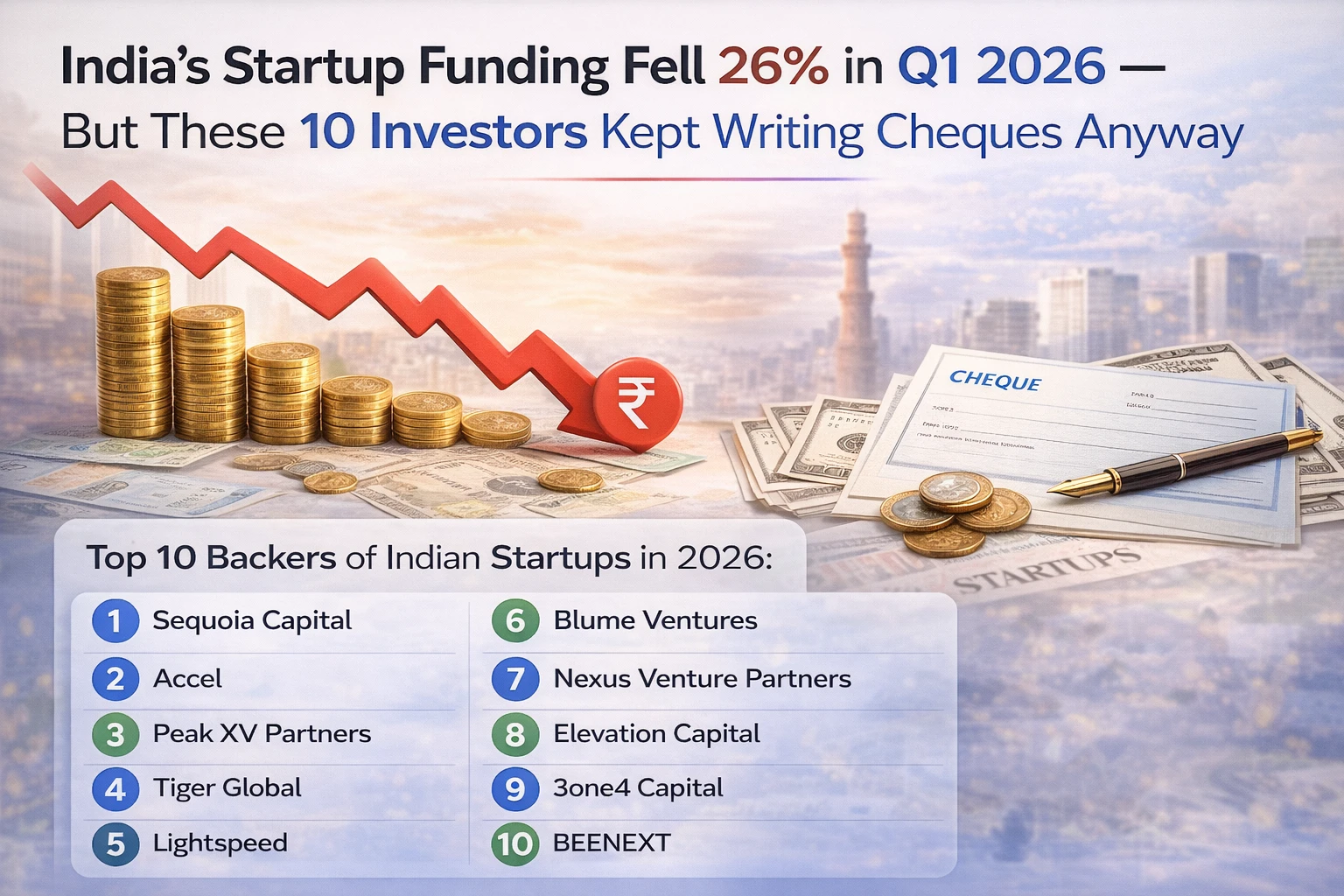
The numbers first: Q1 2026 was a reality check for Indian startup funding
Let's be straight about what happened in the first three months of 2026. Indian startups raised $2.3 billion across 271 deals — that sounds large until you compare it to $3.1 billion in the same quarter last year. A 26% decline. And more telling than the dollar number: not a single funding round crossed the $100 million mark in Q1 2026. That's the first time that's happened since 2022, when the post-pandemic startup boom was still running hot.
This isn't a crash. It's a recalibration — a word the venture capital community has learned to use carefully to mean "investors got more careful without actually stopping." Deal count held up at 271, which isn't dramatically below recent quarters. But the composition of those deals shifted significantly: smaller cheques, earlier stage, more venture debt, and investors increasingly focused on backing startups that can show unit economics rather than growth-at-any-cost charts.
The median deal size actually rose to $3.3 million — which tells you that mid-sized deals are happening, but the giant late-stage rounds that inflate total funding numbers simply weren't there. Late-stage investments dropped 56% YoY to $782 million. Early-stage funding rose 58% to $248 million. Investors moved upstream toward founders with less traction but lower valuations and longer runways ahead.
The top investor of Q1 2026 — and it's probably not who you expect
Stride Ventures topped the list of most active startup investors in Q1 2026, backing 38 startups through the quarter. The companies it backed include Magicpin (the hyperlocal commerce app used heavily in Delhi NCR and Bangalore), Branch (a financial wellness platform popular among Indian gig economy workers and young professionals), Gully Labs, and Swish.
Stride Ventures is a venture debt firm — not a traditional equity VC. That distinction matters enormously for understanding what's happening in Indian startup funding right now. Venture debt means Stride lends money to startups that are revenue-generating but don't want to dilute equity by raising another round at potentially lower valuations than their previous round. The startup pays back with interest, keeps its cap table cleaner, and buys time to grow into its last valuation.
The fact that a venture debt firm topped the most-active-investor list in Q1 2026 tells you everything about where startup founders' heads are right now: they'd rather pay interest than give away equity at a down round valuation. It's a sign of maturity — and caution — across the ecosystem.
BlackSoil, another venture debt firm, also featured prominently in the top 10. Two of India's ten most active Q1 2026 investors were venture debt players. That's not a coincidence — it's a structural shift in how Indian startups are financing themselves through this period of market uncertainty.
The traditional VC giants — Peak XV, Accel, and the others
Peak XV Partners (formerly Sequoia Capital India) continued its run as one of India's most active traditional venture capital firms in Q1 2026. Peak XV currently manages over $10 billion in assets and has backed over 450 companies across India and Southeast Asia. In Q1 2026, it maintained its focus on AI, fintech, and consumer startups — the three areas where it believes India's next generation of large companies will emerge.
Accel India held its position among the top 10 most active investors. With eight India-focused funds and nearly $3 billion in cumulative commitment to Indian startups, Accel's portfolio is a reasonable proxy for the health of India's startup ecosystem. Companies like Flipkart, Swiggy, and Urban Company came through Accel's early backing. In Q1 2026, Accel's dealmaking reflected the broader shift toward early-stage bets.
3one4 Capital, founded by Pranav Pai and Siddarth Pai in Bangalore, manages over $800 million in committed capital and focuses on early-stage technology companies. The firm has consistently backed Indian founders building for global markets — a thesis that's holding up well even as domestic-focused late-stage funding has slowed. Rainmatter, the venture arm of Zerodha, also featured among Q1 2026's most active investors — primarily in fintech and financial wellness startups, where Zerodha's distribution and brand give portfolio companies a natural advantage.
Finvolve rounded out the top 10 alongside prominent angel investors including Kunal Shah (CRED founder), Kunal Bahl (Snapdeal and Titan Capital), and Tiger Global, which remains selectively active in Indian startups at growth stage despite its global pullback from emerging markets over the last two years.
Where the money actually went — sector by sector
Ecommerce dominated Q1 2026 funding at $536 million across 64 deals — the highest deal count of any sector, reflecting continued investor appetite for commerce infrastructure, social commerce, and quick commerce plays that are still expanding in India's tier 2 and tier 3 cities.
Fintech came second at $374 million. UPI's penetration — crossing 18 billion transactions per month in early 2026 — has created a generation of startups building on top of India's payment infrastructure. Lending, credit scoring using alternative data, insurance distribution, and wealth management for first-time investors are all active investment themes.
The most interesting sector data point: AI funding jumped 73% YoY to $253 million, pushing AI into the third position by funding volume. Indian AI startups are increasingly moving from broad "AI platform" pitches to vertical-specific applications — AI for healthcare diagnosis, AI for legal documentation, AI for agricultural advisory, and AI for regional language customer service. Gnani.ai, which TamilTech covered last quarter, is a good example of the Tamil and South Indian language AI opportunity that investors are now treating as a real market, not an afterthought.
Geography: Bangalore leads, Chennai still underperforming
Bengaluru captured $823 million across 89 deals in Q1 2026 — more than a third of India's total startup funding landed in one city. The concentration makes sense: Bengaluru has the deepest pool of engineering talent, the densest cluster of Series B and C companies that are hiring from and spinning off new founders, and the strongest VC firm presence in India.
Delhi NCR was second at $538 million across 74 deals, and Mumbai third at $402 million from 34 deals — Mumbai's lower deal count but higher per-deal average reflects its tilt toward larger fintech and consumer deals.
Hyderabad and Chennai saw comparatively lower activity — a fact that should concern Tamil Nadu's startup ecosystem boosters. Chennai has world-class engineering colleges (IIT Madras, Anna University, BITS Pilani Goa included for talent pipelines), a growing deep tech cluster in the IIT Madras Research Park, and established SaaS companies like Freshworks and Zoho. But the funding that flows through Chennai-headquartered startups remains significantly below Bangalore. The city's startup founders tend to raise from Bangalore-based VCs, which means the capital and dealmaking relationships end up gravitating westward over time.
What this means for startup founders and job seekers right now
If you're a startup founder raising in 2026, the Q1 data gives you a clear picture of investor priorities: show revenue, show unit economics, and think carefully about whether you actually need equity or whether venture debt at a manageable interest rate buys you the runway you need without the valuation pressure of a new round.
For engineering professionals and product managers considering startup roles, Q1 2026's early-stage funding surge is relevant: more seed and Series A companies are hiring in this environment than large Series C and D companies, which are conserving cash. The best career opportunities in the next 12 months are likely at startups in the 20-100 employee range that closed a round in Q1 2026 and are now building their first major product teams.
For Tamil Nadu specifically — the IIT Madras Research Park ecosystem, the Chennai fintech cluster (PayNearby, Kaleidofin, and others), and the growing SaaS founder community — Q1 2026's AI funding surge is an opportunity. Tamil NLP, regional language AI, and deep tech applications where IIT Madras's research outputs can translate into fundable startups are the areas where Chennai can compete for capital that currently flows to Bangalore by default.
TamilTech's take
The 26% decline in Q1 2026 funding sounds alarming but it reads differently when you look at the deal count (still 271), the early-stage surge (+58%), and the AI funding jump (+73%). India's startup ecosystem isn't in crisis — it's in the process of separating companies with real business models from those that were built on cheap capital and aggressive growth assumptions. The investors who stayed active through Q1 2026 — Stride Ventures, Peak XV, Accel, 3one4 — are the ones who will have the best portfolios when the next funding cycle accelerates. For Tamil founders and startup job seekers: the current environment rewards depth over breadth. Build something that solves a real problem for a specific Indian audience, and the capital from this list of investors will find you.





Comments (0)
Be the first to comment!