


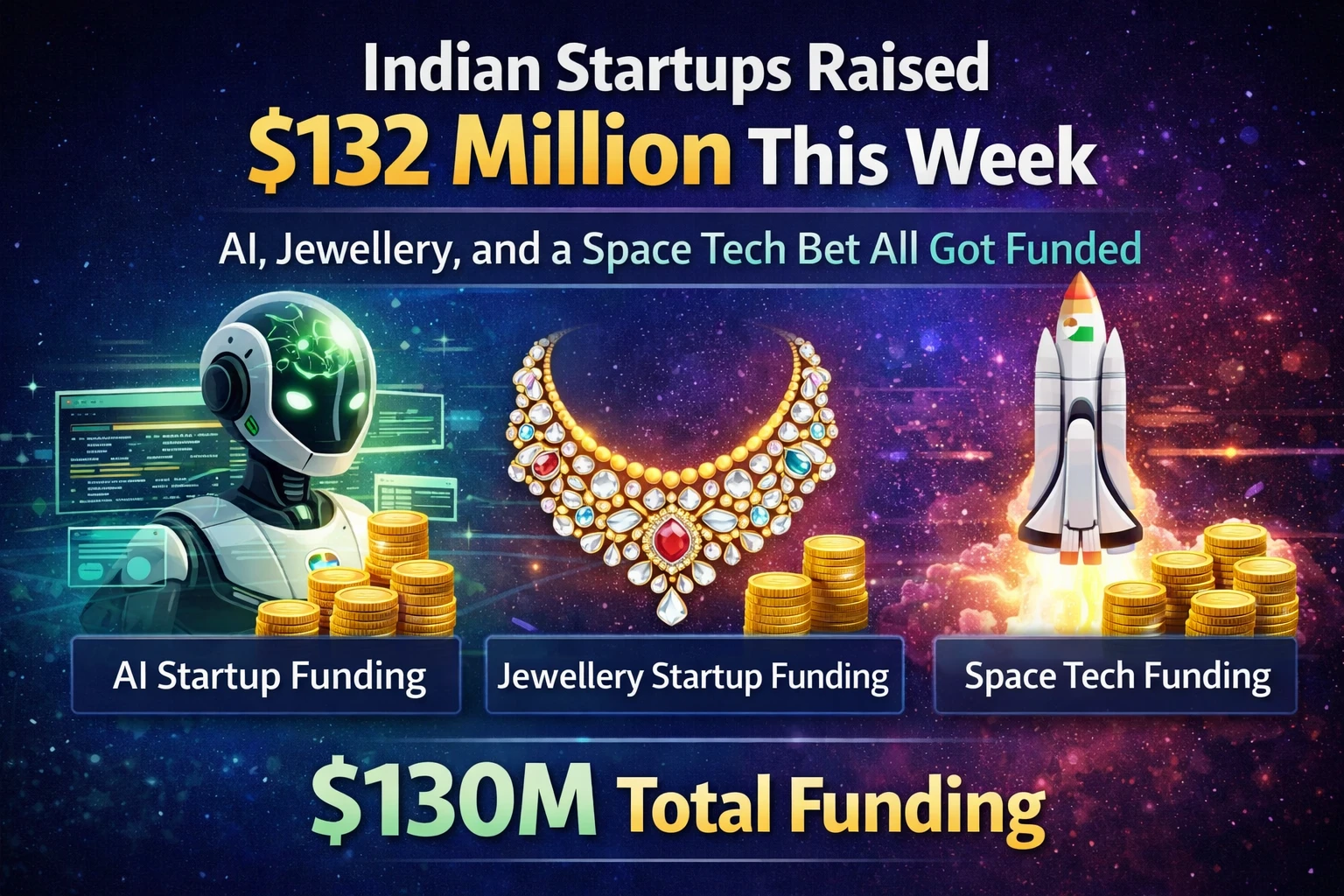
$132 million raised — but the real story is the 62% drop from last week
Indian startup funding doesn't move in a straight line. Last week, Indian startups pulled in $348 million across 25 deals. This week, it dropped to $132 million across 18 deals. That's a 62% decline in seven days — and the primary reason cited by investors and founders tracking the market is the escalation in global geopolitical tensions.
When global uncertainty rises — wars, trade disputes, policy changes — risk capital gets cautious. Venture investors don't necessarily pull back permanently, but they slow down decision-making, tighten due diligence, and defer commitments on borderline deals. What you see in the weekly funding data is the visible surface of that caution.
Despite the pullback, 18 deals still closed. The money went to AI, jewellery, fintech, agritech, spacetech, and enterprise software — a typical week for the Indian ecosystem in terms of sector diversity, even if the total was down. Let's go through the deals worth understanding.
The big two: Noon and Palmonas
Two deals between them accounted for $84 million of the week's $132 million total — which is 64% of all startup funding in India this week going to just two companies.
Noon raised $44 million in what's being described as an enterprise tech play — a horizontal SaaS platform focused on product design. The round was led by Chemistry, with First Round Capital, Scribble Ventures, Elevation Capital, and Afore Capital participating. Noon is positioned as a tool for product and design teams, emerging from stealth mode with this raise. The investor lineup is worth noting: Elevation Capital is one of India's most respected venture firms, and First Round Capital is a marquee US early-stage investor. Having both in the same round signals strong confidence in the product's market potential across both Indian and global enterprise markets.
Palmonas raised $40 million in a Series B round. Palmonas is a demi-fine jewellery brand — the category between mass-market fashion jewellery (₹200-₹2,000 range) and high-end fine jewellery (₹50,000+). Demi-fine typically means real metals (sterling silver, gold vermeil) with semi-precious stones, priced in the ₹2,000-₹20,000 range. This category has been growing rapidly in India as urban, working-age consumers want quality jewellery that's aspirational but not unaffordable. Xponentia Capital and Vertex Growth Fund led the round, with Vertex Ventures SE Asia and India also participating. A $40 million Series B for a direct-to-consumer jewellery brand suggests investors see a real path to significant scale.
The fintech and AI deals
Bachatt raised $12 million in a Series A round led by Accel, with Lightspeed and InfoEdge Ventures also investing. Bachatt is an investment tech platform targeting individual investors — a direct play on India's rapidly growing retail investing market. With demat account openings at record levels and platforms like Zerodha and Groww bringing millions of new investors into markets, the infrastructure and product layer around investment tech is attracting serious capital. Accel leading this round is a strong endorsement — they have a strong track record in Indian fintech.
Gnani.ai raised $10 million in a Series B from Aavishkaar Capital and InfoEdge Ventures. Gnani.ai builds AI applications for enterprises — specifically in the contact center and customer service space, with multilingual voice AI that works in Indian languages including Tamil, Hindi, Telugu, and Kannada. For anyone in Tamil Nadu working in enterprise software or customer service, this is directly relevant: Gnani.ai's technology is aimed at replacing or augmenting call center operations with AI that actually understands Indian language speakers properly, not just English. A $10 million Series B suggests the product is past early adoption and moving toward scale.
The enterprise and B2B deals
NowPurchase raised $8.5 million, co-led by Bajaj Finserv, InfoEdge Ventures, and Orios Venture Partners. NowPurchase is a B2B marketplace for the steel and metals industry — connecting buyers and sellers in industrial materials procurement. This is the kind of company that doesn't make tech headlines but moves real money: industrial procurement in India is a massive, largely undigitized market, and vertical B2B marketplaces that bring it online have demonstrated strong unit economics when they crack distribution.
Bacancy System raised $4.2 million in a Series A led by Sabre Partners and Greenstone Capital. Bacancy provides enterprise services for manufacturing companies — industrial software and solutions for the manufacturing sector. As India's manufacturing sector grows under PLI scheme incentives, the software layer supporting those factories represents a real market opportunity.
The interesting smaller bets
A few of the week's smaller deals are worth noting for what they signal about Indian investor thinking.
Xovian Aerospace raised $2 million from legendary value investor Ashish Kacholia through Lucky Investment Managers. Xovian is a spacetech company — and Ashish Kacholia investing directly in a spacetech startup is noteworthy. Kacholia is known for long-term bets on Indian manufacturing and industrial companies. His entry into spacetech suggests he sees the Indian space sector — post-ISRO's commercial opening — as a legitimate industrial growth story, not just a government-funded science project.
TenderCuts raised $2 million in debt from Lakme Finance. TenderCuts is Chennai's own fresh meat and seafood delivery company — operating primarily in Tamil Nadu. The debt round signals they're focused on operations and inventory rather than growth equity right now, but the company continuing to attract capital means the underlying business is generating enough cash flow to service debt.
Aquapulse raised $2.7 million from NABVENTURES (the venture arm of NABARD, India's agricultural development bank). Aquapulse is a farmtech company. NABVENTURES investing is significant because NABARD-backed investments often unlock additional government scheme funding and rural distribution access that purely private-capital startups can't tap.
InfoEdge Ventures — the week's most active investor
InfoEdge Ventures participated in four deals this week: Bachatt, Gnani.ai, NowPurchase, and one additional deal. That makes them the most active investor of the week. InfoEdge is the parent company of Naukri.com and Jeevansathi.com — it runs one of India's most successful job portals and uses the cash flow from that business to invest in startups through its ventures arm. Being active in four deals in a week when overall funding dropped 62% signals confidence in their portfolio companies' fundamentals despite broader market caution.
What the 62% weekly decline actually means
A 62% week-over-week decline sounds alarming, but the context matters. Last week's $348 million was unusually high — likely driven by one or two large deals that inflated the weekly total. The current week's $132 million is a more normal week for Indian startup funding in 2026.
The geopolitical tension factor is real but temporary. India-Pakistan tensions, global trade disruptions from US tariff policies, and uncertainty in West Asia markets all create short-term risk-off behavior from investors. But the structural story for India — large consumer market, young demographic, growing digital penetration, expanding tech talent pool — hasn't changed. When the geopolitical noise clears, capital typically returns to India-focused venture investing.
TamilTech's take
The two headline deals this week — Noon (B2B SaaS for product design) and Palmonas (demi-fine jewellery D2C) — are both interesting for different reasons. Noon signals that the Indian enterprise SaaS market has matured enough to attract international lead investors like First Round Capital for a horizontal platform play. Palmonas signals that Indian D2C brands in the jewellery category can now raise meaningful growth capital — the brand building and distribution infrastructure to support a ₹40 million Series B is real. The Gnani.ai raise is the most locally relevant for Tamil-speaking India: multilingual enterprise AI that specifically works in Tamil and other Indian languages is a product category that Indian businesses need and global AI companies haven't fully served. Watch that space.





Comments (0)
Be the first to comment!