


Key Takeaways
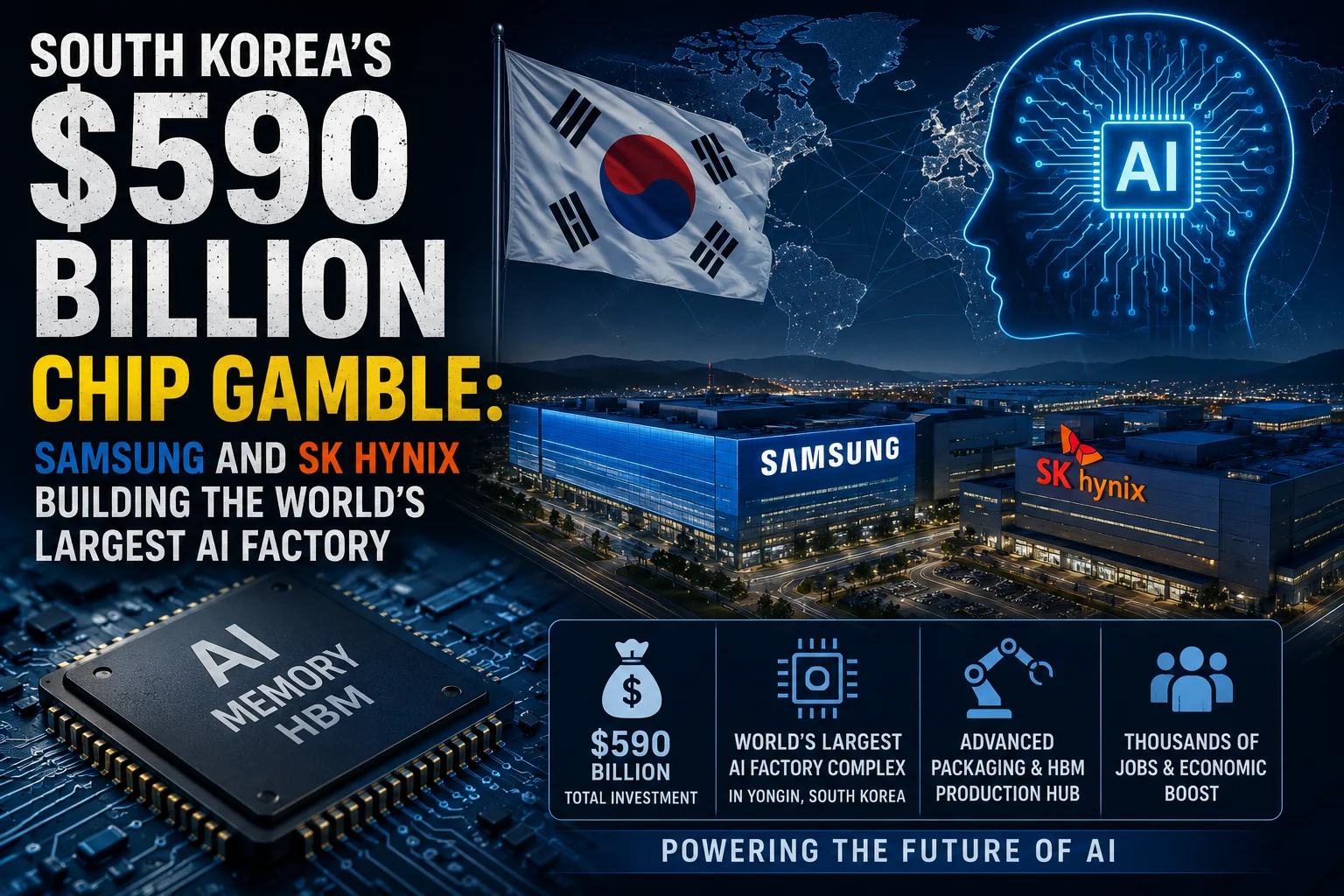
- Samsung and SK Hynix are investing approximately $590 billion (roughly ₹49 lakh crore) to build a massive semiconductor mega-cluster in South Korea.
- The project includes four new state-of-the-art chipmaking plants and a dedicated advanced packaging cluster to be completed over the coming decades.
- This move aims to secure 10% of the global system semiconductor market and dominate the High Bandwidth Memory (HBM) supply for AI giants like NVIDIA.
- For Indian consumers, this massive supply boost could stabilize prices for high-end smartphones, laptops, and AI-driven gadgets by 2027-2028.
- The bottom line: South Korea is positioning itself as the undisputed king of AI hardware, challenging TSMC's dominance.
The Biggest Tech Bet of 2026
So, here is the thing—while everyone is busy talking about AI software and ChatGPT clones, South Korea just dropped a financial nuclear bomb on the tech world. We are talking about a staggering $590 billion investment. To put that in perspective, that is more than the GDP of many medium-sized countries! Samsung and SK Hynix, the two titans of the memory world, are joining forces with their government to build what they call a "Semiconductor Mega Cluster." This isn't just another factory; it is a full-blown tech ecosystem being carved out in the Gyeonggi Province. If you thought the chip wars were intense before, 2026 is officially the year things went into overdrive.
I have been tracking this for a while, and honestly, the scale is hard to wrap your head around. They are planning to build four massive new chipmaking plants (fabs) and a specialized packaging cluster. Why packaging? Because in 2026, simply making a chip isn't enough. You need to stack them, wrap them, and connect them in ways that allow AI to process data at lightning speeds. This is South Korea’s way of saying, "We aren't just the memory guys anymore; we want the whole cake." They are gunning for the logic chip market, which is currently dominated by TSMC in Taiwan. It is a bold, expensive, and high-stakes move that will dictate what kind of tech we use for the next thirty years.
How We Got Here: The AI Hunger
Let’s look back for a second. For years, Samsung was the king of DRAM and NAND—the stuff that stores your photos and keeps your apps running in the background. But then the AI revolution hit. Suddenly, companies like NVIDIA and AMD needed something much faster: High Bandwidth Memory (HBM). SK Hynix took an early lead there, and Samsung has been playing catch-up. Now, in 2026, the demand for AI chips has reached a breaking point. Every car, every fridge, and every smartphone wants to be "AI-powered," and all of them need the silicon that only a few companies can provide.
The South Korean government realized that if they didn't act now, they might lose their edge to the US (with the CHIPS Act) or China’s massive internal investments. So, they cleared the red tape. They provided massive tax breaks and guaranteed power and water supply for these mega-factories. This $590 billion plan is the culmination of years of anxiety about staying relevant. It’s a defensive move turned into a massive offensive strike. They aren't just building for today; they are building for a future where AI is as common as electricity.
The Mind-Boggling Numbers and Specs
Let’s talk numbers because they are wild. The total investment is around 622 trillion Korean Won, which translates to about $580-$590 billion depending on the daily exchange rate. Samsung is bearing the lion's share, focusing on system semiconductors (logic chips) and foundry services. They want to manufacture chips designed by other companies, directly competing with TSMC. SK Hynix is focusing heavily on HBM and next-gen memory that will sit inside the massive data centers running the world's AI models. By the time this cluster is fully operational, it is expected to produce 7.7 million wafers per month. That is a lot of silicon!
But it’s not just about the big guys. This mega-cluster is designed to house over 150 smaller "fabless" companies (companies that design chips but don't own factories) and equipment makers. It is a complete supply chain in one geographic area. This reduces logistics costs and speeds up innovation. Imagine a city where the person who designs the chip, the person who builds the machine to make the chip, and the factory itself are all neighbors. That is the level of integration South Korea is aiming for. They are also focusing on "Extreme Ultraviolet" (EUV) lithography, which is the tech needed to make the world's smallest and most efficient 2nm and 1.4nm chips.
What This Means for India and Your Pocket
Now, you might be wondering, "This is happening in Korea, so why should I care in India?" Well, look at your phone. Whether it’s a Samsung, an iPhone, or a OnePlus, a huge chunk of the components inside come from these two companies. When there is a chip shortage, prices in India skyrocket. Remember the GPU and car price hikes a few years ago? This $590 billion investment is basically a guarantee of future supply. It means that as we move toward 2027 and 2028, the cost of high-end components should stabilize. We might see 16GB or 24GB of RAM becoming the standard even in mid-range phones because the supply will be so massive.
Moreover, India is currently trying to build its own semiconductor ecosystem with the India Semiconductor Mission (ISM). While we are starting with older nodes (28nm and 40nm), the Korean mega-cluster creates a massive market for Indian software engineers and chip designers. Many of the designs that will be manufactured in these Korean plants will be worked on in R&D centers in Bengaluru, Hyderabad, and Noida. It’s a global cycle. Also, more competition between Korea and Taiwan (TSMC) is always good for the consumer. It forces innovation and keeps prices from being controlled by a single monopoly.
Comparison: Samsung vs. TSMC vs. Intel
To understand the gravity of this, you have to see the competition. TSMC is currently the undisputed leader, making chips for Apple and NVIDIA. Intel is trying to regain its crown with massive factories in the US and Europe. Samsung has always been the "second choice" for many chip designers, but this $590 billion plan is designed to change that. Samsung is betting on a technology called Gate-All-Around (GAA) for their 3nm and 2nm chips, which they claim is more efficient than what TSMC is using. If Samsung succeeds, we could see a massive shift where the most powerful chips in the world are "Made in Korea" rather than "Made in Taiwan."
Intel, on the other hand, is struggling with its own foundry business. By building this mega-cluster, South Korea is making it very difficult for Intel to catch up. The sheer scale of 7.7 million wafers a month is something Intel can only dream of right now. For us as users, this means the next few years will see a massive leap in battery life and processing power. Your 2026 smartphone is already fast, but the chips coming out of this new cluster in a couple of years will make today's tech look like a calculator.
TamilTech’s Take: Is it Overkill?
Look, let’s be real. $590 billion is a scary amount of money. Some analysts are worried that we might end up with a "chip glut"—where we have too many chips and not enough people to buy them. But at TamilTech, we think differently. AI is not a fad. It is a fundamental shift in how we use computers. From self-driving cars to real-time language translation in your ear, the need for processing power is only going to grow exponentially. South Korea isn't just building for today; they are building the foundation for the next fifty years of human history.
Our honest opinion? This is a masterstroke. By centralizing everything, they are making it impossible for other countries to compete on price or speed. If you are a student or a tech professional in India, my advice is to keep an eye on semiconductor design. That is where the high-paying jobs will be. The hardware is being built in Korea, but the brains to run them will come from all over the world, especially India. The future is silicon, and South Korea just bought the biggest seat at the table.
What to Expect Next
Expect to see more announcements about specific plant groundbreakings throughout the rest of 2026. Samsung will likely announce its first 2nm mass-production schedule soon, and SK Hynix will continue to roll out faster versions of HBM. For the average user in India, keep an eye on the festive season sales in 2026 and 2027. We expect the surplus of memory chips to lead to some incredible deals on SSDs and high-RAM laptops. The chip war is far from over, but South Korea has just made a move that might have ended the game for many of its rivals.





Comments (0)
Be the first to comment!