


Key Takeaways
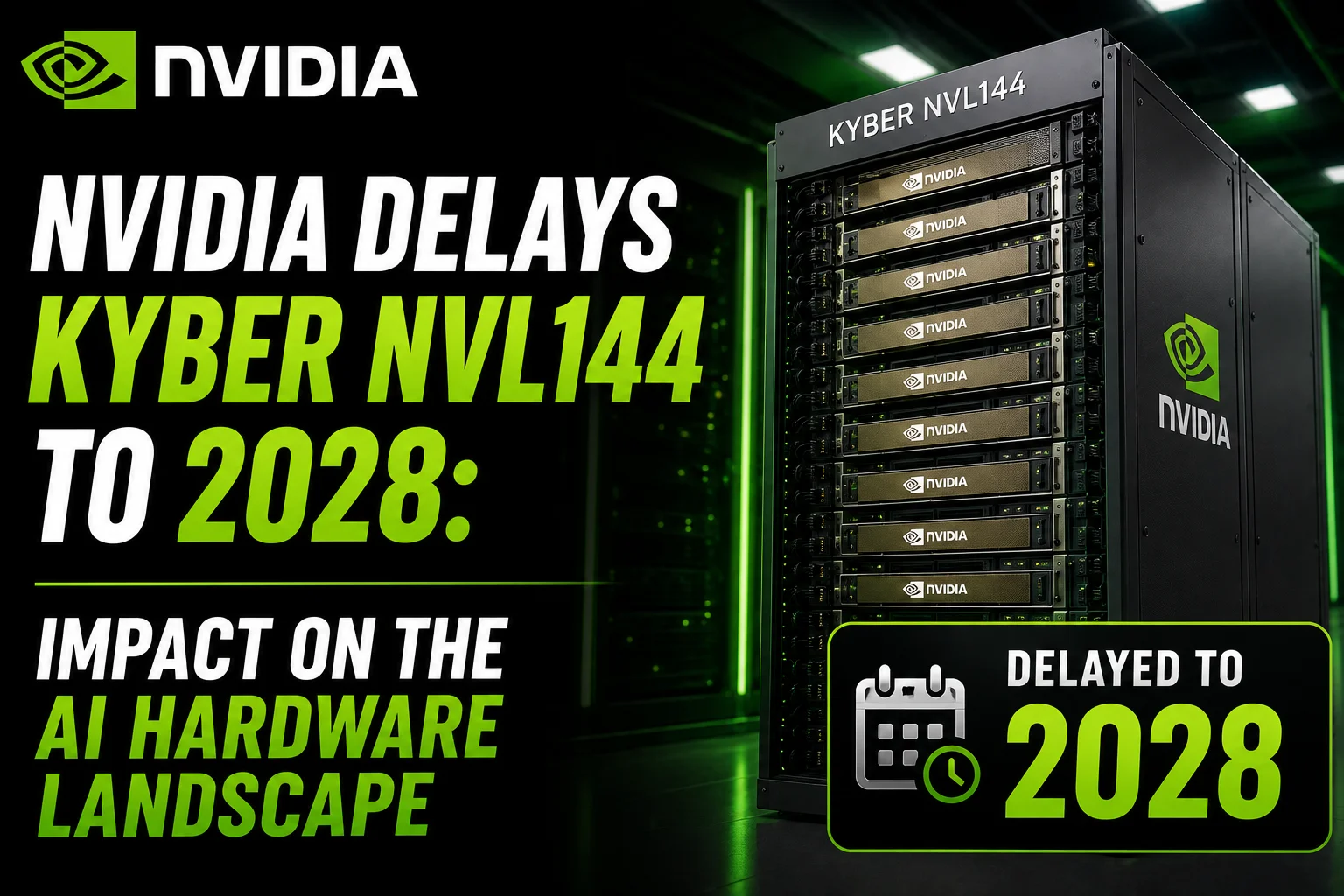
- Nvidia has officially delayed its next-generation Kyber NVL144 AI rack system from its original 2026/2027 window to 2028.
- The delay is primarily caused by massive PCB (Printed Circuit Board) manufacturing complexities and signal integrity issues at the rack scale.
- The ambitious NVL72x2 architecture, which was supposed to link two NVL72 racks together, has been completely cancelled.
- For Indian AI companies like Yotta and Tata, this means existing Blackwell and upcoming Rubin systems will remain the primary choice for longer than expected.
- The bottom line: Building AI hardware at this scale is hitting physical limits, and even Nvidia isn't immune to manufacturing hurdles.
The King of AI Hits a Speed Bump
For the past couple of years, Nvidia has been on an absolute tear. It felt like every few months they were announcing a new chip that was twice as fast as the last one. But as we sit here in July 2026, the reality of physics and manufacturing is finally catching up. We've just learned that Nvidia is pushing back its massive Kyber NVL144 rack system by at least 12 months. What was supposed to be the crown jewel of AI data centers in 2027 is now looking like a 2028 reality. This isn't just a small shipping delay; it’s a significant recalibration of their entire roadmap.
If you’ve been following the AI hardware space, you know that the race is no longer just about the GPU (the chip itself). It’s about the rack—the massive fridge-sized units that house dozens of these GPUs and make them talk to each other. Nvidia’s Kyber project was designed to be the ultimate expression of this, packing 144 GPUs into a single unified system. However, building something that complex is proving to be a nightmare even for a company worth trillions. They are also pulling the plug on the NVL72x2 architecture entirely. Let’s break down why this is happening and what it means for the future of AI.
The PCB Problem: Why Kyber is Stuck in the Lab
So, what exactly went wrong? It all comes down to the PCB—the Printed Circuit Board. Think of the PCB as the nervous system of the computer. In a standard gaming PC, the PCB is a few layers thick and handles signals moving at manageable speeds. In an NVL144 rack, you are trying to move massive amounts of data between 144 different GPUs at speeds that defy logic. To do this, Nvidia planned a massive backplane (a giant PCB) that would connect everything using high-speed copper traces.
The issue is that at these scales, the PCB becomes incredibly difficult to manufacture without defects. When you have a board that large, even a microscopic misalignment or a tiny air bubble during the laminating process can ruin the entire thing. Moreover, signal integrity becomes a massive headache. When electricity moves that fast through copper, it starts to behave like a radio wave, interfering with other signals. Nvidia’s engineers are reportedly struggling to keep these signals clean across such a massive physical distance. By pushing the launch to 2028, Nvidia is essentially giving the manufacturing industry more time to catch up with their wild designs.
The Death of NVL72x2: Too Much Power, Too Little Space
While the Kyber NVL144 is delayed, the NVL72x2 has been sent to the graveyard. This was supposed to be a "dual-rack" solution where two NVL72 racks were bridged together to act as one giant supercomputer. On paper, it sounded like a great way to scale up without waiting for the next-gen Kyber. But in practice, it was a logistical disaster. The power requirements alone were enough to make most data center managers faint. We are talking about hundreds of kilowatts for a single setup.
Beyond power, the cooling requirements for NVL72x2 were nearly impossible to meet for most existing data centers. You need specialized liquid cooling loops that can handle extreme heat density. Nvidia likely realized that the market for such a niche, difficult-to-install system was too small. Instead of wasting engineering resources on a bridge product that few could actually use, they’ve decided to focus on perfecting the Blackwell Ultra and the upcoming Rubin platforms. This is a rare admission from Nvidia that sometimes, bigger isn't always better if no one can actually plug it in.
What This Means for the AI Industry in India
You might be wondering, "Why should I care about giant server racks?" Well, if you use ChatGPT, Gemini, or any AI tool in India, the speed and cost of those tools depend on these machines. In India, companies like Yotta Data Services, Tata Communications, and Reliance have been investing billions into Nvidia hardware to build "Sovereign AI" for our country. This delay means the hardware they bought recently—like the Blackwell NVL72—will stay relevant for much longer. It protects their investment in a way, but it also slows down the leap to even more massive AI models.
For Indian startups and researchers, this might mean that the cost of renting high-end GPU clusters won't drop as fast as we hoped. When new, more efficient hardware like Kyber hits the market, the older hardware usually gets cheaper to rent. With Kyber delayed until 2028, the supply of top-tier AI compute remains somewhat constrained. If you're a developer in Bengaluru or Hyderabad working on a massive LLM, you'll likely be stuck with current-gen architectures for the next couple of years. It’s not the end of the world, but it definitely changes the timeline for the next big breakthrough.
The Technical Specs: What We’re Missing Out On
To understand the scale of the loss, let's look at what Kyber NVL144 was promising. It was expected to feature 144 Blackwell-successor GPUs (likely based on the Rubin architecture) interconnected via a massive NVLink switch fabric. This would have allowed all 144 GPUs to access each other's memory with incredibly low latency, effectively acting as one giant GPU with several terabytes of HBM (High Bandwidth Memory). This is the holy grail for training trillion-parameter models.
The NVL144 was also expected to push the boundaries of power delivery. We were looking at a rack that could potentially pull 200kW to 250kW of power. For context, an average Indian household uses about 200-300 units of electricity a month; this rack would consume that in a few minutes. The complexity of delivering that much DC power to the chips without massive voltage drops is another reason for the delay. Nvidia is literally trying to rebuild how power and data move at a physical level, and 2028 is a more realistic target for that kind of revolution.
How Nvidia is Pivoting: The Rubin Era
With Kyber delayed, Nvidia isn't just sitting idle. They are doubling down on the Rubin architecture, which is the successor to Blackwell. We expect to see Rubin GPUs arrive on schedule, but they will likely be deployed in the more "standard" NVL72 configurations first. This is a safer bet for Nvidia. By sticking to the 72-GPU form factor, they can use existing liquid cooling designs and more reliable PCB manufacturing techniques. It’s an incremental step rather than the giant leap Kyber promised.
This pivot shows that Nvidia is becoming more pragmatic. In 2023 and 2024, they were in a "move fast and break things" mode because they had zero competition. Now, with AMD’s Instinct line and custom silicon from Google (TPU) and Amazon (Trainium) getting better, Nvidia can't afford a high-profile hardware failure. They would rather delay a product and make it perfect than ship a buggy NVL144 that crashes in customers' data centers. It’s a sign of a maturing industry.
TamilTech’s Take: Is the AI Hype Cooling Down?
Honestly, we think this delay is a reality check that the industry desperately needed. For the last few years, the narrative has been that AI hardware will just keep getting exponentially better every 12 months forever. Physics doesn't work that way. When you're dealing with chips that are essentially heaters that happen to do math, you eventually hit a wall. Nvidia hitting this wall with the Kyber NVL144 is the first real sign that the "easy" gains in AI scaling are over.
Does this mean AI is dead? Absolutely not. It just means the focus will shift from "just throw more hardware at it" to "make the software and algorithms more efficient." This is actually good news for developers. If we can't rely on 144-GPU racks arriving next year, we have to find ways to make our models smarter using the hardware we already have. Expect the next two years to be the era of optimization rather than just raw power. Nvidia will still dominate, but the gap between them and the rest of the world might finally start to shrink just a little bit.
What to Expect Next
Moving forward, keep a close eye on Nvidia's 2027 roadmap. We expect them to announce "Blackwell Ultra" or similar mid-cycle refreshes to keep the momentum going while they fix the Kyber issues. For businesses in India planning their data center expansions, the advice is simple: don't wait for the "next big thing" in 2027. The Blackwell systems available now or arriving soon are going to be the gold standard for at least the next three years. If you're building, build now with what's available.






Comments (0)
Be the first to comment!