


Key Takeaways
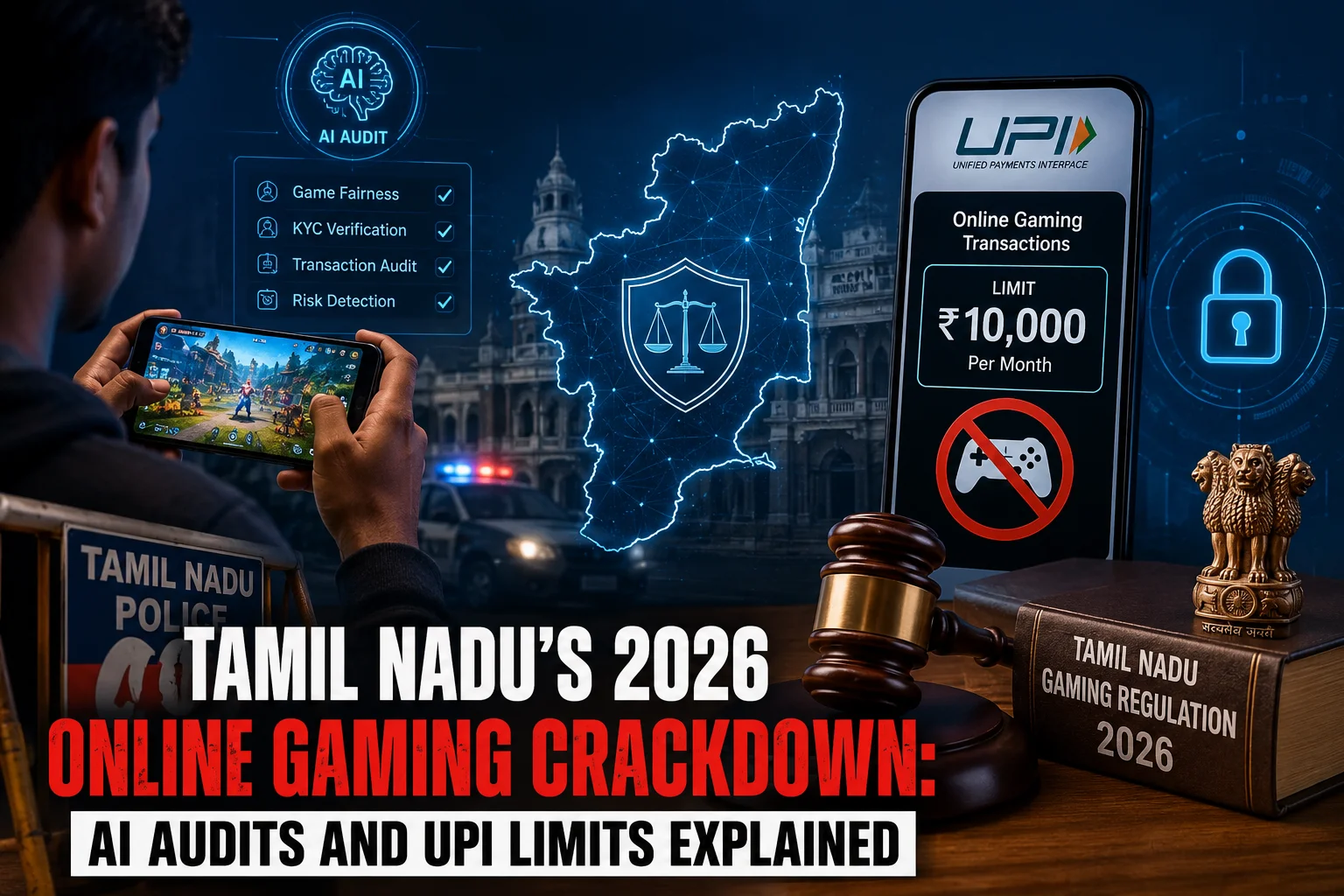
- Tamil Nadu has mandated a 100% manual audit of AI algorithms used by gaming companies to ensure no 'bots' are playing against real users.
- New payment restrictions limit unverified users to ₹2,000 per transaction and a daily cap of ₹5,000 to curb financial loss.
- Mandatory Aadhaar-linked face authentication is now required for all players in Tamil Nadu to prevent minors from accessing real-money games.
- Gaming companies must now provide a 'Self-Exclusion' button and mandatory break-time pop-ups every 60 minutes of gameplay.
The New Reality of Online Gaming in Tamil Nadu
If you are someone who enjoys a quick game of Rummy or a Fantasy Cricket match on your phone, things are about to look very different. As of July 2026, the Tamil Nadu government has moved beyond just debating bans and has officially implemented one of the toughest regulatory frameworks for online gaming in India. This isn't just about blocking apps anymore; it's about controlling exactly how these apps behave on your phone. We at TamilTech have been following the TN Gaming Commission's moves for months, and this latest update is a massive shift in how the state handles digital entertainment and financial safety.
The core of this new regulation is transparency. For years, players have complained that online games feel 'rigged.' Whether it's a card game or a casual betting app, the suspicion that an AI bot is sitting on the other side, designed to make you lose, has always been there. The Tamil Nadu government is finally addressing this head-on. They aren't just taking the companies' word for it anymore. They are demanding a look under the hood. For us users, this could mean a fairer playing field, but it also means a lot more 'digital friction' when we try to play.
The AI Bot Ban: No More Rigged Games?
One of the biggest technical changes is the mandatory audit of Random Number Generators (RNG) and AI algorithms. In the past, companies could claim their games were fair based on private certifications. Now, the TN government requires these companies to submit their source code snippets related to matchmaking and card dealing to a state-approved panel of experts. This is to ensure that the 'House' doesn't always win by using sophisticated AI that analyzes your playing pattern and plays the perfect counter-move. If a company is caught using bots without clearly labeling them as 'Training Modes,' they face an immediate ban in the state and a heavy fine reaching up to ₹50 lakhs.
This is a game-changer because it targets the psychological 'trap' of online gaming. Many AI systems are designed to let a new user win the first few rounds to build confidence and then slowly increase the difficulty or introduce bots to drain the wallet. By auditing these algorithms, the government wants to ensure that if you lose, you lose to a human, not a piece of code designed to bankrupt you. At TamilTech, we think this is a step in the right direction, though how effectively the government can actually 'read' complex AI code remains to be seen.
Payment Restrictions and UPI Monitoring
Money is where the most pain happens in online gaming, and the new 2026 rules are hitting hard here. The Tamil Nadu government has worked with NPCI (National Payments Corporation of India) to create a specific 'Gaming Filter' for UPI transactions originating from the state. If your account isn't fully KYC-verified with the gaming platform, you cannot deposit more than ₹2,000 at a time. Even for verified accounts, there is now a mandatory 'Cooling Period.' If you lose more than ₹10,000 in a single day, the payment gateway will automatically block further deposits to gaming apps for the next 24 hours.
Why is this happening? Because the number of cases involving young adults and even kids using their parents' UPI accounts has skyrocketed. By forcing a lower limit on unverified accounts and a hard cap on daily losses, the state is trying to prevent the 'chasing losses' spiral. We’ve seen so many stories of people losing their entire savings in one night. This technical intervention at the payment gateway level is much more effective than just putting a warning text on the screen. It actually stops the money flow when things get out of hand.
Mandatory Face KYC: The End of Anonymous Gaming
Gone are the days when you could just enter a random birthdate and start playing. The new directive makes Aadhaar-based face authentication mandatory. When you sign up or log in to a real-money game in Tamil Nadu now, the app will trigger a live face scan. This scan is matched against your Aadhaar data to ensure two things: first, that you are actually above 18, and second, that you are the same person who owns the bank account linked to the app. This is a massive blow to multi-accounting, where professional players use 10 different phones to manipulate a single game table.
From a privacy perspective, this is definitely a bit scary. We are giving even more biometric-linked data to private gaming companies. The government says this data must be encrypted and stored on Indian servers, but as we know, data leaks are always a risk. However, from a safety standpoint, this will almost certainly stop kids from using their father's or mother's phone to play high-stakes games. It’s a trade-off between privacy and protection, and the TN government has clearly chosen protection.
How to Stay Compliant: A Step-by-Step Guide for Players
If you want to continue playing your favorite games without getting your account flagged or blocked, here is what you need to do. First, make sure your gaming app is updated to the latest 2026 version. Most apps will now have a 'TN Safety' badge. Second, go to your profile settings and complete the 'Video KYC' or 'Face Auth' immediately. If you don't do this, your withdrawal limits will be stuck at a very low amount, and you might face issues during payouts. Third, set your own 'Deposit Limits' in the app settings before the government-mandated ones kick in. It shows you are a 'Responsible Player' in the system's eyes.
Another important feature to look for is the 'Self-Exclusion' button. If you feel like you're playing too much, you can now click this button to ban yourself from the app for 3, 7, or 30 days. Under the new TN rules, the company is legally forbidden from sending you promotional SMS or notifications during this exclusion period. This is a huge relief because those 'Come back and win ₹500' messages are often what pulls people back into the addiction cycle. Use these tools; they are there for your protection.
TamilTech’s Verdict: Is this too much or just right?
Honestly, we have mixed feelings. On one hand, the AI audit and the bot ban are fantastic. It makes the games fairer and protects users from being cheated by algorithms. The UPI limits are also a great safety net for families. But on the other hand, the mandatory face scanning and constant monitoring feel a bit like 'Big Brother' is watching you play. It adds a lot of friction to what is supposed to be a leisure activity. If I have to do a face scan every time I want to play a ₹50 contest, I might just stop playing altogether.
But maybe that's exactly what the government wants. By making it 'annoying' to play, they are reducing the overall time people spend on these apps. For the average user in Tamil Nadu, this means more safety but less convenience. We expect other states like Karnataka and Maharashtra to follow this 'TN Model' by the end of the year. The era of the 'Wild West' in online gaming is officially over. Stay safe, play responsibly, and always remember—the house is designed to win, even with these new rules in place.




Comments (0)
Be the first to comment!