


Key Takeaways
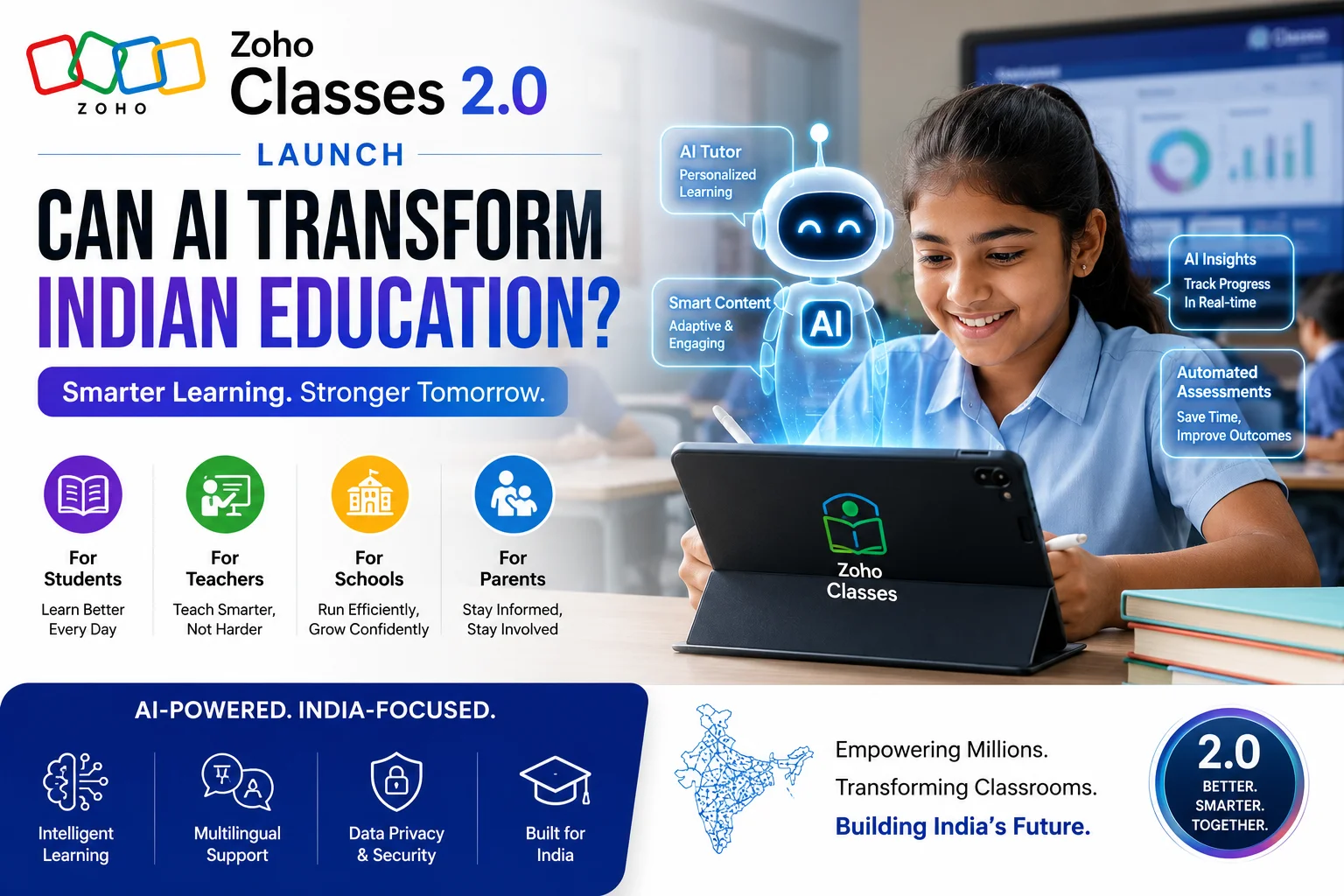
- Zoho Classes 2.0 features a dedicated AI assistant named Zia that can auto-grade descriptive answers and generate personalized lesson plans for teachers.
- The platform is optimized for low-bandwidth 4G/5G connections in rural India, requiring 40% less data than traditional video conferencing tools.
- Pricing starts at just ₹15 per student per month for government schools, making it one of the most affordable enterprise-grade EdTech solutions in 2026.
- The bottom line: Zoho is moving away from the 'coaching' model to an 'infrastructure' model that empowers local schools instead of replacing them.
The Big Reveal: Zoho's Bold Bet on the Future of Learning
So, here is the thing. For the last few years, we have seen the EdTech bubble burst in India. Big names have struggled, and the promise of 'digital learning' felt like it was fading away. But today, July 15, 2026, Zoho has officially launched Classes 2.0, and honestly, this might be the reset button our education system needs. Unlike previous versions that felt like a modified version of Zoho Meeting, Classes 2.0 is built from the ground up with one goal: to solve the actual problems teachers and students face in India, not just in Bengaluru or Chennai, but in places like Ariyalur or Gorakhpur.
We have been tracking this development for months, and what makes this launch stand out is the integration of Zoho’s proprietary AI, Zia. It is not just about showing a video on a screen anymore. Zoho is trying to automate the boring stuff—like attendance and grading—so teachers can actually focus on teaching. In a country where the teacher-to-student ratio is still a massive challenge, this shift is critical. Let’s dive deep into what has changed and why this matters for every parent, teacher, and student in India right now.
How We Got Here: From Simple Video to AI Ecosystem
If you remember the 2020-2022 era, Zoho Classes was a quick response to the pandemic. It worked, but it had its limitations. It was competing with giants like Google Classroom and Microsoft Teams. However, Zoho has spent the last four years studying how Indian schools actually function. They realized that a 'one-size-fits-all' global product doesn't work here. Many students don't have high-speed broadband; they rely on patchy mobile data. Many teachers aren't tech-savvy and find complex dashboards intimidating.
Classes 2.0 is the result of that research. Zoho has moved beyond being just a 'tool' to becoming a 'Platform as a Service' (PaaS) for schools. This year, they have integrated their entire suite—Docs, Projects, and Analytics—directly into the classroom interface. But the real star is the AI layer. By 2026, AI has matured, and Zoho is using it to provide 'Hyper-Personalized Learning.' This means the app can track if a student is struggling with a specific math concept and automatically suggest simpler modular videos or practice sets without the teacher having to intervene manually every single time.
The AI Factor: Meet Your New Teaching Assistant, Zia
The most impressive part of Classes 2.0 is how Zia handles the workload. We are talking about 'Automated Descriptive Grading.' Usually, AI is good at multiple-choice questions, but Zoho claims Zia can now read handwritten assignments uploaded via the app and provide a preliminary score based on the school's rubric. This is a game-changer for teachers who spend hours grading papers. Of course, the teacher has the final say, but the time saved is massive.
Then there is the 'Smart Lesson Planner.' A teacher can simply input a topic—say, 'The Solar System'—and Zia will generate a full lesson plan, complete with interactive 3D models, quiz questions, and even a list of local examples to make the concept relatable. For an Indian teacher handling 60 students in a single period, this is like having a full-time digital assistant. Zoho has also added real-time translation. If a teacher is explaining a concept in English, students can see live captions in Tamil, Hindi, or Telugu on their screens. This solves the massive language barrier that exists in our multi-lingual education system.
India Impact: Pricing and Rural Accessibility
Let's talk numbers because that is where Zoho usually wins. In India, cost is everything. While global competitors charge per user in dollars, Zoho has localized its pricing for 2026. For private schools, the cost is roughly ₹45 to ₹60 per student per month. But the real news is the 'Bharat Edition.' Zoho is offering a stripped-down, high-performance version for government and budget schools at just ₹15 per student. At this price point, it is cheaper than a packet of chips, making it accessible to even the smallest village schools.
Another huge factor is 'Offline-First' technology. Zoho knows that 5G isn't everywhere yet. Classes 2.0 features a 'Smart Buffer' system that downloads content in the background when the signal is strong. If the connection drops during a live class, the app switches to a low-bandwidth audio-only mode with a synced whiteboard, ensuring the lesson doesn't stop. This focus on the 'last mile' of India is what sets Zoho apart from Silicon Valley companies that assume everyone has a 100Mbps fiber connection.
Setting Up Your Smart Classroom: A Quick Guide
If you are a school administrator or a teacher looking to switch, here is how the process looks in 2026. First, you head to the Zoho Classes portal and register your institution. The onboarding is surprisingly simple—you can bulk-import student data using an Excel sheet or even a simple photo of your school register, which Zia then digitizes. Next, you set up your 'Virtual Departments.' Unlike older apps, you can mirror your physical school structure here, including staff rooms, libraries, and even 'Digital Playgrounds' for extracurricular activities.
Once the structure is ready, teachers get a 'One-Click Launch' dashboard. They don't need to create separate links for every class. Students just log in to their app and see their 'Daily Path.' The app even integrates with UPI for fee payments, making the administrative side of schooling much smoother. For parents, there is a dedicated 'Observer App' where they can see real-time attendance and AI-generated progress reports without waiting for a parent-teacher meeting once every three months.
Zoho vs. The World: Pros and Cons
So, how does it stack up against Google Classroom or the remnants of the big EdTech players? The biggest 'Pro' is data privacy. Zoho has always been vocal about not selling user data, and for a school environment, this is non-negotiable. Your child's learning patterns aren't being sold to advertisers. Another pro is the 'All-in-One' nature. You don't need Zoom for calls, WhatsApp for groups, and Google Drive for files—everything is inside Zoho.
However, there are some 'Cons' to consider. The sheer number of features can be overwhelming at first. Even though Zoho has simplified the UI, there is still a learning curve for older teachers who are used to traditional methods. Also, while the AI is good, it is not perfect. Automated grading for creative subjects like Literature or Art still needs a lot of human oversight. If a school relies too much on the AI, the 'human touch' of education might get diluted.
TamilTech's Honest Take: Is This the Future?
We think Zoho Classes 2.0 is a massive step in the right direction. For too long, EdTech in India was about selling expensive tablets and 'fancy' animations. Zoho is doing something different—they are building the plumbing for schools. They aren't trying to replace the teacher; they are trying to give the teacher superpowers. In our opinion, the ₹15 'Bharat Edition' is the most significant part of this launch. If government schools actually adopt this, we could see a real bridge being built across the digital divide.
What should you expect next? Expect more local language support and deeper integration with AR (Augmented Reality) as affordable AR glasses start hitting the Indian market later this year. If you are a school owner, we highly recommend taking the 30-day trial. For parents, keep an eye on how your child's school is adapting to these AI tools. The future of education isn't just about 'online' or 'offline'—it's about being 'smart,' and Zoho seems to have figured that out.





Comments (0)
Be the first to comment!