


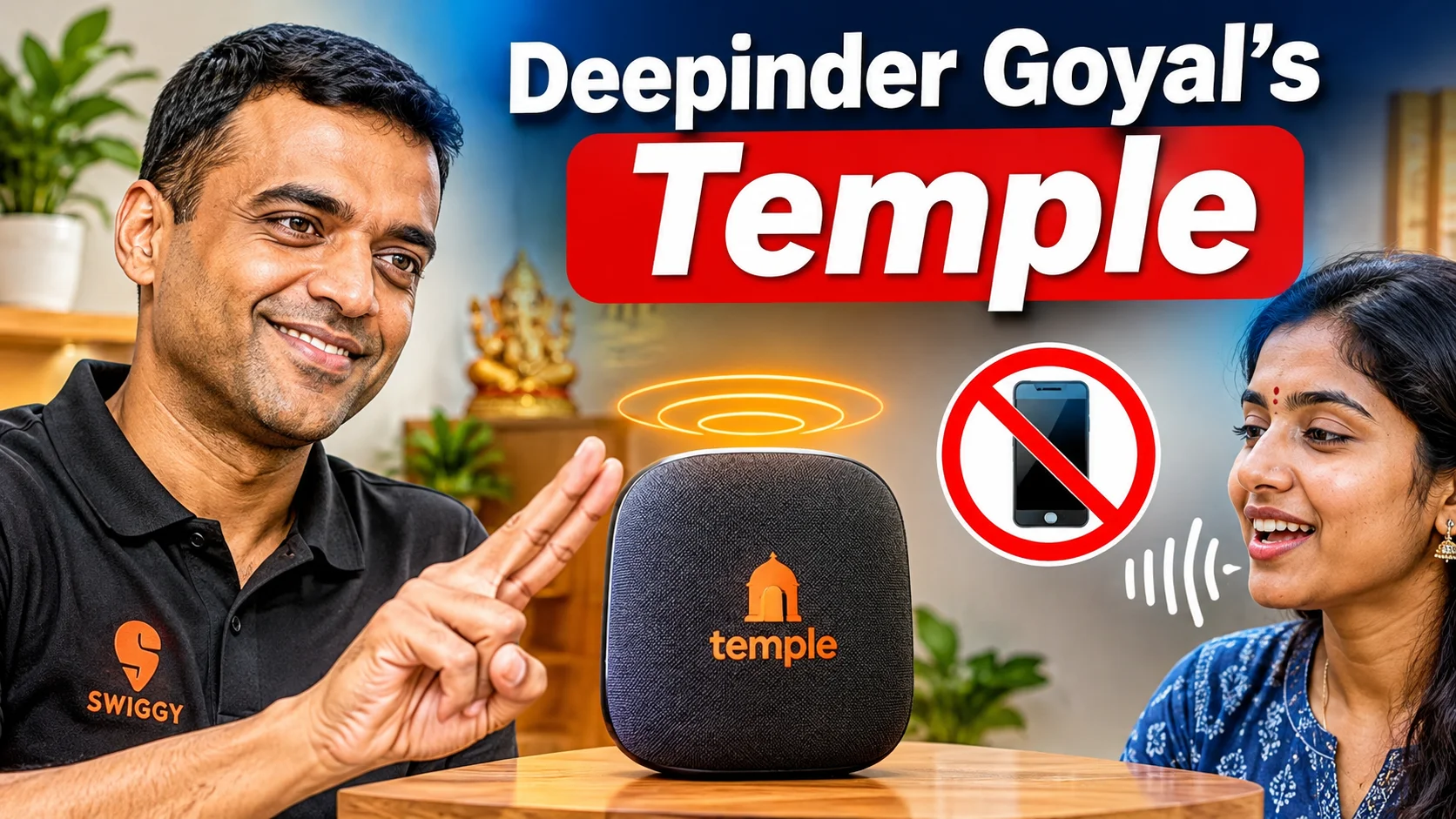
The group chat did not ask for another phone. It asked what Deepinder Goyal just stuck near his temple. On Friday, 6 November 2026, the Temple founder and former Eternal CEO unveiled the wearable he has been hinting at. Business Today updated its report on 7 November 2026 at 2:27 PM IST. Moneycontrol covered the same announcement. The short version: a small device, no screen, meant to hear you without a normal microphone, and not meant to hear the rest of the room. The first product, Temple 01, is described as shipping in 2027 with AI and health features. That is a shipping window, not a date you can put on a calendar, and neither report prints a price.
Goyal’s line on X, dated 6 November 2026, is the one people are forwarding: “Temple is an ambitious project. The team is delusional enough to think we can build this. And we will.” Business Today says he called it “humanity’s last personal device,” an alternative to the smartphone and other screens. I would not buy the slogan. I would buy, or refuse, the mechanism. The slogan is a poster. The mechanism is the only part that can be checked later.
What “roomdeaf” is supposed to mean
Moneycontrol quotes the cleaner technical claim. Goyal says Temple uses motion sensors to detect vibrations from the wearer’s voice and turn those vibrations into text. He calls the approach “roomdeaf audio.” It is designed to take the user’s voice and filter out other conversations and sounds around them. His line, as reported: “Temple doesn’t have a mic, but can still hear you.” The same piece says the device is meant to listen without a microphone, a camera or a screen, and that the missing mic and camera are why it cannot record the conversation happening around you. Boardrooms, concerts, crowded rooms: those are the examples he gave.
Business Today uses the product description’s phrase, “roomdeaf voice AI.” The device is designed to understand the user’s voice, convert it to text, and ignore surrounding talk. The company says it does not have a microphone in the traditional sense and cannot hear other people in the room. The same article also says, higher up, that the wearable can hear conversations without recording them. Those two sentences sit in tension. “Hear conversations” and “cannot hear other people” are not the same picture. I am not going to sand that down into one smooth privacy promise. Until someone who is not Temple tests a unit in a noisy Indian office, both lines are company language. The Moneycontrol version is the one I can retell without squinting: sensors on your voice, not a mic on the room.
Two taps, a buzz, and a tape called a Grip
Both reports agree on the gesture. You double-tap. You do not pull out a phone to wake it. Business Today says a small buzz confirms that it is listening, and another double-tap ends the interaction. Moneycontrol says a small vibration confirms listening, and another buzz means it has finished processing. I am not going to merge those into one button story. One desk says you tap again to stop. The other says a second buzz marks the end of processing. If you are the sort of person who cares whether a wearable is still listening on a local train, that difference matters, and only the product can settle it.
The mount is a medical-grade adhesive tape Temple calls Grips. Business Today says the device is non-invasive, made for continuous daily wear, and the tapes are intended to be changed weekly. Moneycontrol says the tapes are meant for continuous multi-day use, including showers, swimming, workouts and sleep, and that the device is expected to need a recharge about once a week. Weekly tape changes and a weekly charge can both be true. A swim claim is a company claim. Sweat, coconut oil, a Chennai afternoon and a helmet are not in either article. Do not treat “shower and swim” as a lab result.
A notes app that lives on your head
The screen-free pitch is a memory aid. Business Today says Temple is designed to capture ideas, reminders, birthdays, anniversaries and personal notes, and to help with appointments and to-do lists, so you are not unlocking a phone for every stray thought. Moneycontrol adds proposed uses: dictate an idea, log an everyday observation, get a vibration for a reminder, send a message to someone close, get an alert when they reply, and set a medication reminder. “Proposed” is the right weight. A feature on a launch note is not a feature on your face.
This is the part that will feel familiar if your phone is already a graveyard of reminders. The Indian version of the use case is not a Silicon Valley keynote. It is the chemist reminder your parents miss, the gas booking you forget until the cylinder is empty, the school function that was mentioned once in a voice note. A wearable that actually catches those, without a screen at dinner, is useful. A wearable that mis-hears them in a loud kitchen is a new kind of missed call. Neither report shows an accuracy number, a supported language list, or a Tamil or Hindi demo. I will not invent one. If Temple only behaves in a quiet room, in English, it is a smaller product than the poster.
Health tracking is the second product hiding inside the first
Goyal told Moneycontrol the idea started as a weekend health wearable while he was still running Eternal. An engineering break, he said, is what pulled him back to building Temple full time. That origin matters because the voice companion is not the whole pitch. Health is the other half, and it is where the claims get large.
Business Today says the device is designed to capture heart rate, heart rate variability, VO2 max and related signals. It also describes plans for snoring detection, sleep insights, continuous core body temperature and calorie tracking, with an AI system looking at the information through the day. Plans are not shipping features. “Designed to capture” is not “we tested this against a medical device.” The same piece says the product description suggests Temple could eventually notice patterns in the notes you dictate, such as repeated headaches or dizziness, that you might then take to a doctor. “Could” and “eventually” have to stay in the sentence. A pattern hint is not a diagnosis, and a wearable is not a physician.
Moneycontrol’s matching piece is the note-taking version of that idea: you log headaches and dizziness, and Temple tries to spot a pattern over time. It does not, in the section I am using, turn that into a claim that the device has already done it for anyone. If a reel tells you Temple will catch a stroke or replace a smartwatch’s medical features, that reel is ahead of both articles.
The privacy promise, as a promise
Business Today says Temple intends to keep conversations encrypted end to end so they do not reach a “model company,” and that it does not intend to sell user data for advertising. That is the line Indian readers will want, because every assistant so far has asked for the microphone and then a privacy policy the length of a bus ticket. Write it down as intent. The article does not show an independent security audit, where the keys live, what happens if the tape company or the app company changes hands, or whether a lost device can be wiped. End-to-end is a specific phrase. It is only as good as the implementation nobody outside Temple has reviewed in these reports.
The roomdeaf claim is the other half of the same promise. A normal speakerphone hears the room. This is supposed to hear the skull, or at least the vibration of your voice, and refuse everyone else. If that holds, it is the first voice assistant I would consider in a family room where three conversations are already happening. If it does not hold, it is a microphone with better marketing. The reports do not include a test with a second person talking. Belief is optional. Measurement has not been published here.
What 2027 does and does not mean
Business Today says shipping starts in 2027, and that Temple 01, with AI and health features, is the beginning of a longer vision, not the whole of it. Goyal described the work as long-term research and development toward a screen-free companion. There is no month, no first city, no India price, no warranty line and no word on whether the first units are a limited run. Moneycontrol’s news story is the Friday unveil, not a store page. If a link in your chat already asks for money, check that it is Temple’s own channel. These two articles do not list a checkout price.
I also would not treat a 2027 ship date as a reason to ignore the category until then. The arguments are already here. Do you want a computer on your head that you cannot glance at? Is a weekly tape a habit or an irritant? Who is liable if a health pattern is wrong? Those do not require a review unit. They require the company to keep its nouns stable: no traditional mic, motion sensors, double tap, Grips, encryption, no ad sale, Temple 01 in 2027.
Who should care before a review exists
Care if you already hate taking the phone out, and you trust a founder-led hardware bet enough to watch it. Goyal is not an unknown tinkerer. He is the former Eternal CEO, which is why this is not a campus demo that three people will see. Care if a parent would actually wear a tape for medication reminders, because that is a real job phones keep failing at. Do not care, yet, if you need a medical device. Nothing in these reports clears Temple as one.
The honest status on 7 November 2026 is this. A well-known Indian founder showed a screen-free voice wearable, said it has no microphone and reads voice vibrations, said the room stays out of it, and pointed at 2027. The rest is a product description: taps, tapes, notes, heart signals, sleep plans, encryption, no ads. I will take the demo when it is a demo. Until then the forwarded poster is louder than the evidence, and the evidence is still the company’s own words.




Comments (0)
Be the first to comment!